




It was a scramble to get started. The wind had blown in a day earlier than expected and endurance racer Hannah Otto and her team were faced with a conundrum: attempt the Fastest Known Time (FKT) of Hawaii’s tallest mountain today or delay.
Rewind a few months, and Mauna Kea was niggling at Otto’s brain. She’d done FKTs before—100 miles on Utah’s White Rim, 137-mile Kokopelli Trail, the fastest time on the Whole Enchilada—but the Hawaiian mountain was a stop she wanted to scale ever since she competed in the World Championships there as a young triathlete.
Article continues below
There was a sentimental draw to Hawaii for the 30-year-old. But she’s also drawn to hard things. She is one of three riders to have finished in the top ten all four years of the Life Time Grand Prix, won the Leadville 100 in 2022 and has represented the USA at the mountain bike World Championships four times. Mauna Kea, or ‘White Mountain’, represented one of cycling’s most difficult feats: with 13,700 feet of elevation gain over 55 miles, it’s the longest climb in the world and transitions from pavement to five brutal gravel miles at the end. To beat the record, she’d have to complete it in under six hours.
(Image credit: SCOTT)
“This one was potentially one of the most nerve-racking,” Otto says of her latest FKT attempt. “The other ones were here in the States, on the mainland. I had the opportunity to go and see it, come home, digest it, and then go back and do it. This one was different. Since we had to fly to Hawaii, I had to see it, process it, and do it all in a short period of time.”
Once Otto had closed her internet tabs, gathered her support crew and set out for Hawaii, she was met with the sheer scale of the feat ahead of her. The first 40 miles account for nearly 7,000 feet of the climbing. The other 7,000 feet of elevation come in the final 15 miles at a 20% gradient.
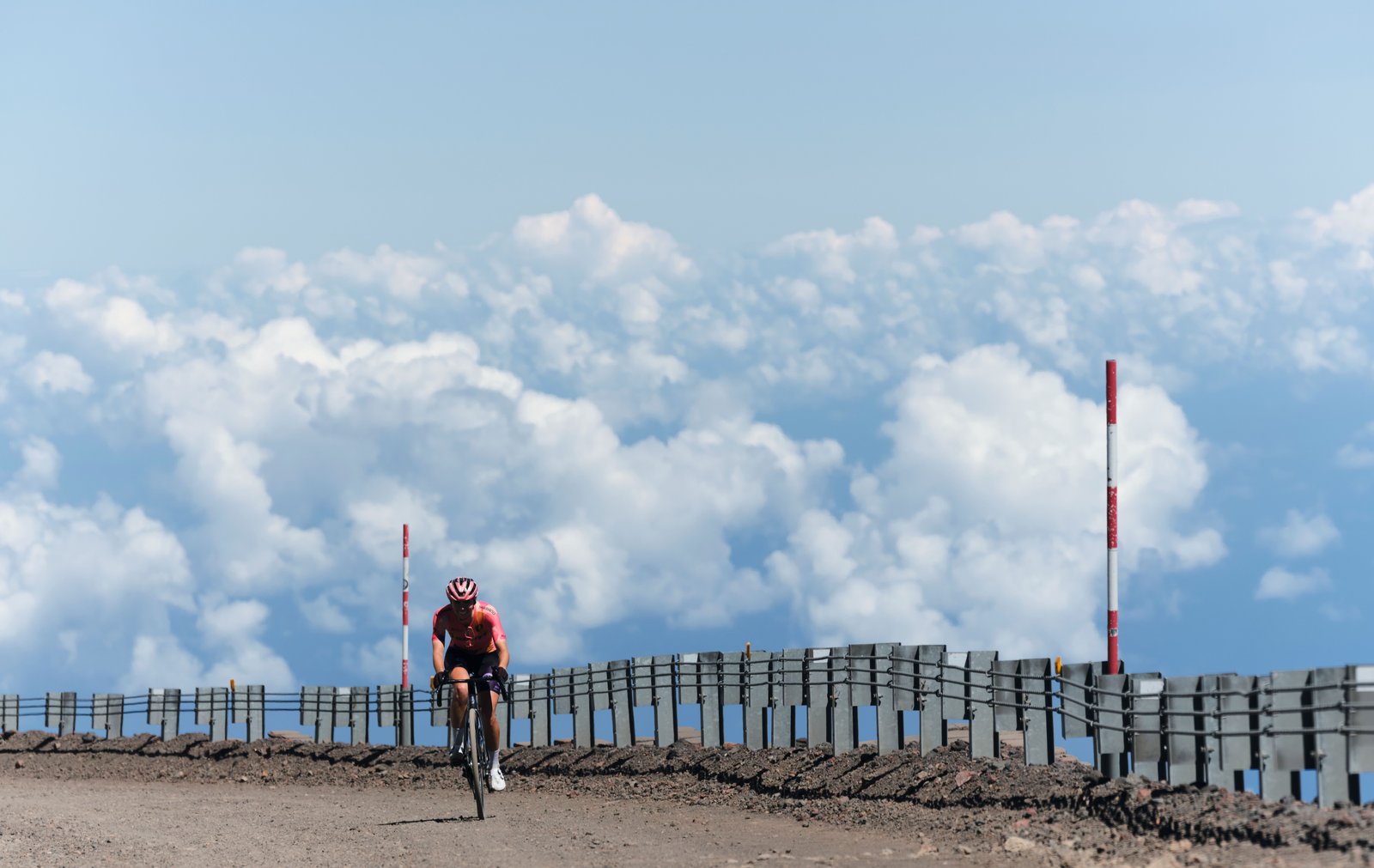
Aside from the physical distance and height she’d have to climb, Otto would also have to cycle through changing temperatures and mountain ecosystems. On leaving the town, she would ride through a barren landscape formed from lava rock. Then she would move through grasslands and into what she called the “cloud space,” where the moisture in the air hangs like rain. Bursting above the cloud, the mountain becomes barren once again. There she would have to brace for whipping wind and chilly temperatures.
“It almost feels like you’re on the moon, but you’re actually on a volcano!” Otto says in the recently released documentary, ‘Infinite Pursuit’
But it’s the final few miles on soft and loose gravel road that could prove the most difficult section of the climb. Graded bi-weekly, the team realised that the day they’d proposed to set off uphill would coincide with when the gravel is softest. Combine that with the forecasted wind, and the attempt looked more difficult to achieve. And so they set off a day earlier.
(Image credit: SCOTT)
As much as Otto likes a challenge, she also likes a plan, and the last-minute change to the attempt did, for a second, throw her off guard. But the support team had decided it was best, and so she trusted them.
The wind was Otto’s first great challenge to face. Twenty miles into the ride, she was six minutes ahead of the record but in the next 20 miles, the headwind wore away at her time.
“I did have a moment where my mind started to allow the doubt to sink in,” Otto remembers. “But I stayed motivated, and I kept pushing. It’s not about not having those doubts, it’s about having them and reframing it into effort: I can’t control the time; I can’t control the wind; I can’t control whether I succeed in the sense of being the fastest, but I can control how much I give on the day and how hard I try.”
Over her 21-year-long career, Otto has cultivated a unique approach to life and racing. Rather than setting out to be the fastest or the best, she lines up to prove to herself that she can do it. Instead of being in competition with others, she’s in a process of continuous self-development.

(Image credit: SCOTT)
“For me, this is how I have survived in this sport for so long,” she says, “a sport that is really rigorous and demanding.”
Otta shares that when she was a young professional, “winning wasn’t on the table.” On the Clif Pro Team she was surrounded by Olympians and World Champions.
“If I compared myself to those athletes at that stage in my career, I would have never measured up. It would’ve felt like I was always behind,” she says. “But instead of comparing myself to them, I could ask myself: are you better than you were last time? Are you the best you can be today? And that’s what always motivates me.”
It is no wonder then that Otto is capable of such astonishing feats. On October 23, 2025, she successfully claimed the Mauna Kea FKT with a time of 5 hours, 43 minutes, and 50 seconds.

(Image credit: SCOTT)
“One of the things I love about gravel racing, about endurance mountain bike racing, and about these FKTs, is they’re open to everyone,” she says, now six months on from the challenge. “I am constantly motivated and inspired by people who finish behind me. It’s not about the speed, it’s about the process and what you overcome.
“I think the biggest thing I really want people to take away from this is to not be afraid to try whatever their Fastest Known Time is, whether it’s Mauna Kea or the climb in their neighbourhood…the bravery is in the willingness to try without knowing for sure that you can succeed. If we knew we could succeed, the point would kind of be mute. It’s the excitement that comes from trying despite not knowing.”
Read the full article here