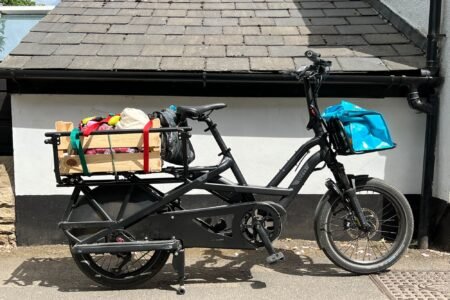





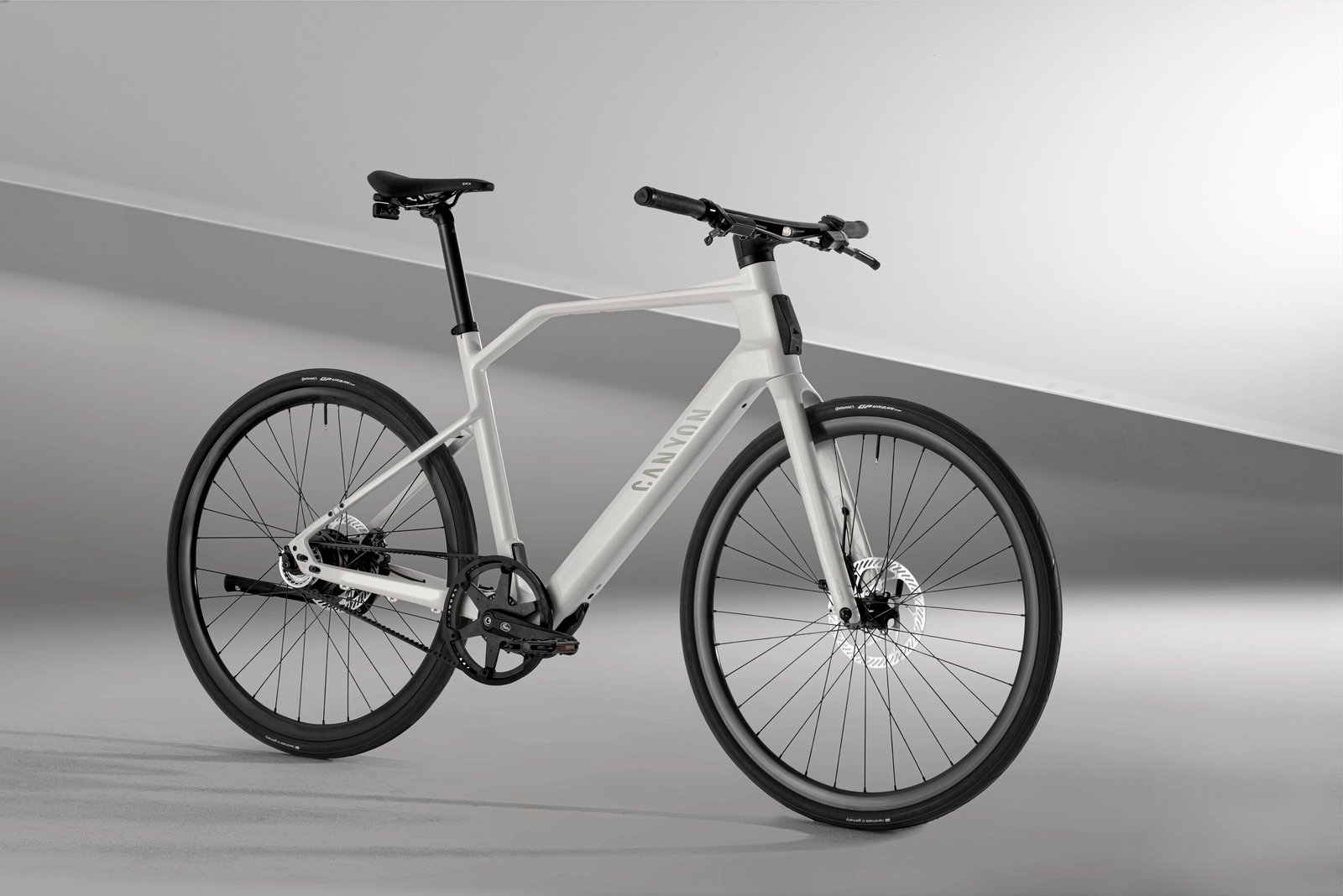
If you were a fan of last week’s futuristic and, in theory, super-safe Canyon Predict concept, you may well enjoy the company’s latest release. The Roadlite:On e-bike is close to mass production and features the V2X (Vehicle 2 Everything) system, which allows cars and bikes to communicate with each other.
Like the Predict, it will be showing at Eurobike next week, but unlike it, the Roadlite:On is production-ready.
The V2X tech, which Canyon has trialled alongside Volkswagen (VW), includes a nano-board in the downtube and a GPS antenna in the headtube, which can send signals to vehicle displays, alerting drivers to the presence of the bike. For the cyclist, the e-bike will send vibrations to the left or right handlebar grip, and visual information can be displayed on a connected smart device, such as a phone, watch, or computer.


Where cities are trialling infrastructure that pairs with these systems, the bike can communicate via the likes of “bicycle specific ‘green waves’ at traffic lights”, according to Canyon. The tech is standalone and has been adopted by VW already across a number of models, with Toyota and Cadillac among the pioneers.
The Roadlite:On also features a dynamic braking light and radar system, which can alert drivers to a rider’s intended actions. More prosaically, it’s powered by a Bosch motor and battery.
Launching the system, Canyon stated in a press release: “The technology aims to address a growing safety disparity on modern roads. Over the past decade, cars have become inherently safer, and motorist deaths have fallen. As it stands, though, the bike industry has not kept pace with the auto industry, and the number of cyclists killed or seriously injured on our city streets is rising.”
Official statistics bear this out. In the USA, cyclist deaths have risen dramatically over the last 10 years, from 902 in 2014 to 1,392 in 2024, according to the National Safety Council. In Germany, where Canyon is based, cyclists killed in road accidents have risen 20% in 10 years; car occupant deaths have fallen by a third. UK figures are trending downwards, from 113 to 82 during the same time frame.
It’s hard to criticise any attempt to improve road safety. Loss of life destroys families, and serious injuries, which are far more numerous than deaths, can blight lives. Anything that seeks to reduce this can only be a good thing. But the question has to be asked – are we getting this the right way round?
The idea that cyclists need to invest in a machine dripping with safety bells and whistles to defend against inattentive drivers won’t sit well with everyone. Neither will the implication that a lack of safety features on the average bicycle mean the cycling industry is not pulling its weight. Yes, cars are becoming safer, but much of that safety comes from the occupants being more insulated than ever, in cars that are only growing in size: in other words, hit something and you’re more likely to be absolutely fine.
That said, this sort of tech can also help protect inattentive bike riders, and Canyon’s adoption of the V2X system is surely a positive step. It, or something very much like it, seems destined to be part of the future of road safety for everyone.
So let’s see more of the world’s auto manufacturers step up and work towards fitting such things as standard. The tech is there – it just requires the will. And an acceptance of accountability.
Read the full article here