




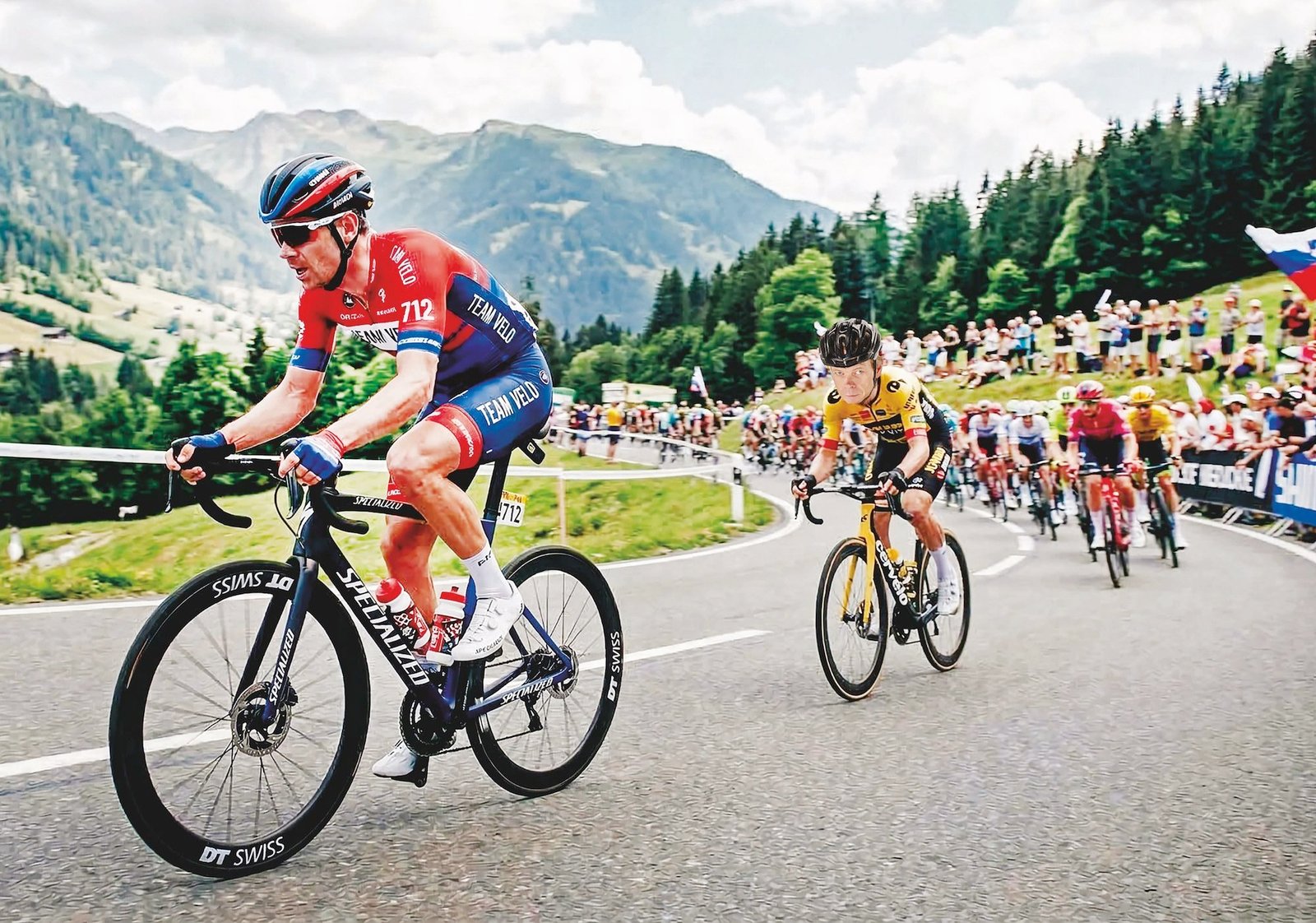
When watching bike racing on television, getting dropped looks so straightforward. That moment when a rider loses contact with the back wheel in front of them, and a gap starts to open, then grows, then finally becomes an irretrievable gulf. Depending on who it happens to, either they vanish and are never seen again, or the coverage will linger on them cruelly. Whichever, the moment of fracture is clearly visible. The crisis in the mind of the rider, however, is not.
I’ve been dropped many times on several continents. It’s never simple. When a gap opens, you know you need to close it immediately because every metre it grows means an exponential increase in the effort needed to close it.
So, despite the fact you’re at your limit already, you get out of the saddle and sprint. But the wheel in front gets no closer. You try to give even more – although already you know there is no more.
Latest Videos FromCycling Weekly
You hope and pray – maybe the riders ahead will hesitate? But a terrible truth becomes apparent. You will not close the gap. In everyone else’s reality, it’s just a few seconds. But it’s whole minutes if it’s you, whether you’re slipping out of the front group in a World Tour race or trying to reel in a frisky club run.
Michael Hutchinson is a writer, journalist and former professional cyclist. As a rider he won multiple national titles in both Britain and Ireland and competed at the World Championships and the Commonwealth Games. He was a three-time Brompton folding-bike World Champion, invented ugly aero socks and was the first rider ever to sit in a hot seat at the end of a time trial.
One question I always think about in these bleak moments is, what exactly is going wrong? Why can’t I close the gap? What’s stopping me?
There are a number of theories. The first is that it is just physiology. You just can’t push any harder because something biochemical is stopping you – lactate is the traditional enemy, and while it’s almost certainly not that, maybe it’s something like it. You’ve smashed the glass for your “only in emergencies” energy supply, drained it, and it’s not enough. Your legs simply stop obeying commands.
The next theory is that there’s a circuit-breaker of some sort in your central nervous system. It decides that you’ve had enough, that the end of what you can safely attempt has arrived. It’s not a conscious thought – it’s like your heart beating, it just happens, because it has to.
These are both good theories. I like them both. In the white-heat of failure I certainly like both of them more than I like theory three. Theory three is, put simply, that you just decide you’ve had enough. You are experiencing as much discomfort as you’re prepared to live with, and you quit.
I can deny it as hard as I like, but this is what it feels like to me. It boils down to whether the key moment is a realisation of bleak reality, or a conscious decision about what you’re going to do. And I think it’s a decision.
It’s a decision that comes very hard on the heels of the first time the voice inside your head says, “My goodness. This is hard. And gosh it’s uncomfortable. You know what would make this stop? That’s right… you can make it go away… I mean, how much is it really worth to you to hang on?”
More than once, I’ve made the decision, then changed my mind and tried to chase, and failed again. Sometimes I’ve persuaded myself that if I keep plugging away at my own pace, they’ll have to slow down and gradually I’ll reel them in again like the diesel I am. This has been known to work, but all it does is give me the opportunity to get dropped on the next hill instead.
Most often I’m just left alone with my regrets and the conviction that there was more in there if only I’d had the bravery to dig for it. I don’t think I’ve ever once felt like I had given all there was. It greatly enhances the feeling of failure.
It looks simple. It isn’t.
Great Inventions of Cycling – 1945
The signpost sprint is exactly what it sounds like – a sprint for a signpost. Normally a feature of an informal club run or reliability trial, they started to become an increasing feature of UK group rides after World War Two, as British riders discovered there were things in the world other than riding time trials and drinking tea.
The signpost might be a village name sign, a speed limit sign, a “café 500 metres” sign or essentially anything sticking out of a verge. Every group will have their own key sprints – it’s never something as simple as every village. Some are deeply historic – there’s a chaingang in Yorkshire that’s been sprinting for the same sign on the outskirts of Leeds since the 1950s.
If you’ve never ridden with a particular group before, rest assured that you won’t crack the algorithm for what’s a sprint and what’s not first, second or third time out. You will begin to suspect that they select what’s a sprint and what’s not based on whether you’re positioned to get to it first. And that is probably exactly what they’re doing.
Remember if you go for a sprint that, while considerable bragging rights attach to “winning”, you must remain casual about it. If you absolutely have to put your arms in the air, make sure you do so safely, and above all, ironically.
Acts of Cycling Stupidity
I recently heard a rumour about a new variety of cheating, which I very much hope is true. It’s probably limited to online racing, although I’d enjoy watching someone attempt to use it in the real world.
It concerns a UK-based rider who, having given up on more technological varieties of gaming his turbo trainer numbers, sought a more analogue method. He attached his tandem to the trainer, and got his 12-year-old son to ride stoker.
Since he really only wants about an extra 30-40 watts most of the time (more would arouse suspicion), his son is usually happy to do it for £20 an hour, and he doesn’t even need to set down his phone.
If he’s lucky his son won’t think of putting the price up. Or just plain blackmailing him.
Read the full article here