


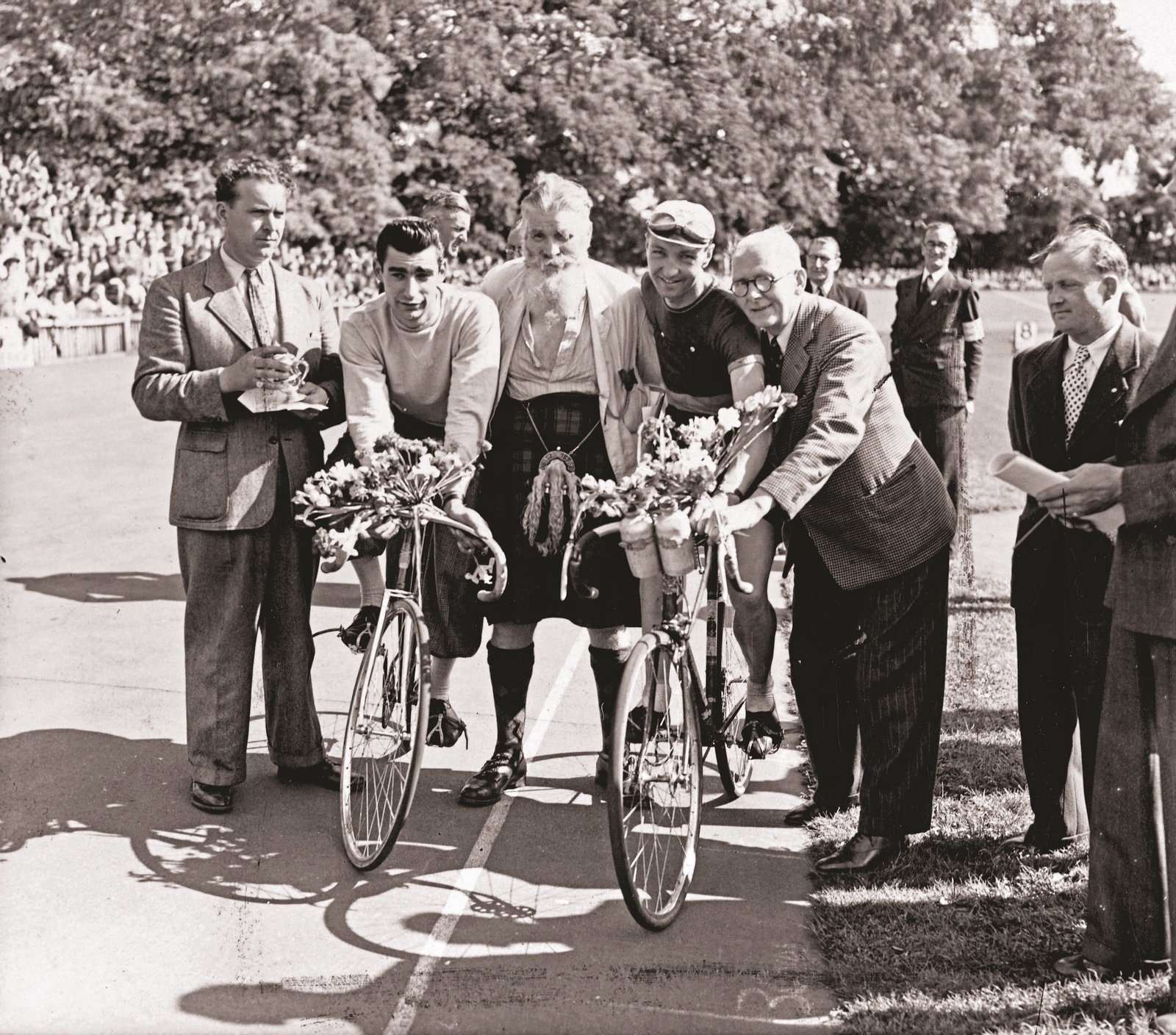
In October 2024, I discovered a stack of old copies of The Bicycle from the 1930s, tucked away in my father’s wardrobe. They had belonged to my great-uncle, Bill Mills, who founded the magazine 90 years ago. Intrigued, I began piecing together his life. In the course of my research, a chance exchange with cycling historian Feargal McKay revealed that, in 1947, Bill had organised an Anglo-French stage race. The first race to cross the English Channel and the first backed by a national newspaper, it was designed to pull British cycling out of the post-war gloom ahead of the 1948 London Olympics. A radical plan, then – so why had I never heard of it?
The race, like Bill himself, has been all but forgotten. By coincidence, or something stranger, I had cycled a route similar to the race, albeit in reverse, shortly before discovering Bill’s magazines. The chain of serendipities seemed to beckon to me to uncover the story behind the lost race that could have changed the course of British cycling.
Bill Mills made it his life’s work to bring Paris-London to fruition
(Image credit: Future – Cycling Weekly archive)
Continental aspiration
By 1947, Bill was already a significant figure in British cycling. He had been devoted to the sport since boyhood, and as a young rider living in Brighton, he frequently travelled to France to watch European races. In his own racing, he rose through the club ranks to become one of Britain’s leading time triallists. But it was mass-start racing that captured his heart.
Latest Videos FromCycling Weekly
After riding professionally with Swiss Hour record-holder Oscar Egg’s team and crashing heavily in the 1932 Rome World Championships, Bill returned to England with a Continental vision for mass-start racing – and a taste for Italian gelati and red wine. Together with the forceful Vic Jenner, his GB team-mate in Rome, he organised closed circuit events at Brooklands, which soon became popular, proving that time trials were not the only way to race. A few years later, in 1936, Bill drew on his experience working for the News Chronicle to launch The Bicycle. Bold in his patriotic vision, he strove to shake up British cycling and keep pace with our European rivals.
Home Olympics ahead
Life in post-war Britain was bleak, defined by rationing, austerity and social upheaval. Out of the rubble and financial ruin, the 1948 Olympic bid aimed to restore national morale and international standing. Yet when London won the bid, the established cycling nations were alarmed. Britain was an eccentric outlier where mass-start racing was banned and instead riders raced against the clock in secret at dawn, cloaked in alpaca coats. There were doubts about whether the country could successfully stage an Olympic cycling event.
Bill was more optimistic: he believed British riders could be made Olympics-ready, provided they were exposed to European-style racing. He came up with an ingenious plan: a three-day Anglo-French cycling match. Stages one and two would be run under French mass-start rules, and stage three would be a traditional British time trial. Each nation would enjoy a home advantage.
By this time, Bill was working for the News Chronicle, and after much persuading, his bosses agreed to sponsor his race as part of Britain’s Olympic campaign, stumping up £2,000 (roughly £95,000 today). Organisational support came from Bill’s long-term friend and renowned French cycling journalist Jean Leulliot. Only one hurdle remained: securing approval from Britain’s divided cycling authorities.
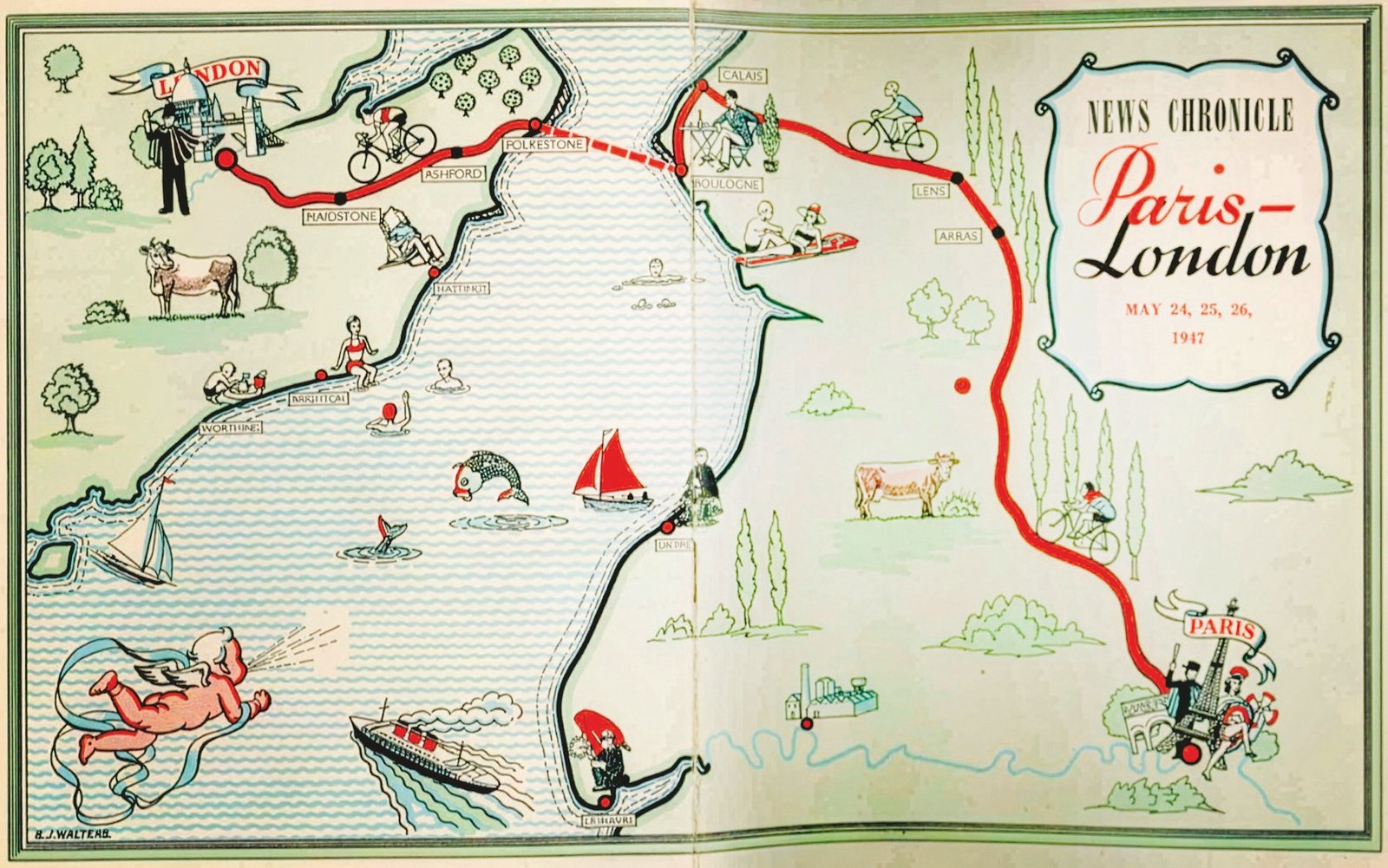

An illustrated map of the route, published in the News Chronicle
(Image credit: Cycling Weekly archive)
The go-ahead at last
World War Two might have ended, but a civil war was being fought between cycling’s governing bodies over mass-start racing. The National Cyclists’ Union (NCU) backed Bill’s event without hesitation, nailing its colours to the mast with the slogan, “Not a single Olympic cycling title must leave this country.” But because the race included a time trial, it also needed approval from the Road Time Trials Council (RTTC), which saw only danger and demanded full compliance with its regulations, including keeping races secret. The result was farcical: newspapers across the world would publish the race details, yet the News Chronicle would not be permitted to do so until the race had finished. With its back to the wall, the paper withdrew its sponsorship.
Bill responded in his usual outspoken style, publishing an article in The Bicycle that denounced the RTTC’s decision as a monumental obstruction to Olympic progress and a blow to Britain’s international standing. Matters escalated when Percy Stallard’s rebel group, the British League of Racing Cyclists, announced News of the World backing for its Brighton to Glasgow race. Suddenly the establishment risked losing control altogether. Afraid of losing face, the NCU appealed to the UCI, which overruled the RTTC and issued an international permit. In March 1947, Bill triumphantly announced that the race was back on.
He pressed on with arranging trains, boats, customs clearance, police escorts, meals and hotels, chores made even more onerous by post-war scarcities. The race was christened the ‘News Chronicle, Paris to London Anglo-French Road Race’. Teams were selected and dates fixed for the Whitsun weekend, 24-26 May 1947. Continental cycling was coming to Britain.
Heroic home victory
Under blue skies and a blazing sun, 30 slick, well-equipped French riders rolled up beside Le Bourget airfield, 10km north of Paris. The comparatively shambolic British team looked on uneasily, eyeing up their rivals’ CO2 inflators, derailleur gears and gleaming alloy fittings. The playing field was far from level.
Britain’s race got off to a disastrous start. Bill observed loose gear levers, broken cables, burst tyres, a snapped saddle and riders swapping machines mid-race. The lack of British teamwork was, in Bill’s words, “almost laughable”. Yet there was a flash of promise. Britain’s Ernie Clements somehow reached the Lens track first, only to skid on loose concrete and surrender the stage to France’s Dominique Forlini. Even so, two Britons made the top 10. One was George Fleming.
Overnight in Lens, a miracle took place: the British learned to ride as a unit. On cobbles early in the stage, under relentless heat, they attacked. The French, divided by interclub loyalties, refused to work together. Sensing disorder, the British seized the initiative and forced a break, with only one Frenchman able to respond. Seventeen miles from Calais, Fleming made a solo breakaway.
Watching the Briton attack into a headwind, the French journalists scoffed at his chances. They were soon eating their words. Bill clocked Fleming at 22.4mph as the gap extended beyond two minutes. Rushing onto the finish, he reported the moment a solitary figure appeared: “Is it Fleming? Of course it is! Desperately tired, he comes up to the finishing line. His head hangs; he cannot raise it even for a smile.” “How was it, George?” Bill asked. “The last few miles were a bit hard,” came the reply.
Back on English roads for the final stage TT, Fleming’s strength against the clock proved decisive. At Herne Hill Velodrome, before a crowd of 10,000, he was declared the overall winner. For the first time in history, the British public watched one of their own triumph in an international cycling race and on home soil too.
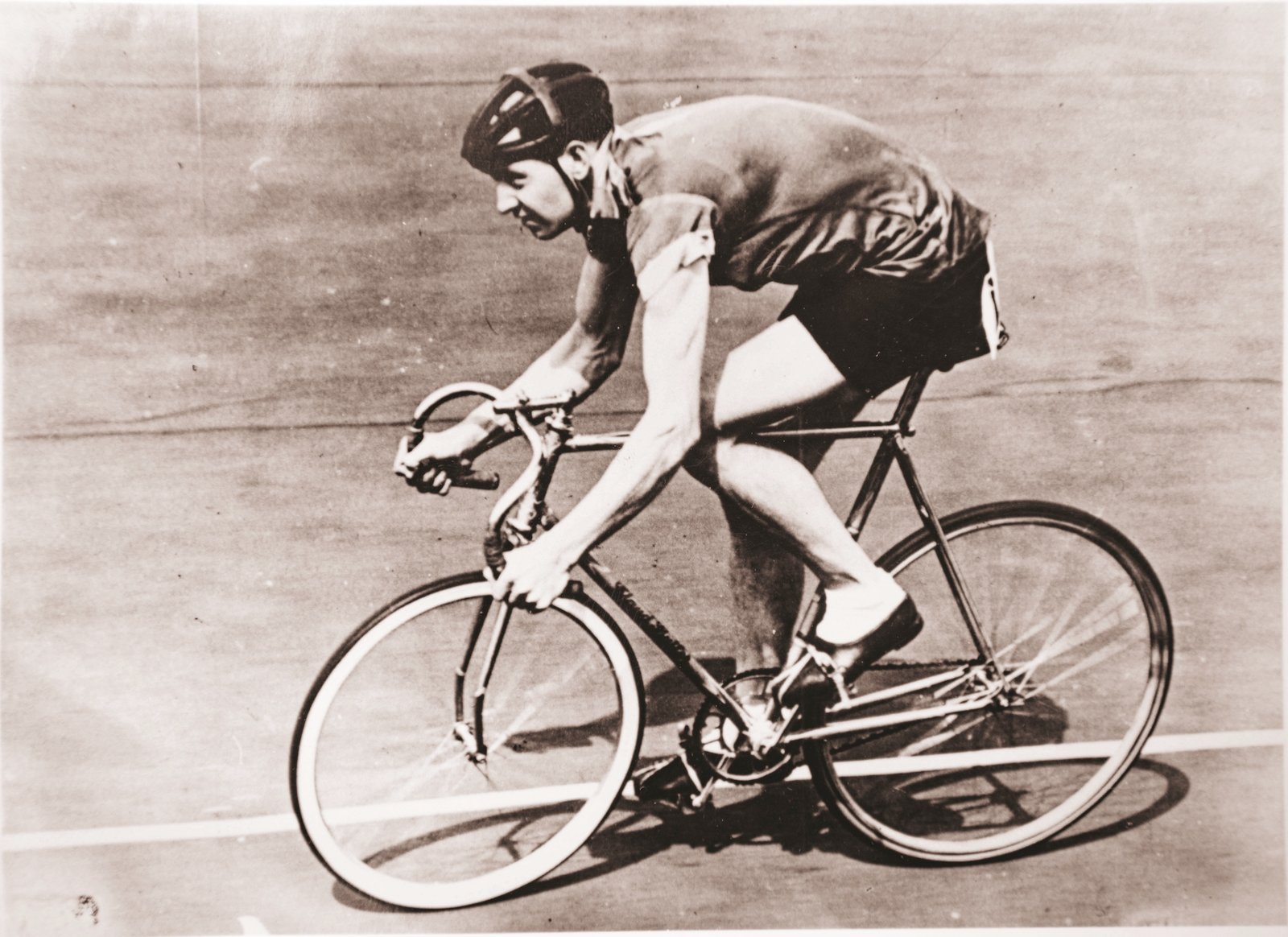

No one could match an on-form George Fleming
(Image credit: Cycling Weekly archive)
Great expectations
For Bill, it felt like a beginning. Cycling was no longer dismissed by the national press as a moribund, irrelevant sport. British riders had entered the international picture, and he hoped the race had set a precedent. Buoyed by the headlines and profit, the News Chronicle handed Bill an increased budget of £3,000 for a sequel. “Ask for more if you think it necessary,” they told him, “we want an even bigger and better race.” Bill planned to widen the international field, creating an annual pre-Olympics showdown. It looked set to become a regular fixture, a world-class race linking France and Britain in a sporting partnership par excellence.
The governing bodies’ truce proved short-lived, however. Jenner, formerly Bill’s ally, had grown sceptical of mass-start racing and now, taking the RTTC’s side, was locked in a dispute with the News Chronicle‘s promoter. He insisted on a traditional early start, for safety’s sake. What had worked in practice was now overruled by bureaucracy and obstinacy.
Jenner revived a 1939 agreement that stripped the NCU of its right to object in defence of an Ilam start. The UCI could not bail them out this time. A meeting was called in the hope of compromise. An hour later, Bill received a memo from the News Chronicle: “Scrub Paris-London. It’s all off.” There was no alternative sponsor waiting in the wings and no organising body capable of stepping in. The race would never be repeated.
For Bill, the failure to reach an agreement was yet another example of egos and internal bickering holding back the sport. Fleming shared his frustration in an open letter published in The Bicycle on 14 April 1948, arguing that Paris-London had taught Britain more about road racing than had any domestic event before or since. Without races like it, he warned, Britain would never produce world or Olympic road champions.
Enduring legacy
Fleming was proved right. Britain won no individual road cycling medal at the 1948 Olympics. The ultimate verdict came from the results: Olympic gold was won by France’s José Beyaert, who had placed third in Paris-London the year before. Britain’s first post-war Olympic gold in road cycling would not come until Nicole Cooke’s victory in Beijing, 60 years later. The governing bodies’ bickering would continue until the British Cycling Federation was formed in 1959, delaying British riders’ progress in elite road races by decades. Had Paris-London survived beyond 1947, it might have transformed British cycling’s trajectory. Bill had understood what the sport needed to flourish in Britain, an established annual international stage race to rally national ambition, to learn from, and against which to measure.
In 1965, Bill approached the Daily Mail (then owner of the News Chronicle) to ask whether it was interested in reviving the race. He received no reply. On 2 April, 1965, Bill took his own life. He was 58. The weekend before his death, he had written his final article, about his dream of a Paris-London return; it was published posthumously on 17 April, 1965 in this magazine. The circumstances of Bill’s death are not fully known to our family, but we do know that cycling had given him his purpose, and he had fought for its future to the detriment of his health and second marriage. It narrowed his world, and eventually the vision that had sustained him no longer held.
Paris-London left its mark, and so had Bill. It was a race that mattered, and a moment when Britain showed it could be a credible cycling nation. Its success prompted other national newspapers to seek cycling races to sponsor, eventually leading to the Daily Express‘s backing of the Tour of Britain in 1951. I will ride London-Paris again this summer, this time carrying with me the full story behind my great-uncle’s creation and what it meant to him. And when the men’s and women’s Tour de France cross the Channel next summer, it will feel to me as though the spirit of Bill’s race has finally returned.
THE PATH TO OLYMPIC ROAD RACE GOLD
Despite massed start road racing in the UK being in its infancy, Bill Mills’s dream was for Great Britain to win Olympic gold at the 1948 London Olympics. In the end it would take another 60 years to achieve that goal on the road. Here are the major events along the way:
1942 First massed start race – Percy Stallard runs rebel Llangollen to Wolverhampton road race
1947 Paris-London – Bill Mills’s race proves Britain has an appetite for major cycling events
1948 London Olympics – silver medal in the team road race
1951 Tour of Britain – the first major domestic stage race begins
1955 Tour de France – British team competes for the first time
1958 Tour stage win – Brian Robinson becomes first Briton to win a Tour stage
1959 Formation of the BCF – BLRC and NCU unify and form the British Cycling Federation
1965 Road world champion – Tom Simpson becomes Britain’s first world champion on the road
1974 Tour’s first UK visit – stage two of the Tour de France takes place on Plympton by-pass
1996 Lottery funding lands – the BCF is one of many British sports to receive major financial backing thanks to the National Lottery
2008 Olympic road race gold – Nicole Cooke secures the long-awaited victory in Beijing
This feature was originally published in the 21 May 2026 print edition of Cycling Weekly magazine – available to buy on the newsstand every Thursday (UK only). Digital versions are available on Apple News and Readly. Subscriptions through Magazines Direct.
Read the full article here