

“Do better for female cyclists,” says Olivia Moore in a video that appears on my Instagram feed, a well-earned medal hanging proudly around her neck.
She isn’t criticising the route, the atmosphere or the volunteers at the Mallorca 312 gran fondo. In fact, she describes it as “an epic day”. Her frustrations lie elsewhere: the toilets.
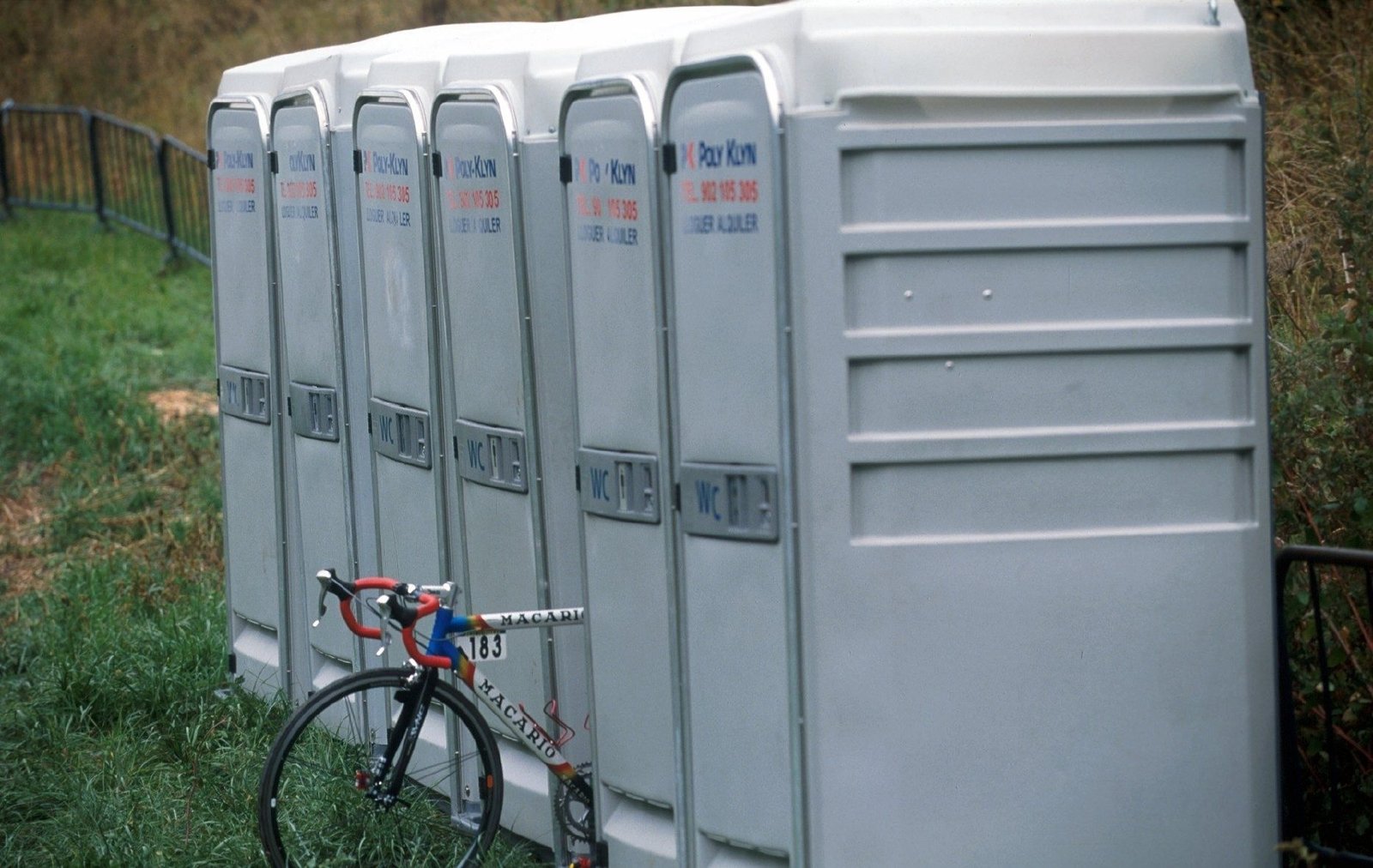
According to Moore, there were too few toilet facilities at both the start line and the first feed station. She says the first stop had just four portaloos – catering for the 8,500 participants taking part in the mass-participation endurance event – three of which were out of use.
Latest Videos FromCycling Weekly
Unsurprisingly, she says, the queue for the remaining toilet – ironically labelled “male-only” – was “ridiculous”, leaving her waiting for 45 minutes. Moore says the queue meant she “missed the time cut off to do the 225 [km] route”, leaving her feeling “super disappointed” and “a little bit robbed” after putting in the training for the annual gran fondo which sees riders cover up to 312 kilometres around the Spanish island. The organisers of the Mallorca 312 did not respond when Cycling Weekly reached out for comment.
Moore wasn’t alone. Nearly 380 comments beneath the video echo her frustrations, with riders sharing similar experiences at the same event and others across the cycling calendar. They describe lengthy toilet queues, jerseys labelled as ‘unisex’ that simply don’t fit women well, and a broader feeling of being an afterthought.
Toilets may be the talking point of this particular sportive, but the issue runs much deeper. Across the sport, women raise concerns about everything from facilities and event logistics to representation, safety and inclusivity. If organisers want to attract more women to their events, are they doing enough to make them feel welcome?
What is a sportive?
(Image credit: chris catchpole)
Sportives are mass-participation timed cycling events. In Europe, they’re typically called gran fondos, and some are much more competitive – even akin to a road race – than others. Within pro races, cyclists will stop by the side of the road to pee (or even pee whilst riding). However, the sign-ups at sportives range from those aiming to win a podium spot to those looking for a good day out on the bike; most will be expecting a more civilised approach to toileting than that seen within the pro peloton.
The stats speak for themselves

The London Marathon is close to gender parity with its registration stats
(Image credit: Getty Images)
Running has shown what’s possible. In recent years, race organisers have improved the female experience through practical changes, inclusive policies and community-led initiatives, helping to drive a surge in women’s participation.
Participation data reflects that progress, with younger runners approaching gender parity on race start lines. The London Marathon lists its 2026 gender split with 44% female registrations. A 26.2-mile run is perhaps a closer comparison to grand fondos and epic sportives than the 5km ParkRun events held across the UK every Saturday, but interestingly, the split there is similar, with ParkRun’s organisation stating a 44% female competitor count in 2019 alongside a 53% female registration figure.
Cycling sportives – timed mass-participation events, some more competitive than others – still attract relatively few women. Around one third of riders at L’Étape du Tour de France Femmes 2025 were women, compared with around 15% at Maratona Dles Dolomites 2026.
Amber Keegan, writer and founder of Athlete Interactions, recalls entering a Band of Climbers Peak District cycling event that publicly stated its ambition to increase female participation to 25%, a goal she says was later dropped without explanation. “There’s no shame in trying and failing to improve the gender balance,” Keegan told us, “but silently backing away from your commitment felt pretty pants.”
Founder Stuart Hall says the ambition remains, with 25% a “stretch target” en route to an end goal of a 50/50 split for its Toughest 100 event. “After seeing how few women took part in 2023 [five out of 150 participants], we worked hard to encourage more women to take part in 2024, which you can see by the fact we had 12% female entries,” Hall says. “We set a target of 25% for female entries. This was exactly that, a target, which we did miss, but I think the fact we worked hard to speak to female cycling groups, influencers, communities, showed by the fact we had 12% female entries.”
Maximilian Wussler, founder of Red On Sports, organisers of The Gralloch gravel event – which features competitive racers as well as more relaxed sportives – has seen the contrast first-hand since launching the combined running and cycling event ‘explorr Festival’.
“Since we expanded into running events, we’re seeing a roughly 50/50 split, and we’ve done nothing different on the marketing side,” he says. “Running is still fairly new to us, but our sense is that a lot of the gap is structural rather than about how you market it. Running seems to carry fewer of the barriers cycling does, and it has a much deeper, more established base of women taking part already. Gravel is catching up, but even after the real progress of the last few years, the best case is still around 20% women.”
So, what can cycling learn from running to ensure more women not only sign up, but return year after year?
Why do women still feel overlooked?
Organisers need to recognise biological and sociological differences, according to Power
(Image credit: Getty Images)
It’s rarely just one issue that makes female cyclists feel overlooked. Like any great sportive, the overall experience is shaped by countless small details, from the moment entries open to the moment riders cross the finish line.
“Women are biologically different,” says Sophie Power, founder of sheRACES. “We have periods; we have pregnancy,” she notes, citing pregnancy deferral policies as a key driver for change. “But we’re sociologically different as well, and that is the point that I think races don’t take into account.
“From the age of five, girls don’t think they’re as good at sports as boys, so when races describe their events as the biggest, the baddest and toughest, that actually puts us [women] off.”
That does not mean women aren’t drawn to challenge goals. Many females are motivated by testing their limits. Rather, Powers’ point is that the way events frame difficulty can influence who feels confident enough to enter in the first place.
Samantha Varley, head of product and operations at Sportive Breaks UK, says increasing female participation won’t be solved overnight.
“There are numerous barriers that can influence whether women feel able, supported and confident enough to take part in cycling events,” she says. “Addressing these challenges requires a shift from a one-size-fits-all approach.”
What does change look like in practice?
Attracting more women isn’t simply about reserving places for them at the start line. “You’ve still got to make your event something that women want to race,” Power says.
She believes many of the changes are simple. SheRACES outlines nine commitments that she says every race should adopt as standard. “There’s basically no excuse if you don’t,” she adds.
The commitments include using diverse marketing imagery, introducing pregnancy deferral policies, giving women equal prominence in event communications, adopting a zero-tolerance approach to unacceptable behaviour and actively seeking participant feedback after race day.
For many women, deciding whether to enter begins long before race day. The images, language and information on an event website all influence whether riders feel an event is for them.
“If I see pictures of all white, skinny men, I don’t think that race is for me,” says Power. “We want to see a diverse range of imagery of all types of bodies.”
SheRACES nine key commitments
Pregnancy deferral policies are one key commitment
(Image credit: Charlie Crowhurst for Future)
- Show a diversity of athletes in marketing imagery.
- Ensure all prizes and rewards for women are of at least of equal value to those for men. This includes prize money, number of categories and a choice of female fit or unisex t-shirt.
- Review toilet and changing facilities to ensure they are sufficient and well communicated. Having period products available at start and finish lines, and where possible on course.
- Ensure the women’s race is given equal prominence in celebrations, social media posts, interviews and other communications.
- Allow women who fall pregnant before the race to transfer their place to a future event within two years (for non-ballot races, refunds or athlete transfers are also permissible).
- Communicate and enforce a no-tolerance policy for harassment of any kind (to include runners, all event volunteers and staff).
- Actively seek feedback from participants after each race and making best efforts to make changes to support them better.
- Make these commitments easy to find on my website or in participant information.
- Review compliance with the guidelines on a regular basis (annually as a minimum).
Varley also believes organisers need to think about how they present the challenge itself.
“Men frequently sign up first and worry about fitness later; women tend to be more cautious,” she says. “Strict event time cut-offs create a major fear factor, causing capable women to self-select out due to worry over their pacing.”
Alex Miller, founder of Lawless Coaching, supports this. She’s found that more women hesitate to enter events, not due to lack of fitness but because they don’t see themselves as competitive or fit enough compared to male participants.
“Mothers are also often concerned that they cannot prioritise training enough to be competitive,” Miller adds. “In recent years I’ve seen a huge shift in the amount of support for both women and beginners in these sports, groups and clubs running women-only and beginner-focused sessions supporting a first step into the sport.”
Varley also suggests showcasing average finish times alongside training advice and promotional imagery featuring riders of different abilities to reassure more women that they can do it.
Another important change is pregnancy deferral policies. “If a woman’s going to have a baby, she shouldn’t be penalised for that,” says Power. “Even having that in place just lets women know, even if they don’t want to use it.”
Clear event day logistics can be just as influential. Keegan points to this year’s Maratona Dles Dolomites as an event that helped put her mind at ease.
“The 138km sportive had six toilet and mechanical stops en route,” she says. “That was such a massive reassurance.”
Power believes organisers shouldn’t underestimate the importance of communicating those details in advance. “Be clear that there are toilets – where are they and where are the stops?” she says. “Logistics are really important to women to feel confident that they could take this on.”
Clearly communicated event day logistics are on the wish list
(Image credit: Getty Images)
With sportives and gran fondos attracting large numbers of cyclists who will have varying attitudes towards group riding etiquette, event day culture matters too.
Power states that organisers should have clear codes of conduct, making it obvious what behaviour is and isn’t acceptable, while giving riders assurance that any incidents reported will be acted upon.
Founder of women’s cycling clothing brand, Luca, Luca Kuhn noticed a clear difference between events. “Riding was much friendlier at the Maratona compared to Mallorca 312, where people were overtaking left, right and centre,” she says. “It was really intimidating.”
The impact of these changes is already being seen. Etape Caledonia, highlighted repeatedly by women in response to the Instagram video, partnered with Women in Tri to encourage more women onto the start line. Female registrations increased tenfold, the event’s 40-mile route achieved gender parity, and one in three female participants was riding their first sportive.
Moore, in her Instagram video, still described her sportive as “an epic day”. She simply wanted the experience around it to match. If cycling wants more women collecting medals around their necks, success won’t be defined by one big change, but by getting the small details right.
Read the full article here