




Audi Formula 1 boss Mattia Binotto is calling on the FIA to “rethink” the ADUO upgrade scheme after Mercedes was one of the manufacturers afforded room for additional power unit upgrades.
The Mercedes engine is widely regarded as the strongest in 2026, helping the squad win seven out of the first nine grands prix.
But because only V6 power is measured to determine which power unit manufacturers qualify for upgrades, Mercedes had been one of the manufacturers allowed to conduct further work on its engines.
Meanwhile, the Red Bull Ford Powertrains V6 was determined by the FIA to be the benchmark, locking it out of further improvements beyond the restricted homologation schedule. A frustrated Red Bull has contested this outcome, but additional reviews by the FIA have not changed its findings.
Rival manufacturers have long suspected the likes of Mercedes and Ferrari are holding back the performance of their V6s, whether for reliability reasons or to game the ADUO system.
Speaking exclusively to Autosport, Binotto therefore feels the upgrade system needs an overhaul.
Red Bull Ford Powertrains
Photo by: Red Bull Content Pool
“In my opinion, the limit has been that it has exclusively measured performance on the track. A car with an overall advantage can afford not to fully exploit the potential of its power unit,” Binotto explained.
“It’s possible, for example, that Mercedes had an engine with superior potential, but had no need to push it to the limit because it already had an advantage thanks to the car. If that were the case, it could have also gained additional development margin.
“That’s why I think the regulation needs to be rethought in this regard. This wasn’t the original intent of the ADUO: the goal was to help those who were actually falling behind, not to create situations in which the true potential of a power unit might be difficult to assess.”
F1 newcomer Audi is one of the reasons why the ADUO system exists in the first place, as it had been worried over the initial performance of its very first power unit and the system was a helping hand to ensure the German powerhouse wouldn’t be stuck if its engines had been off the pace.
Audi’s engines, while not up to par with those of its rivals as expected, have made a reasonable start, with instead Honda being the party that desperately needs the catch-up mechanic the FIA devised.
Binotto says he’s not doubting the FIA’s findings, but thinks the ADUO system has strayed too far from its original premise.
“On the results, I’m not questioning the work done by the FIA. They have all the tools and data necessary to make their assessments, despite the limitations that any measurement system inevitably entails,” Binotto added.
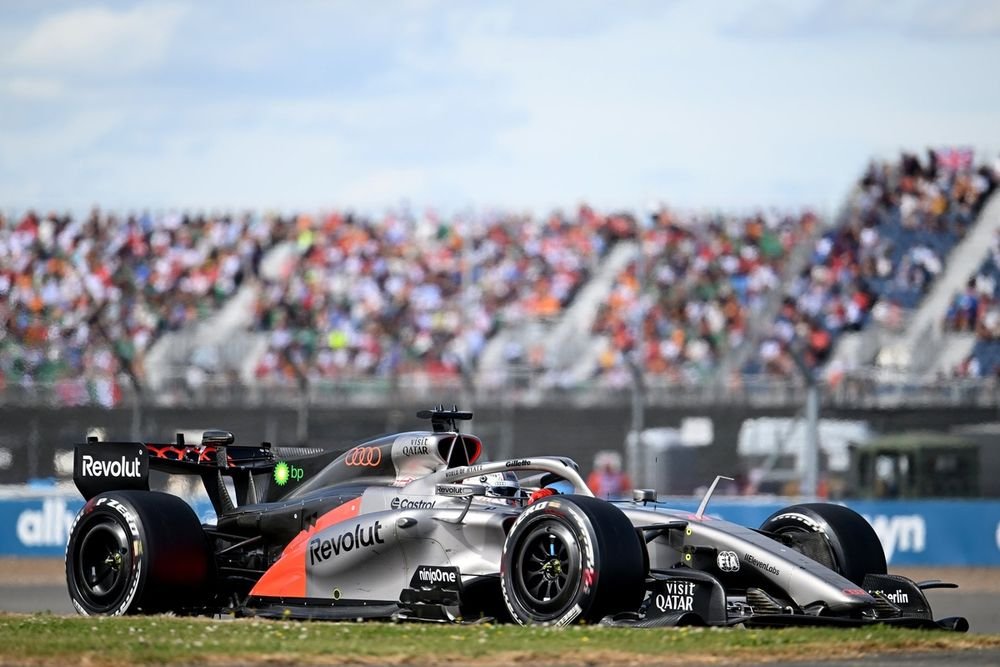
Nico Hulkenberg, Audi F1 Team
Photo by: Manuel Eletto / Getty Images
“However, I believe it’s important to remember the original objective of the ADUO. When it was first discussed, the concept was that of a sort of safety net. If a manufacturer was far behind at the start of the regulatory cycle, with regulations virtually frozen and very little room for development, it would risk dragging that disadvantage for five years.
“This gave rise to the concept of performance convergence: allowing those who were further behind to have a greater chance of catching up. Ultimately, it’s the same principle that already exists for chassis and aerodynamics.
“Those further back in the standings have more hours in the wind tunnel. Likewise, those who are further behind in terms of power unit performance receive greater development opportunities to catch up with the others and make the championship increasingly balanced.”
ADUO’s sliding scale affords manufacturers upgrade tokens for every 2% their V6 engine is down on power, which is a minuscule amount.
The other sticking point is that while only the performance of the V6 engine is taken into account to award upgrade tokens, qualifying manufacturers can then overhaul virtually their entire power unit, including hybrid components.
It creates an environment in which manufacturers could radically improve their overall power units without adding performance to the V6 specifically, guaranteeing further upgrade opportunities down the line while freezing the leading manufacturer Red Bull out.
The FIA was keen to take more factors into account when coming up with the ADUO system, but F1’s governing body says it was the manufacturers who were backing the idea to stick to V6 power as the determining factor.
We want to hear from you!
Let us know what you would like to see from us in the future.
Take our survey
– The Autosport.com Team
Read the full article here