



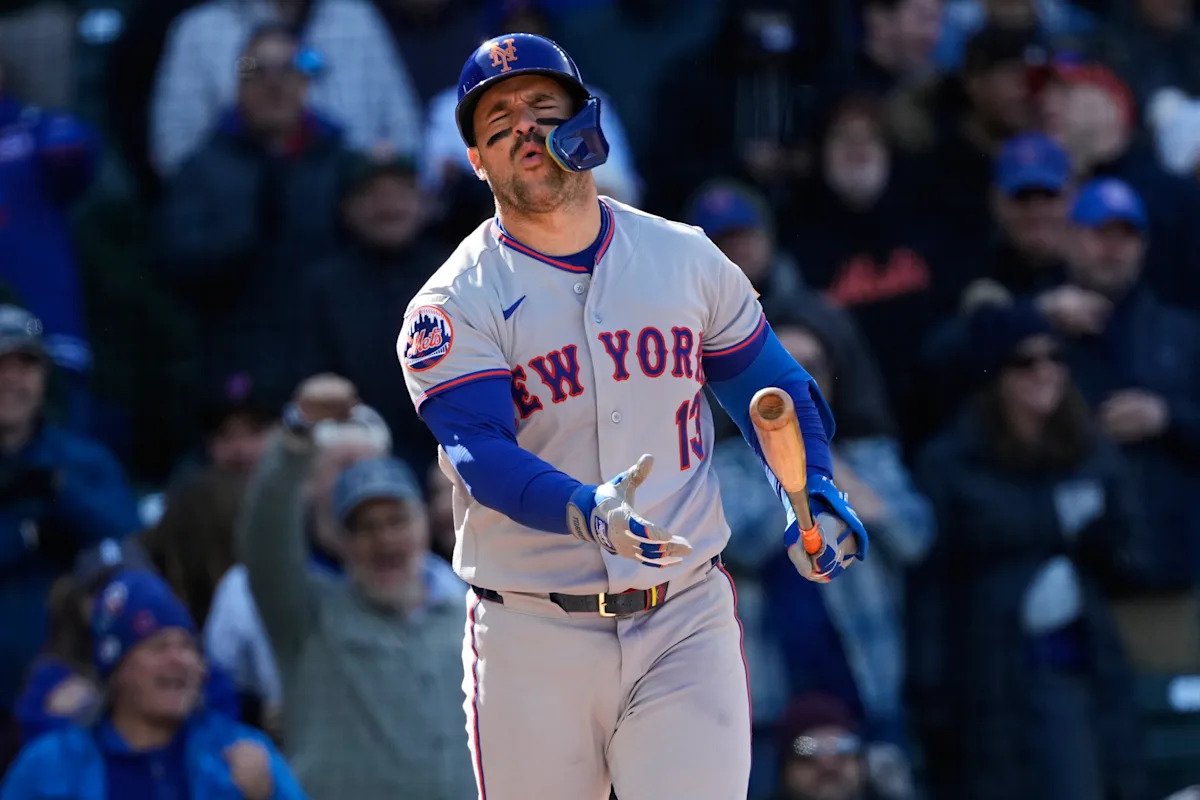
NEW YORK — The New York Mets, losers of 11 straight, are a cornucopia of woe, a showcase of frustration, a very, very expensive bummer.
Through 22 games, the Queens club has slumped its way to a National League-worst 7-15 record. Only the Philadelphia Phillies have a worse run differential. The Mets haven’t won a ballgame since April 7. New York’s $200 million offense has scored the fewest runs in baseball. People are calling for manager Carlos Mendoza’s job. Things have already gone flying off the rails, and it’s not even May.
Considering how the Mets concluded last season and conducted this winter, the frustration is even more warranted. The 2025 team, owners of the sport’s best record on June 12, authored a late-summer collapse of historic proportions, eventually missing the playoffs by one game. A winter of change followed, with president of baseball operations David Stearns acting aggressively to shuffle his roster and his coaching staff.
Out went stalwarts Pete Alonso, Brandon Nimmo, Edwin Díaz and Jeff McNeil. In came a pseudo-fantasy team of veteran additions: Bo Bichette, Jorge Polanco, Luis Robert Jr., Marcus Semien, Luke Weaver, Devin Williams. The result was genuine optimism and curiosity about a new era of Mets baseball.
But that goodwill and those good vibes have already gone up in smoke. The Mets are a mess. Thankfully, for their sake, the season is young. Ample time remains for a turnaround. But what has gone so sour so quickly? What exactly is wrong with the New York Mets? And how did it get this bad this fast?
Juan Soto’s injury leaves an offensive void
The Mets’ losing streak dates to April 7, but their problems began a few days earlier. On April 3, in a game against the San Francisco Giants, superstar slugger Juan Soto left early after feeling discomfort in his leg while running the bases. Said issue turned out to be a calf strain, pushing Soto to the injured list. And that’s where he has lingered for New York’s entire schneid.
In his absence, the Mets have ranked last in OPS, OBP, slugging percentage, extra-base hits and runs, and they’re second-to-last in walks, chase rate and home runs. They have averaged just over 2.5 runs per game since Soto’s injury. Understandably, most teams would expect a decrease in offensive production when their best player hits the shelf. But with few other Mets stepping up to shoulder the load, New York’s offense has gone arctic.
Outfielder Tyrone Taylor, Triple-A call-up MJ Melendez and catcher Francisco Alvarez have all been productive over this stint, but practically every other hitter is slumping. Polanco (6-for-33, now on the IL), Brett Baty (7-for-37, no homers) and rookie Carson Benge (6-for-40, no homers) have had particularly bad stretches.
Treading water during Soto’s relatively brief absence was a reasonable goal. Instead, the Mets have completely capsized. Thankfully, Soto should be back at some point in the next week.
Slow starts from veteran additions
By jettisoning stalwarts such as Alonso, Nimmo, Díaz and McNeil, the Mets conducted something of a clubhouse refresh. For nearly half a decade, that quartet dictated the culture in Queens, guiding the club to peaks and valleys along the way. Their departure created a vacuum, one that new faces such as Semien, Polanco and Bichette were expected to fill.
This turnover process has been made extraordinarily difficult by the group’s abysmal offensive start. That trio of newbies has posted an incomprehensibly bad .560 OPS across 245 combined plate appearances. It’s very difficult to emerge as a leader, a presence, a sounding board when you’re performing that poorly. That’s surely part of what is happening with Semien, Polanco and Bichette.
Kodai Senga’s struggles and bad timing
The Mets have scored more than two runs in a game just twice during their 11-game slide. Unfortunately, starter Kodai Senga was absolutely clobbered in both of those contests, surrendering 13 earned runs across 5 2/3 total innings. This season so far, the right-hander has been responsible for nearly 20% of New York’s total runs allowed.
This was supposed to be a bounce-back year for Senga, who looked entirely rejuvenated during spring training. He was throwing in the high-90s, with command of multiple pitches, and looked like the ace he was back in 2023, when he finished second in NL Cy Young voting. But after solid showings in his first two starts, Senga has reverted back to the ineffective version of himself. He can afford only a few more stinkers before Stearns, Mendoza and Co. start to think seriously about other rotation options.
The Mets’ cornerstone shortstop has looked completely discombobulated in the early going. His failure to step up after Soto went down has played a massive role in New York’s recent run of offensive ineptitude. But while Lindor’s poor results at the plate — .600 OPS, just one homer — are certainly part of the story, something deeper seems amiss with the Puerto Rican superstar.
Lindor has already made a number of uncharacteristic mistakes in the field and on the bases, mistakes that have elicited questions around the game about his state of mind and leadership qualities. Perhaps a spring training spent rehabbing — Lindor had hand surgery in February — has contributed to the early missteps. But no matter the reason, a player with Lindor’s track record and paycheck should never look this out of sorts for this long.
Some general misfortune and bad luck
For what has historically been baseball’s most slapstick franchise, this start is business as usual. Losing in crushing fashion on Sunday because former Met Michael Conforto hit a game-tying double in the ninth and former Mets prospect Pete Crow-Armstrong used his speed to score the game-winner in the 10th was the epitome of adding insult to injury.
Statistically speaking, the Mets have indeed been unlucky in the early going. Only San Diego, Detroit and Cincinnati have underperformed relative to contact quality on offense more than New York. The Mets are 1-5 in one-run games, despite having an above-average bullpen. Eventually, sequencing and luck should return to equilibrium. And the Mets’ defense, a massive question entering this season, has actually been pretty good. So has the pitching, outside of Senga. There are some reasons for hope.
But even if the Mets are not really this bad, they’ve dug themselves quite a hole. The Atlanta Braves are already 8.5 games clear in the NL East. It’s getting late early in Queens, so the Mets better get hot quickly. Thankfully, there’s a road back to competence: A nine-game homestand against Minnesota, Colorado and Washington, three rebuilding clubs, begins Tuesday.
If the Mets stumble against that cushy lineup, it might be time to start ringing the alarm bells in earnest.
Read the full article here