

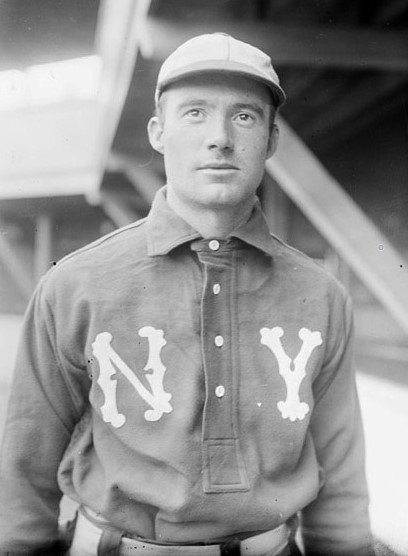
The history of the Yankees dates back to the start of the 20th century and a humble team known then as the New York Highlanders. Their first ever game was played on April 22, 1903, against the Washington Senators, a 3-1 loss at American League Park, one of the more well-known Griffith Stadium’s predecessors in the nation’s capital (close to Gallaudet University). And stepping into the batter’s box to take the first ever at-bat in franchise history was an outfielder known as Lefty Davis.
Alphonso DeFord “Lefty” Davis
Born: February 4, 1875 (Nashville, TN)
Died: February 4, 1919 (Collins, NY)
Yankees Tenure: 1903
Little is known about Lefty’s early life and upbringing, but Tennessee had become an epicenter of early organized baseball by the late 19th century, and the Nashville region was certainly in that mix. The Southern League, founded in 1885, was the predominant regional circuit of minor league clubs that included teams from Atlanta, Augusta, Chattanooga, Columbus, Nashville, Memphis, Birmingham, and Macon.
Davis got his start in organized baseball in 1896 at the age of 21 playing the outfield for Mobile Blackbirds of the Class-B Southern Association. In 43 games that season, Davis batted .309 in 191 at-bats and also made five relief pitching appearances to the tune of a 1.75 ERA across 36 innings. He moved up to Class-A ball the following season, batting .307 with five home runs and 12 stolen bases in 225 ABs for Detroit in the Western League. 1898 saw Davis split time between Detroit and Minneapolis Millers, and he batted .291 with two home runs and 26 stolen bases across 122 combined games. He played out his final two minor-league seasons with Minneapolis, establishing a reputation as a speedy center fielder and stolen base threat, leading to his establishment in the majors.
The Philadelphia Athletics selected Davis to their team, but before he had played a single game, he jumped to the Brooklyn Superbas as players had far more agency over where they played in the inaugural years of the NL and AL. In his debut season with Brooklyn in 1901, Davis batted just .209 in 25 games, leading to his release midseason. The Pittsburgh Pirates signed him as a free agent, and he would play out the remainder of the 1901 season with the dominant NL team of that era.
In the Steel City, Davis joined the ranks of future Hall of Famers Honus Wagner, Jack Chesbro, and Fred Clarke. He appeared in 87 games for the Pirates after making the switch, slashing .313/.415/.421 for an impressive 139 OPS+ along with two home runs and 22 stolen bases, helping Pittsburgh capture its first NL pennant. The following year, he helped the Bucs defend their NL pennant crown, though he did miss a significant portion of the season to a broken leg.
It was around this time that the Highlanders were coming into existence. With the inception of the AL in 1900, there were calls to establish a pro club in New York. However, the incumbent New York Giants of the NL blocked those plans, and so instead that franchise was awarded to Baltimore and named the Orioles in 1901. In 1902, Orioles manager and part-owner John McGraw departed Baltimore to become manager of the Giants, and the short-lived Orioles folded at the end of that season.
Prior to the start of the 1903 season, the NL and AL resolved their differences and once again a proposal to create an AL team in New York was put forward. Out of the 16 major league owners, 15 voted to approve the proposal, and thus the team that started as the Baltimore Orioles was officially chartered in New York as the Highlanders. Needing to assemble a roster for the season, the Highlanders targeted that back-to-back NL pennant winning Pirates squad. Davis, Chesbro, Jesse Tannehill, Tommy Leach, Wid Conroy, and Jack O’Connor all agreed to jump to the nascent franchise, with only Leach later reneging on his commitment.
In their inaugural game as a franchise in 1903, Chesbro was on the mound as the starting pitcher and Davis was penciled in to the leadoff spot. In the bottom of the first (the home team had the choice of batting first back then) at American League Park in Washington, DC, David grounded out against future Yankee Al Orth. Both starters pitched complete games as the Senators held on to win, 3-1.
Davis would play 104 games for the Highlanders that season, his only full season with a single major-league club in his career. He slashed .237/.319/.263 with no home runs and eleven stolen bases in 372 ABs. Manager Clark Griffith was unimpressed and succeeded in dumping Davis from the team at the conclusion of the season.
Davis returned to the minor leagues, playing two seasons for Class-A Columbus, where he would bat .275 in 148 games in 1904 and .279 in 153 games in 1905. He then returned to the Minneapolis Millers in 1906, batting .333 with 47 stolen bases in 149 games. This resulted in his final opportunity in the majors — 73 games for the Cincinnati Reds in 1907, where he batted .229/.293/.297 with one home run and nine stolen bases in 266 ABs, making the final appearance of his big league career on July 16th against Philadelphia.
Davis wasn’t quite finished with baseball, however, playing for the St. Paul Saints of the American Association in 1908 and 1909, the York White Roses of the Class-D New England League in 1911, and ending with two seasons for the Class-C Winona Packers of the Northern League in 1913 and 1914 before hanging up his cleats for good. In his retirement, he settled in Upstate New York before passing away at the young age of 44 on his birthday in 1919.
Davis typified the light-hitting, transient ballplayers of the Deadball Era. His tenure with the Yankees was short-lived, and he’s definitely overshadowed by a far more Lefty who came along a few decades later. Still, Lefty Davis remains immortalized in the history books as the first batter in franchise history.
References
Lefty Davis. Baseball-Reference.
Lefty Davis. Baseball Almanac.
Tedesco, Marie. “Minor League Baseball.” Tennessee Encyclopedia. October 8, 2017.
Gordon, David J. “The Rise and Fall of the Deadball Era.” SABR. Fall 2018 Baseball Research Journal.
See more of the “Yankees Birthday of the Day” series here.
Read the full article here