



In the weeks leading up to the season opener in Melbourne, the words “compression ratio” have dominated paddock conversations. Since rivals caught wind of the fact that Mercedes complies with the 16:1 limit during static tests at ambient temperature but is able to achieve a higher ratio while running, the topic has become political and inflated.
During the first week of pre-season testing in Bahrain, Toto Wolff stated that Mercedes had involved the FIA throughout the process of developing its new engine. He expressed no concerns whatsoever about the legality of his new power unit and described it on Thursday as a “storm in a teacup”.
That, however, raises the question of why the FIA still felt the need to initiate a vote on the matter.
“There are a lot of nuances when discussing such a matter, because there’s what the regulations intend to be, and to keep the compression ratio at 16:1 was one of the core objectives when the regulations were discussed with the PU manufacturers back in 2022, when they were finalised,” FIA’s single-seater director Nikolas Tombazis said when asked by Autosport.
“And there’s also a topic of exactly what’s written in the regulation. It became obvious that with what was written in the regulations, there could be ways that one could have a higher compression ratio.”
Tombazis is keen to stress that this is a matter of the regulations requiring clarification and not a manufacturer actually breaching the rules.
“In terms of whether there’s any discussion of somebody cheating or somebody breaking the rules, that’s never been the topic of the discussion. So there’s been a lot of emotion on the topic, but I think there’s never been any position from FIA that somebody is doing something illegal.
Nikolas Tombazis, FIA Single Seater Director
Photo by: Andy Hone / Motorsport Images
“When the rules need improving, because they don’t achieve fully the objective, we try to make amendments. We want to keep the rules focused on what the objective is, and not to be evolving gradually when interpretations have maybe stretched them a bit in one or the other direction.”
It is a classic example of 20 FIA employees trying to close off the regulations against hundreds of team members attempting to find loopholes.
“As I have said this a few times, there’s about maybe 15, 20 people dealing with regulations in the FIA. We have meetings with teams and PU manufacturers, technical directors and so on very frequently. But then each team has 200 or 300 people focused on performance, designing bits, trying to find downforce or performance, and the same happens for the PU manufacturers.
“It’s unavoidable that with new regulations, there’s going to be some areas where solutions are found that are beyond what the rules intended. So what we’re trying to do with this vote is close this topic and hopefully achieve a solution.”
What are the next steps in F1’s engine discussion?
It means that all manufacturers, the FIA and Formula One Management have 10 days to submit their votes online, with a supermajority required. Four of the five power unit manufacturers, plus the FIA and F1, must agree in order for the proposed change to be adopted.
Should the proposal pass the vote and subsequently be approved by the FIA World Motor Sport Council, the compression ratio will be measured in two ways from 1 August onwards: the current check at ambient conditions, and an additional check at a representative operating temperature of 130C.
If a manufacturer – for example Mercedes – has to modify its engine for the second half of the F1 season, the regulations provide scope for that, which does not fall under the ADUO system.
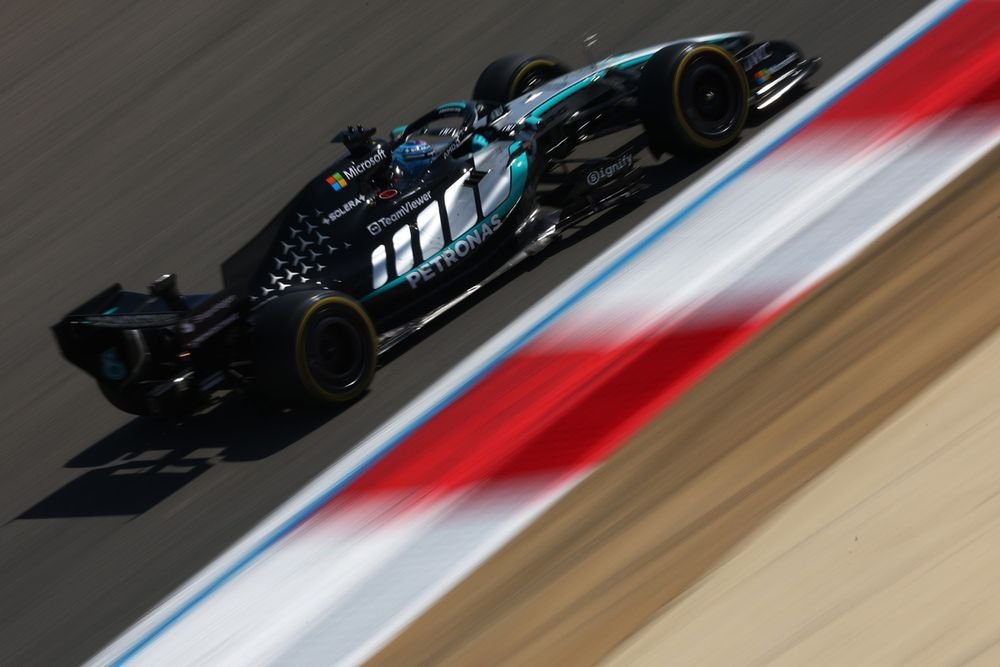
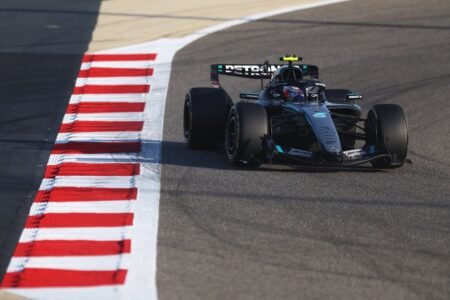
George Russell, Mercedes
Photo by: Mark Thompson / Getty Images
“There’s a process for necessary modifications,” Tombazis said. “In the appendix which defines the PU homologation, there’s also a process for adapting to regulatory amendments, so that is entirely possible.”
An important note is that such modifications do fall under the budget cap for power unit manufacturers.
It also raises the question of why the FIA has opted specifically for 1 August as the implementation date. Changes ahead of the Australian Grand Prix were not feasible, but why introduce it mid-season rather than waiting until 2027?
“We felt there wasn’t any discussion of anything illegal, and people have spent time designing their engines and solutions. We didn’t feel it was fair to do something for the start of the season, we felt that would have been wrong,” Tombazis explained.
“But we also feel it was something beyond what we felt was the intention of the rules. Therefore we felt it was correct to not let it go on too much. As I say, there’s a degree of subjectivity there. I can’t say that is the only solution that a human can think of, but we felt it was a balanced approach.”
Tombazis adds that adapting an engine to a possible rule change is not as drastic as some in the paddock suggest.
“The levels of difference of the compression ratio, if you work out the numbers, and if you take the diameter of the cylinder, the stroke, and see how much we’re talking about in terms of millimetres, it is an extremely small number. It is very easy to adjust an engine from one setting to a slightly different setting. We’re not talking about throwing everything away.”

Toto Wolff, Mercedes
Photo by: Sam Bloxham / LAT Images via Getty Images
Is this really a storm in a teacup?
The FIA emphasised that in its view the issue is less significant than some manufacturers might assume, and that the difference in horsepower is also smaller than suggested.
“I’ve been on the other side of the fence working on a team, and people get extremely passionate about performance. They’re extremely competitive. The stakes are high, so they get very, very excited,” Tombazis said.
“When people are so excited, they sometimes tend to lose a bit the perspective of the argument, and they tend to see things in a slightly one-sided way. I have that when I play backgammon with my wife. We forget love, and we sometimes argue about something. It’s extremely competitive.
“Formula 1 is that times 1,000. So people get a bit too excited, and I don’t think this topic ever needed to get to this level of attention. I’m not saying it’s not important, but does it merit all this excitement for many months? Frankly, no.”
However, in order to prevent the issue from dragging on throughout the season, Tombazis said the FIA did feel the need to take action: “But I do stress that I think this matter isn’t really something that is anywhere near as important as people make out.”
We want to hear from you!
Let us know what you would like to see from us in the future.
Take our survey
– The Autosport.com Team
Read the full article here