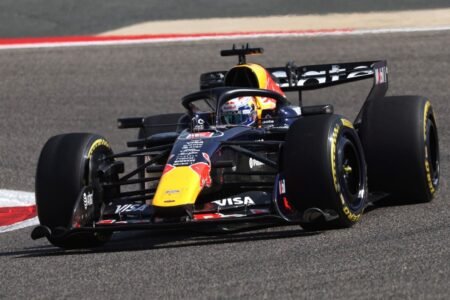




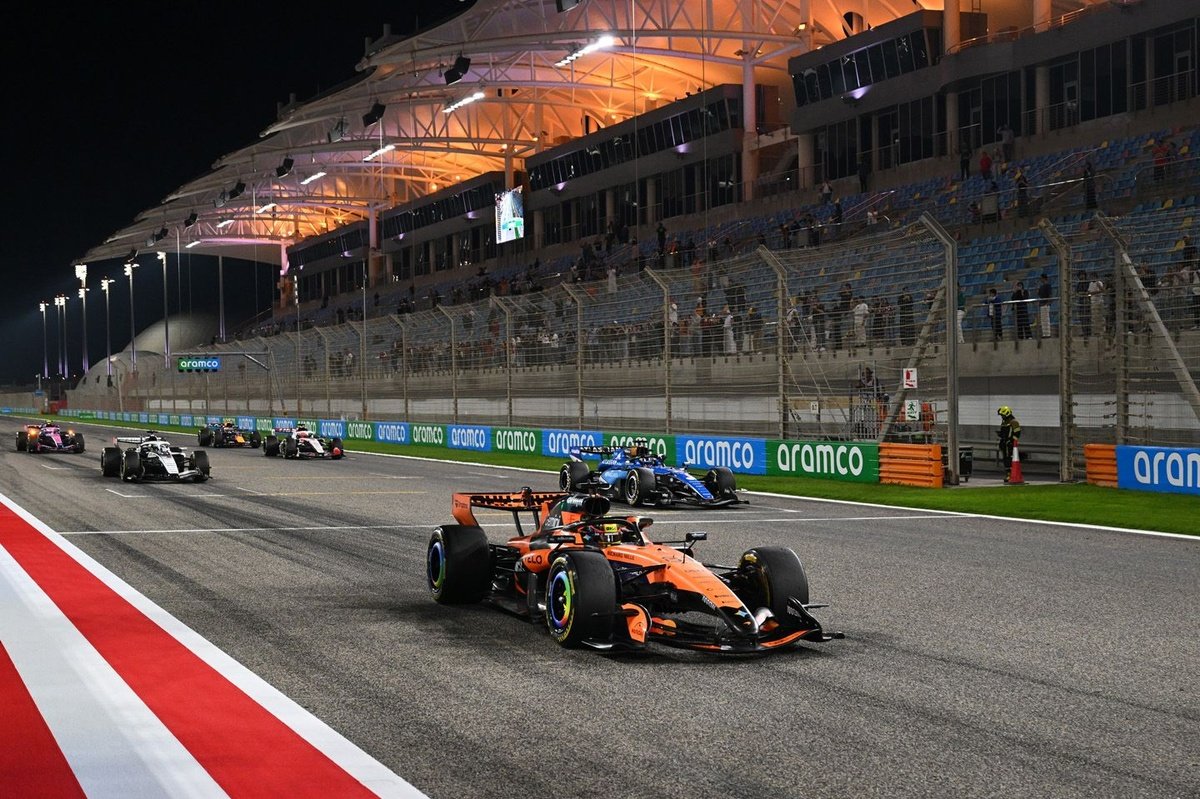
Amid safety concerns over Formula’s laborious start procedure with the 2026 cars, the FIA trialled a longer start procedure at the end of Wednesday’s running in Bahrain pre-season testing.
Drivers received an additional five seconds between the last car lining up on the grid and the start light sequence, which helped those at the back of the grid spool up their turbos by revving the engine, something which is now necessary under the new regulations due to the vastly changed hybrid component.
The trial, which is set to continue on Thursday and Friday, was the result of Wednesday morning’s F1 Commission in Bahrain, where concerns over the start sequence were on the agenda.
Wednesday night’s practice starts took place without any noteworthy hiccups, which has encouraged McLaren that the measure is going in the right direction.
“There were some concerns that were voiced previously, so this was a kind of a chance to put a number of cars together to go through what we expect the start procedure to actually be,” said Mark Temple, McLaren’s technical director for performance, after team boss Andrea Stella was among those expressing concern.
“Certainly, from what I saw, it all looked pretty normal and pretty sensible. I think that kind of helps allay some of those fears, that when everyone’s ready, everyone knows what they’re doing, and the procedures are followed, I don’t think it’s a big issue.
“I think it’s going to be perfectly reasonable. I’m sure there may be a little bit more fine-tuning, and there’ll be feedback from this one, from the drivers, from the teams, and that will be revisited.”
Why starts have become so tricky
Oscar Piastri, McLaren, Andrea Kimi Antonelli, Mercedes, Esteban Ocon, Haas F1 Team, Alexander Albon, Williams, Sergio Perez, Cadillac Racing
Photo by: Mark Sutton / Formula 1 via Getty Images
The renewed discussions around race starts are a direct result of the decision to remove the complicated MGU-H from the 2026 power units. Drivers were able to use the unit to spool up the turbo up to the right number of revolutions to optimise their getaway off the line.
With the MGU-H now gone, and drivers not allowed to use their more powerful MGU-K motor below 50km/h, they have had to resort to holding revs for a long time instead to minimise turbo lag.
“Turbocharged engines, in order to get the full torque delivered from them, you need to have the boost pressure, so that means you need to have the turbo spinning,” Temple explained. “Last year’s cars, you had the MGU-H, so you had the electrical motor that you could use to keep the turbo spinning, so that then, when you demanded torque from the combustion engine, you had that boost to deliver the torque.
“With this year’s cars, because you no longer have that electric motor, then you have to keep the turbo spinning, essentially by flowing gas through the turbo. What the cars are doing on the grid is basically charging their battery against the engine, and that’s helping to keep the turbo spinning, so that when you want to demand more torque, you have the turbo spinning up and you have the boost that you need.”
Why there is a political element to 2026 starts
Concerns over the start are not exactly new, as the need to hold revs for such an unusually long time had long been flagged in the build-up to this year’s regulation change. Over the course of 2025 Ferrari inquired with the FIA if that behaviour was intended and if it was happy to stick to the current procedures.
With the response being to keep everything as it was, Ferrari instead fine-tuned its turbo design to optimise its race starts, which – for example – can be done by reducing the size of the turbo so it spools up faster. So when rival teams finally sounded the alarm bells over the start procedure in pre-season testing, the Scuderia wasn’t particularly impressed with the prospect of drastic changes to a start procedure which it had deliberately prepared for, and perhaps made compromises that could dent performance in other areas.
It goes some way towards explaining why Ferrari-powered drivers didn’t feel there was any need to make big adjustments, and why they felt it was not correct to bring safety into the discussion, which is grounds for the FIA to make unilateral changes.
“It’s definitely not dangerous,” said works driver and seven-time world champion Lewis Hamilton. “I think we should probably take that connotation away from it, because it’s just a different procedure.

Lewis Hamilton, Ferrari
Photo by: Sam Bagnall / Sutton Images via Getty Images
“It’s just a longer procedure than it has been in the past. If right now you put the five lights up, we would all still be standing there when the lights went out for a little bit longer. But you can still pull away without the turbo going. It’s just that you probably will anti-stall a couple of times. So perhaps the anti-stall is something that maybe is a potential for some people. But I don’t think that it’s dangerous.”
Max Verstappen also shrugged off concerns, indicating Red Bull Ford Powertrains had made similar trade-offs in its turbo design. “You can raise those points now, but maybe they should have looked at it a bit earlier as a team,” the four-time world champion said.
“As for the start, that’s simply the choice you make with the turbo. We consciously made a certain decision there.”
The Dutchman then jested: “Those who have problems with it, well, they can also start from the pitlane. Then you’re out of everyone’s way and you can just join the race from there…”
If the FIA decides to stick to its slightly longer start procedure as a compromise, it would at least alleviate the biggest pain point, which is that drivers who start towards the back of the grid wouldn’t have had enough time between lining up on the grid and the lights going out.
Cadillac’s Valtteri Bottas, who will likely be in that position more often than not, said: “My only concern with that is like when you’re at the back of the grid, the light will already start going and you won’t have enough time to get the turbo spinning before the lights go off.
“That’s obviously only an issue for the drivers in the back. But apart from that, I think we’ll find solutions, and I don’t see any element of danger in just having to hold revs for longer.”
We want to hear from you!
Let us know what you would like to see from us in the future.
Take our survey
– The Autosport.com Team
Read the full article here