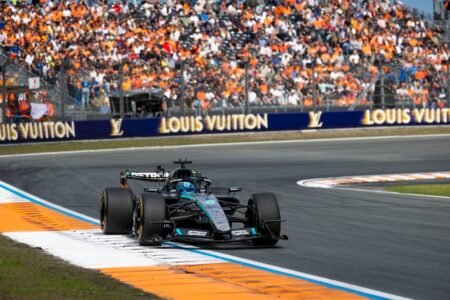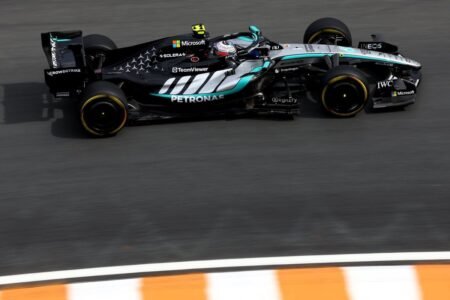




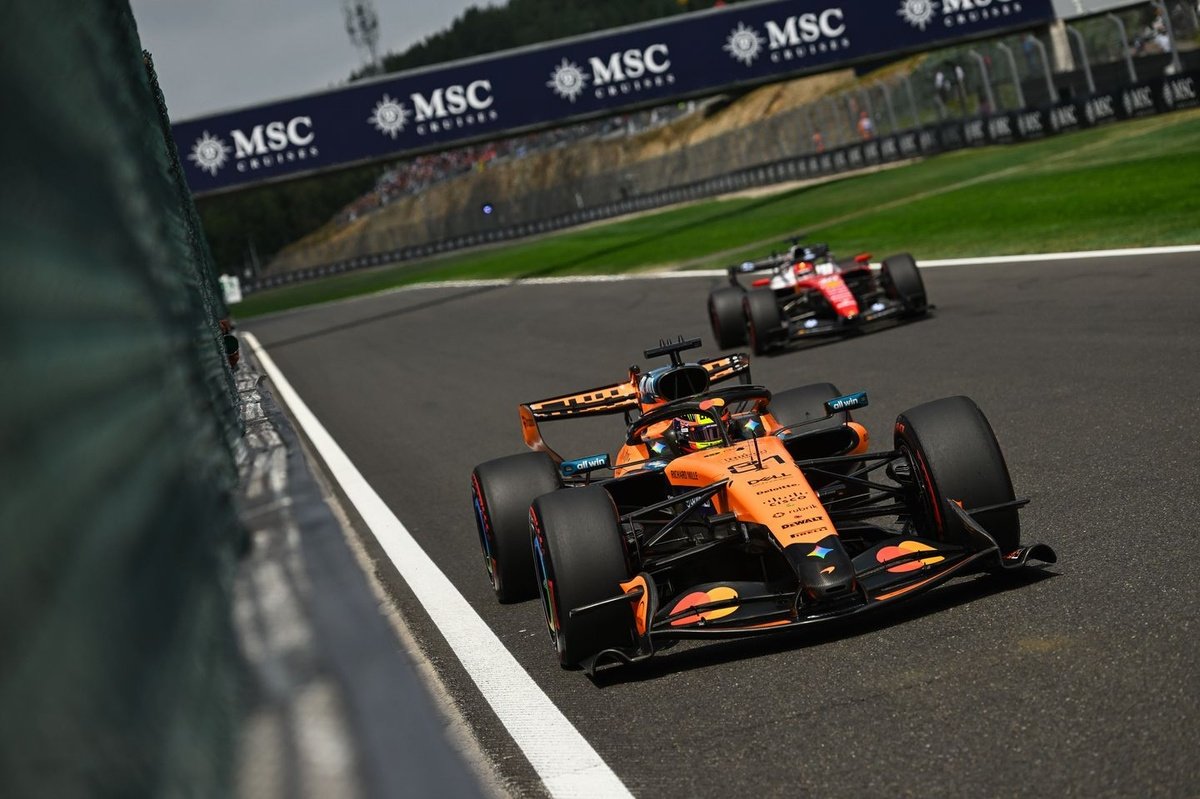
McLaren suspects Oscar Piastri’s deficit to team-mate Lando Norris has “nothing to do with his driving”, and everything with its Formula 1 power unit algorithms.
Piastri qualified two tenths behind Norris at Spa-Francorchamps, with virtually all of that deficit coming on the straight line between Stavelot and the Bus Stop Chicane, during the derating phase in which cars are running out of electric energy and are already starting to slow down.
The usual explanation is that Piastri wasn’t able to optimise how his Mercedes battery harvested energy through the previous sector, with the likes of Pouhon and Fagnes used as ‘charging stations’ under the current iteration of the regulations.
But according to his team boss, there wasn’t necessarily something Piastri himself could or should have done differently with his right foot.
“When you come to a circuit like this, which is inherently highly power-sensitive, then these sensitivities to driving input, to how much you deploy before a certain corner, were even more visible,” Stella explained.
“And across team-mates, if I compare Lando and Oscar in their best lap in Q3, Oscar is losing time in the final straight and Blanchimont for reasons that have nothing to do with Oscar’s driving. They are just a minor deviation in how the power unit was operated.”
Oscar Piastri, McLaren
Photo by: Marc Fleury
Stella suspects a similar thing is happening at the works team, which is at a loss to explain the straight-line difference between a baffled George Russell and high-flying team-mate Kimi Antonelli.
“I think this seems to be pretty much the same across the two Mercedes cars. When you overlay Antonelli and Russell, it looks like Lando and Oscar,” Stella said. “We do so much work in offline simulation. And now as a customer team, we are at race 10 and we are finally getting the tools to actually simulate before the event.
“I would say that most of the conversation this weekend has been about power unit and optimisation. But it’s not like it only [varies] works team to customer team. Because, like I said before, it looks like there are deviations even for the works team between one driver and the other.”
Stella added: “I think [Piastri] could have been one to two tenths faster, just if the power unit had behaved as we anticipated.”
If trying to grasp 2026’s mind-bogglingly complex energy deployment has been hurting your brain, then perhaps there is some comfort in the fact that it has been confounding even teams of highly-trained engineers with decades of experience at the highest level.
The main reason is that these electric engines are not behaving in a stable, predictable manner, because they are learning on the fly. They build an information bank based on data gathered not only on previous runs, but even optimise deployment and predict future energy needs from corner to corner.
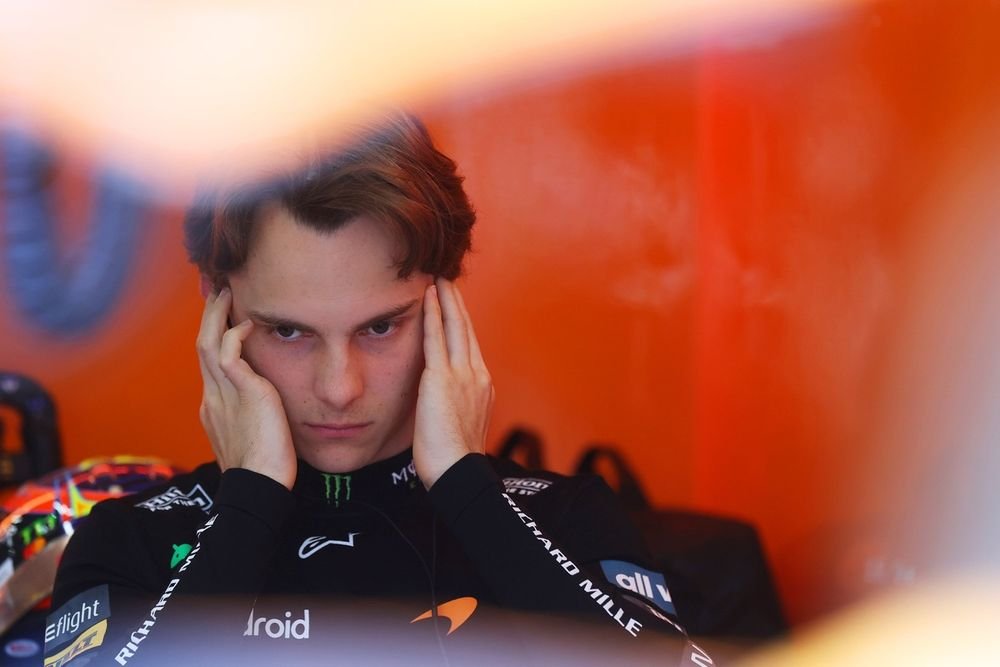
That’s why any minor deviation can be so disruptive. Piastri missed a lot of track time on Friday with a hydraulic leak, which would have likely set him and his power unit software on the back foot. On his first run in Q3 he went wide and kicked off gravel. That not only ruined his first lap, but may also have had an impact on how his power unit behaved on run two, punishing the Australian across different runs for one minor mistake.
Oscar Piastri, McLaren
Photo by: Steven Tee / LAT Images via Getty Images
“You don’t operate these power units in an open-loop way, whereby I would be able to have an offline simulation and say, oh, that’s how the electrical power will be deployed, and it will always be identical to itself,” Stella tried to explain.
“There’s a large component that happens with live calculations, and the power unit kind of forward thinks, forward calculates what it has to do based on some [parameters]. This is why it’s not so easy to understand what kind of calculations have been made as the car was going.”
It is especially difficult to understand for the drivers, which is one of the reasons why they have been so vocal about the 2026 rules. Rather than pushing flat out and making the difference with their commitment through Spa’s most challenging corners, most of their attention goes to optimising braking and harvesting techniques to top up the battery as efficiently as possible.
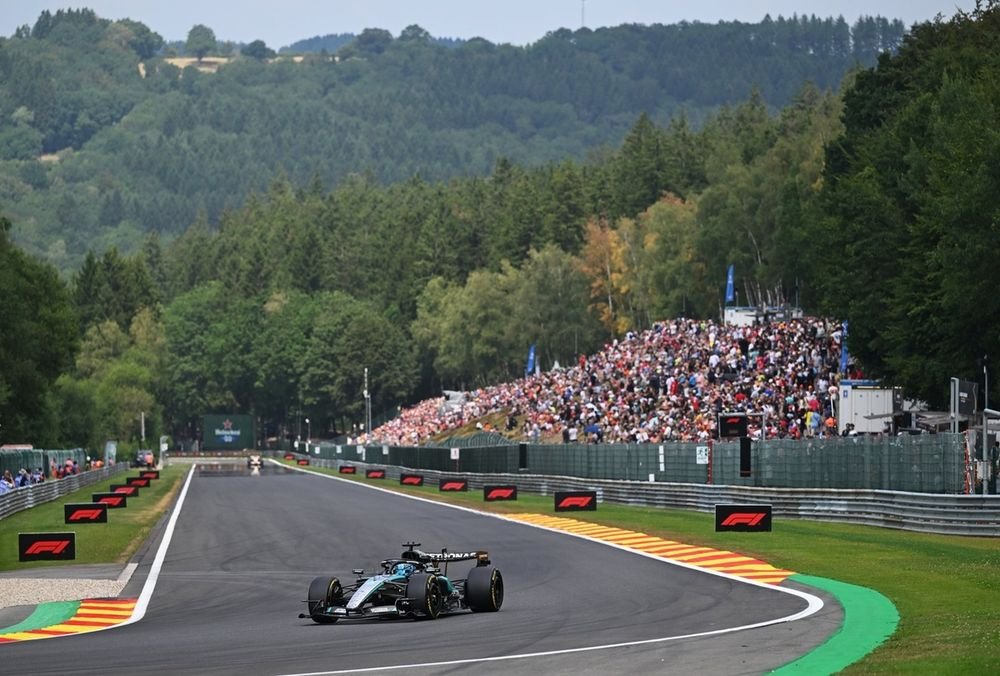
As Russell put it after qualifying: “My whole focus for the last 36 hours has been on straightline speed. It hasn’t been focusing on the set-up, the tyres or anything, because we’re all trying to solve what is going on.”
As Stella elaborated: “This is not only for the influence it has on the straights, but also because it affects the braking points, because if you have an additional amount of [energy] harvesting before braking, then you are approaching the braking zone 10km/h slower and your braking point changes.
“This is quite difficult to master for the drivers. It’s not only about getting the most out of the power unit, but also because the variations of the power unit affect your references as you approach a corner.
George Russell, Mercedes
Photo by: Sam Bagnall / Sutton Images via Getty Images
“[The power unit software] definitely learns, but the variations are so small that they may happen from one lap to the other, even if you have learned from the previous laps.”
Drivers are feeling like they are no longer just fighting their rivals, their car’s grip limits and the laws of physics, but fighting their own power unit’s machine learning algorithms.
High-speed Spa’s relative lack of braking zones as natural harvesting opportunities has brought out the most extreme version of the 2026 rules, and it has made some drivers look forward to next week’s race at the stop-start Hungaroring over one of the traditional driver favourite circuits.
We want to hear from you!
Let us know what you would like to see from us in the future.
Take our survey
– The Autosport.com Team
Read the full article here