



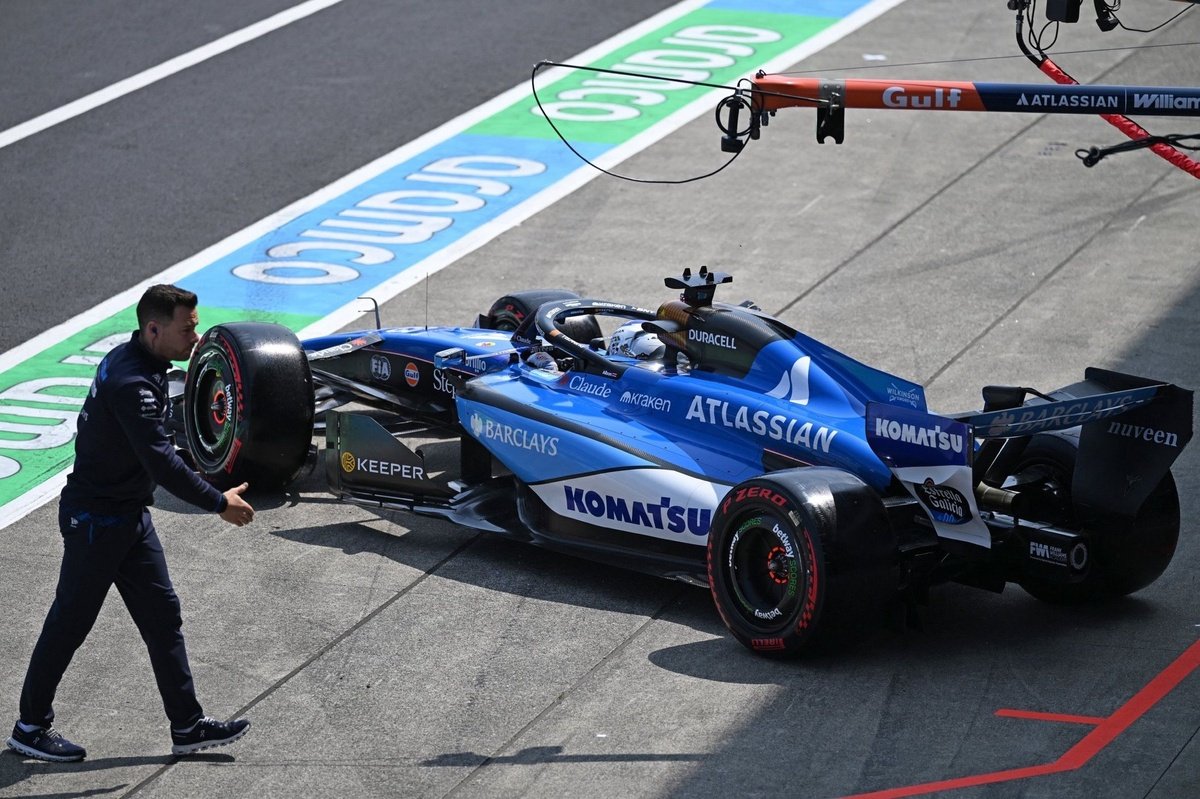
There’s a very curious aspect of Alex Albon’s Japanese Grand Prix that largely went unnoticed. It’s no secret that Williams is paying a high price for the extra weight of its Formula 1 car, estimated at over 20kg, which has delayed development in several areas. This is a condition that penalises the FW47, and one the team hopes to mitigate with a gradual weight-reduction programme.
While waiting for more substantial updates, it’s logical to keep working on the current package, searching for aerodynamic gains. In recent race weekends, Williams has already devoted part of its sessions to studying solutions to the issues impacting the car – such as situations where one tyre lifts off the ground, reducing available grip.
The lack of front-end grip is a long-standing issue for Williams, dating back to the previous technical cycle. Even before the Japanese Grand Prix, Albon had explained that the Grove-based team would carry out experimental tests at Suzuka as well, continuing what had been seen in recent weekends – especially in situations where fighting for points wasn’t possible.
“Yes, I think what we learned was enough to validate the experiment,” Albon previously explained. “[It] looked positive and then at the same time, we believe there was possibly something on the rear end of the car from China and when we changed the gearbox it seemed to solve it.”
These experiments continued at Suzuka in the final part of the race, when a points finish was out of reach. The team changed the front wing settings to understand how certain adjustments would affect the aerodynamic map and the car’s behaviour. For this reason, Williams called Albon into the pits at the end of lap 45, fitting a new set of soft tyres and altering the front wing angle.
After completing just one lap with this set-up, the Grove team called the Anglo-Thai driver back into the pits again, further adjusting the front wing angle by 4.5 clicks. The same process was repeated over the next three laps, progressively changing the wing angle – sometimes by more than four clicks. During the final pitstop, the fifth in five laps, the tyres were also changed again, switching back to a set of medium compounds.
Alexander Albon, Williams
Photo by: Alastair Staley / LAT Images via Getty Images
These are quite significant values, illustrating that the goal was also to push toward more extreme and varied set-ups to gather as much data as possible, building a broad aerodynamic map to analyse at the factory and compare with simulations.
The car is equipped with sensors that measure pressure across aerodynamic surfaces, allowing engineers to derive downforce values and understand the car’s behaviour, since wing adjustments have a cascading impact on airflow toward the rear of the car.
The data will be valuable ahead of the forced one-month break following the cancellation of races in Bahrain and Saudi Arabia. During this time, teams will be able to analyse what has been gathered in the first three races while waiting for updates scheduled for Miami.
Williams knows it needs to make up ground in this time, and every useful piece of information on the correlation between track and simulator can make a difference in defining development and set-up from the US round onward.
We want to hear from you!
Let us know what you would like to see from us in the future.
Take our survey
– The Autosport.com Team
Read the full article here