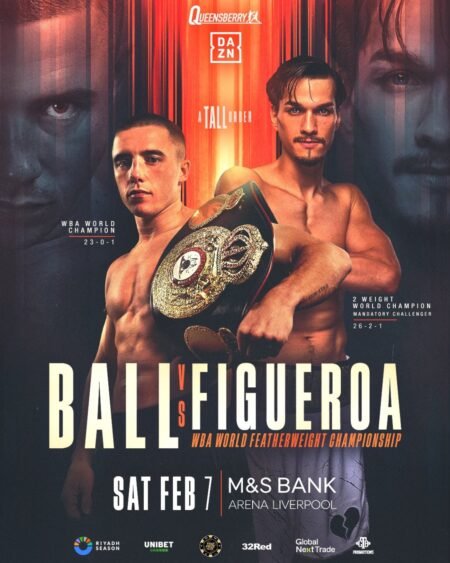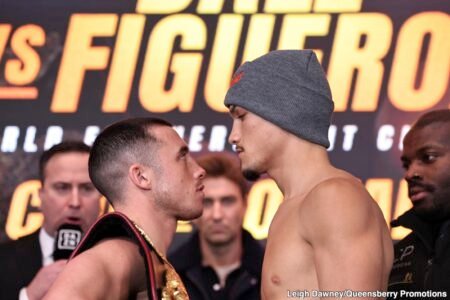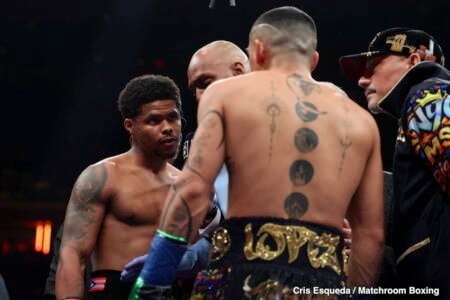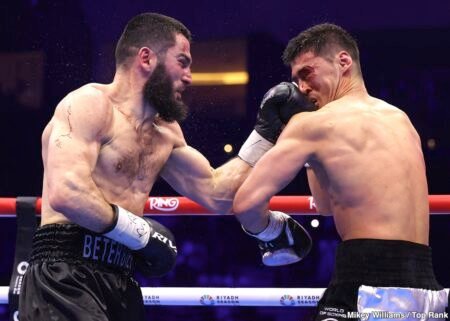




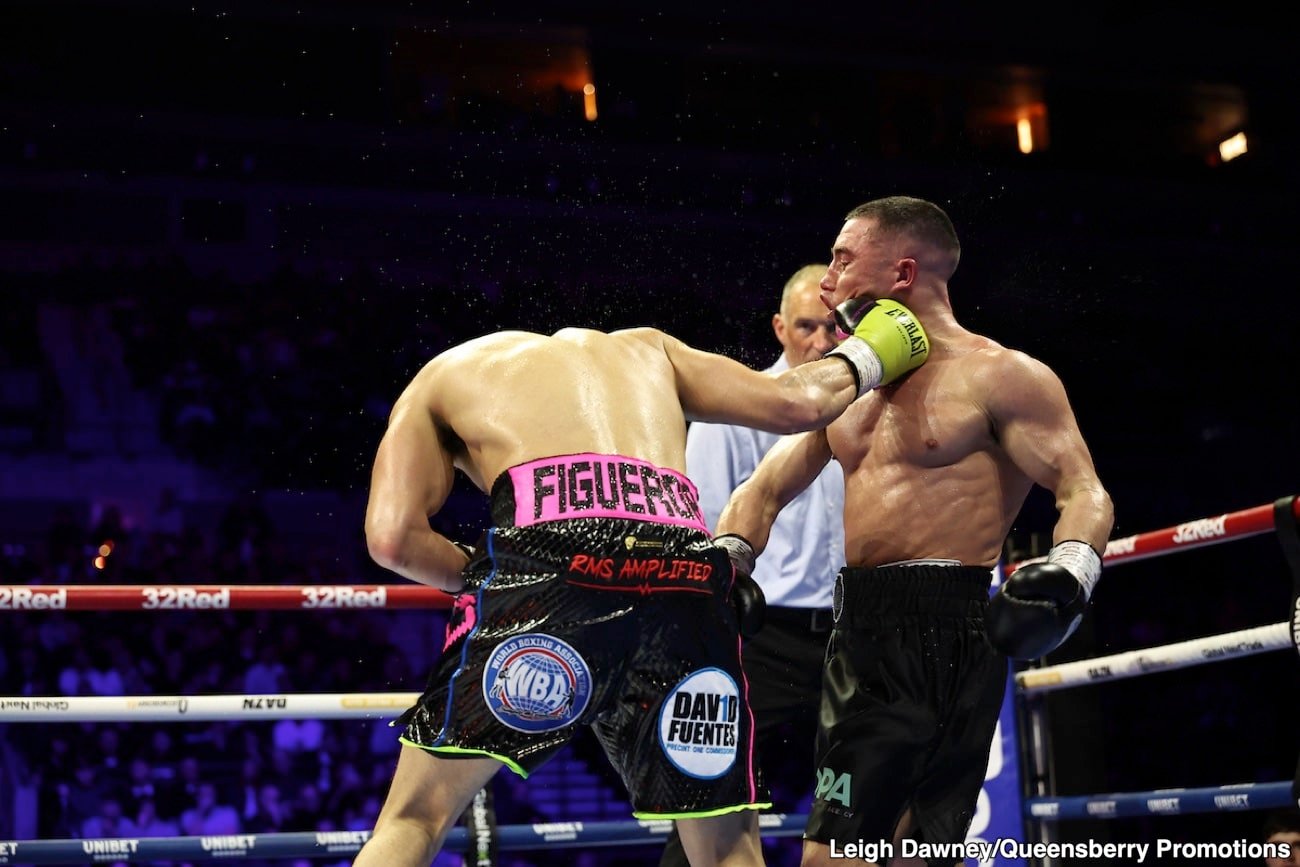

What became clear early was how firmly Brandon Figueroa controlled the inside. Despite standing 5’9″, Figueroa was the more effective fighter at close quarters against the 5’2″ Ball, leaning on him, punching in volume, and forcing exchanges that Ball could not slow or reset. The height difference did not give Ball space to work. It allowed Figueroa to crowd him and impose pressure in areas where Ball usually thrives.
Accumulated Punishment
The pattern continued to take a toll as the rounds passed. Figueroa’s high output style became a steady drain, similar to the approach he used against Joet Gonzalez, when he threw more than 1,000 punches. He did not need that level of volume here. He threw and landed enough to steadily wear Ball down across the rounds, leaving the finish to feel like the endpoint of a process rather than a sudden accident.
The severity of the punishment became unavoidable in the closing sequence. On the first knockdown, Ball went face down on the canvas and remained there for several moments, still enough to raise immediate concern. When the action resumed, there was no recovery or regain of control
Figueroa stepped in and unloaded on a badly hurt Ball, who offered no counters and little defense, before sending him down again, partially through the ropes. What stood out was not the violence of the sequence, but the absence of resistance. The instincts that had always carried Ball through exchanges were no longer visible.
The punch stats support why that concern exists. Ball landed 249 of 567 punches, a 43.9 percent connect rate that shows he remained accurate and engaged. Figueroa landed 214 of 757 punches, just 28.3 percent accuracy, but the volume never let up. He was willing to absorb shots to keep throwing, trusting pressure and repetition to erode Ball over time. Over twelve rounds, that approach took its toll.
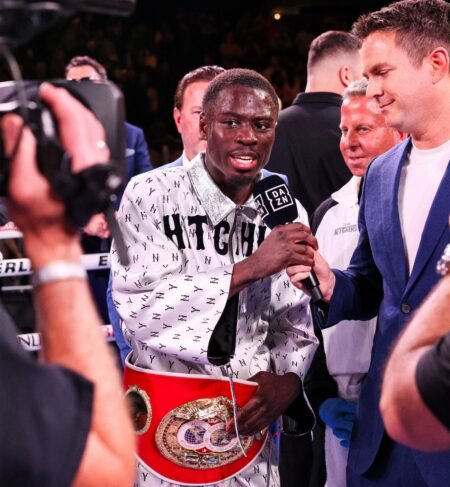
Ball lost his WBA featherweight title in the 12th round at the M&S Bank Arena, and afterward, Figueroa’s trainer Manny Robles criticized the officiating, saying the referee “counted to 100” and calling it a horrible job. The frustration sounded less like a tactical complaint and more like disbelief at how much punishment had been allowed to accumulate before the fight was halted.
That reaction highlights the larger issue. Fighters can recover from knockouts. What is harder to recover from is the kind of sustained, close range punishment that strips away reaction, resistance, and agency before the end arrives. Ball’s success has always been built on pressure, durability, and relentlessness.
After a night like this, the question is not whether he can win another fight, but whether those traits can still function the same way, or whether the cost of absorbing that much damage has permanently altered the fighter he can be.
Read the full article here