



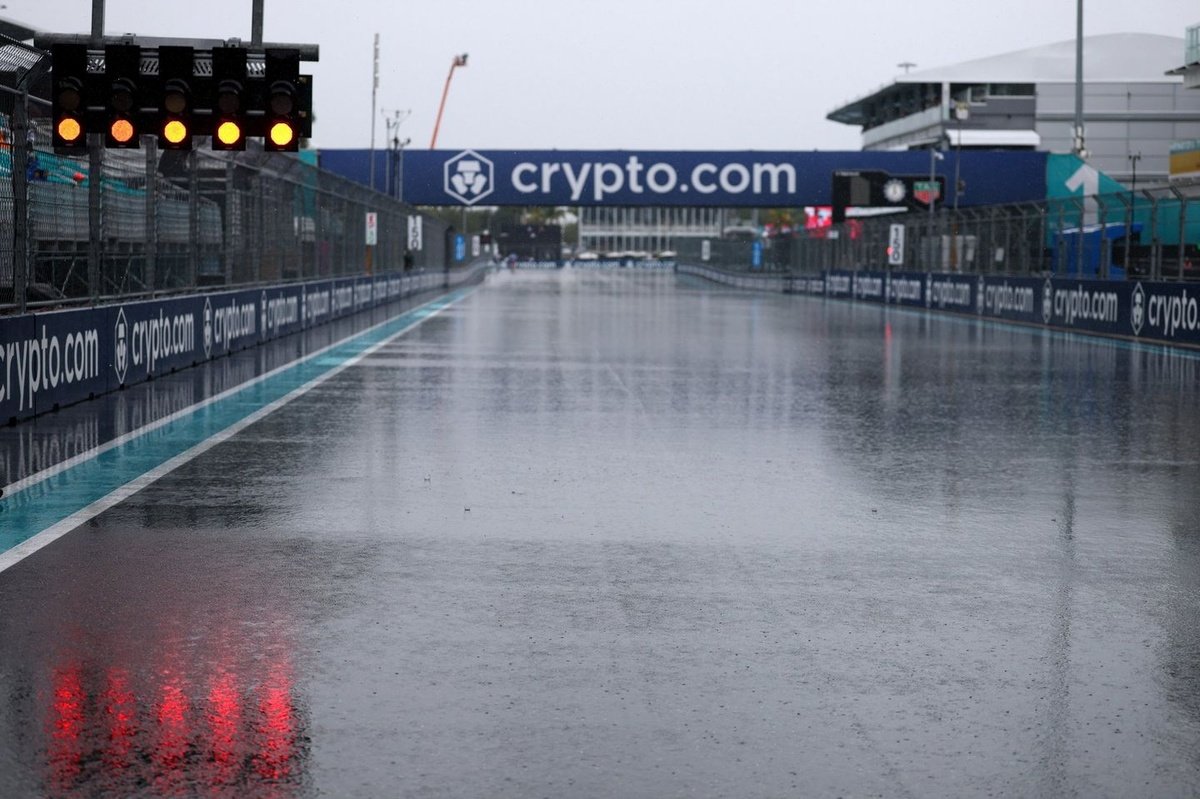
It has long been fashionable for the Cassandras of the F1 paddock to cry woe, woe and thrice woe from the Thursday of a race weekend onwards, based on the weather forecast for Sunday.
In Miami, this has been lent an additional significance – and not just because the start of Sunday’s race has been moved from 4pm to 1pm local time in response to forecast thunderstorms.
F1 is currently in a sub-optimal state of preparedness for wet events, given the change in tyre sizes this season and the scarcity of running in like-for-like conditions during the races and testing so far. Even the rise in blanket temperatures for the intermediate tyres – from 60C to 70C – agreed in the package of pre-Miami rule tweaks is experimental.
It was during the pre-season ‘shakedown week’ in Barcelona in January that teams and drivers first observed some of the quirks of the new intermediate-compound tyre. Day two of that phase was wet and only Red Bull and Ferrari took to the track with a single car each.
The takeaway from this was that the new inter seemed slower to come up to temperature and ‘switch on’ than before. While Pirelli’s offering has carried over the philosophy of a ‘family’ of tyre compounds, these have had to evolve in terms of construction and material to suit a change in size: wheel diameter remains the same but the front tyres have narrowed by 25 mm (to 280mm), the rears by 30mm, and both are a slightly lower profile (by 15mm overall at the front and 10mm at the rear).
Presenting less tread to the track surface, along with the slightly smaller internal volume, means a different balance of energy going through the structure and tread, some of which is naturally lost as heat as the rubber deforms under load. The feeling within the F1 paddock is that while Pirelli has successfully carried over the characteristics of the previous family of slick tyres to the new generation of narrower ones, the intermediates are perhaps a little too robust.
On top of that, the full wets remain a work-in-progress: historically they are very effective at displacing large amounts of water, but overheat rapidly, so by the time track conditions deteriorate to the point they become a viable option, a red flag is imminent anyway. Pirelli has been trying to make these tyres more ‘raceable’ but opportunities to test are scarce, and often the cause of political friction since teams tend to look askance on rivals securing track time with current cars.
So, what F1’s tyre supplier has been attempting to do since January is accelerate its learning about the behaviour of the intermediates, most recently running a Ferrari at an artificially wetted Fiorano over two days in April. There was also a post-race test in Japan where Pirelli had hoped to gather more data on its dry compounds, since most of the running so far has been on the C3, but that plan was disrupted by rain, which at least allowed some wet and intermediate running.
Teams faced damp conditions in the Barcelona shakedown
Photo by: Formula 1
But even this, while better than nothing, doesn’t yield a broad spread of relevant like-for-like data. For this, it needs more cars running on track in representative conditions. If rain were to strike during practice for a grand prix weekend it would be ideal; failing that, a race would also be useful, although the competitors might not see it that way.
“We started in Barcelona [in the January shakedown] with Ferrari and Red Bull testing on day two,” said Pirelli chief engineer Simone Berra in Miami.
“It was quite cold and there was a lot of standing water, and we collected the first feedback from them. It was a very early phase and the teams, let’s say, were starting to comment about warm-up being a little bit tricky in these conditions, but obviously just two teams, very cold conditions, let’s wait for another significant test.
“In Japan, we were unlucky in the sense that it rained both the days and we didn’t have the possibility to test the dry tyres, but we had the possibility to test intermediate and wets. And also, in Japan with less standing water, slightly higher temperature, driver feedback was still about sort of difficult warm-up, especially on the front axle, where it’s complicated to keep the temperature in the working range.
“So, you start at 60 degrees [blanket temperature] and the risk is if you don’t put enough energy on the tyres, to keep losing temperature, it becomes tricky then to generate energy and to increase temperature – so it’s a snowball effect. We start thinking a little bit more on how to support drivers in this sense, so we decided in agreement with the teams and the FIA to test in Fiorano with 70 degrees blanket temperatures.
“There was a proposal of 80 degrees but we wanted to make a first step, evaluate the first step and then to try to see where we were and then to move on.
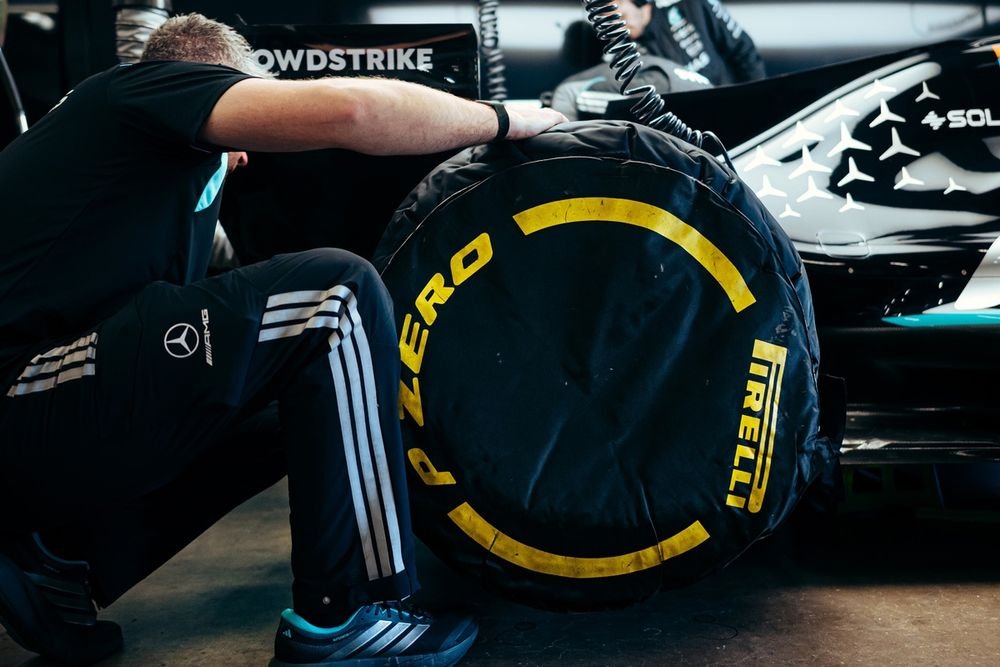
Tyre blanket temperatures have been tweaked
Photo by: Pirelli
“In Fiorano [where the track was artificially wetted], the test went good but the conditions were slightly different because it was a bit hotter, quite significantly hotter. So after the test, having received the feedback that the warm-up was better and we were going in the right direction, it was decided to increase the blanket temperature from 60 to 70 degrees and to wait until the first wet event to evaluate if this step has a significant effect, there are no more warm-up issues and we end up in a generally better situation.
“That’s now the next step for us because we want also to evaluate the intermediates with the blankets at 70 degrees with more teams. A test is a controlled situation but we would like to see in a race weekend, during a race, when you have 11 teams driving, then you have more feedback and you have a clear overall picture of where we are.”
Purely from a data-gathering view, then, a wet race in Miami would be a useful data-gathering exercise. While the tyres are homologated for the season, developing a better understanding of their performance characteristics in different conditions will inform better choices on how to run them – whether that’s through setup and pressures, or blanket temperatures.
The principle of raising the blanket temperatures is to give the tyres a head start. When a tyre is rolling, energy goes through it as it compresses at the contact patch and then rebounds. In the interim state, some of this is lost as heat.
F1 tyres are engineered to give peak performance within a certain working range of temperatures, that of the intermediates (80-100C) being slightly lower than slicks (90-110C), given the tyre of conditions in which they’re intended for use. The normal procedure is for race tyres to be pre-heated in blankets to 60C and then for hysteresis (the compression/rebound process while rolling) to do the rest.
The experience so far is that the intermediate compound isn’t deforming enough under load to generate the necessary warm-up, so raising the blankets to 70C is a logical lever to pull. But its effectiveness has to be evaluated over a broad range of operating conditions before any more changes are made.
“Let’s consider that it rains on Sunday, it’s anyway a different situation compared to all the previous tests and considerations because the temperature is higher than what we had [at previous tests],” said Berra.
“So, let’s say it’s not really a final test – let’s see how it goes this weekend, see how it goes if it rains, for example. In Montreal it could be cold, could be wet, and the energy [abrasion] of the circuit is not that high.
“So, we can collect some more information and then we can decide together with the teams where to move on because obviously our intention is to support them if there is anything we can do in this sense.”
We want to hear from you!
Let us know what you would like to see from us in the future.
Take our survey
– The Autosport.com Team
Read the full article here