



Another season, another name, another kid from Dallas. At street level, the city appears to be like any other – yet it continues to produce league-shaping NBA players. The main highway through Dallas cleaves down the middle of Texas. Taking it south brings you closer to the center of the state’s basketball talent pool. The road slopes downward as the city’s cosmopolitan polish thins out, neighborhoods split cleanly from downtown by sun-baked concrete and beige. Pink, green, and blue houses sit behind chain link fences, where yards are scoured down to dirt. Auto mechanic shops line the frontage roads with open bays and hand-painted signs peeling in the sun. Farther south, the road dips again, and space opens up to the heart of the story.
Welcome to Duncanville.
By then, you’re already deep inside a suburb that’s transformed its high school system into an NBA pipeline. Duncanville isn’t an outlier. It’s the clearest expression of how serious North Texas has become about harvesting basketball lightning. Dallas is the incubator. Duncanville is the headquarters.
Two of the nation’s most important high school basketball buildings sit here. First, Duncanville High School holds more basketball memory than some professional arenas. State titles in 2019, 2021, and 2025, led by NBA rising stars Anthony Black and Ron Holland II, hang as proof. Few public high school programs in the country have consistently produced more NBA players than Duncanville, which has provided the league with six pros in the last five years.
But not all hoops history is clean. The University Interscholastic League (UIL), Texas’s governing body for public-school athletics, stripped Duncanville’s 2022 Class 6A championship after eligibility violations tied to improper enrollment and academic ineligibility, including issues related to Black’s grades. Had that title remained, Duncanville would have been credited with three consecutive state championships (2019, 2021, and 2022); the 2020 season was canceled due to the Covid-19 pandemic. Such a distinction, unmatched by any other Texas Class 6A boys’ program in the modern era, would have formally inscribed the school as a rare three-peat champion in UIL records.
That season, Duncanville became the first Texas school to be crowned MaxPreps National Champion since 2010. During the early 2020s, Duncanville and nearby Richardson High School were not only the two highest-ranked schools in Texas but also, at one point, ranked first and second in the entire nation. Those two teams featured three future NBA lottery picks and produced five NBA players between them.
Since 2020, Dallas-Fort Worth has produced multiple NBA lottery picks: Black (sixth overall in 2023); Cason Wallace (10th overall in 2023); Holland (fifth overall in 2024); and Tre Johnson (sixth overall in 2025).
Related: Life after LeBron James: who will inherit the NBA’s future?
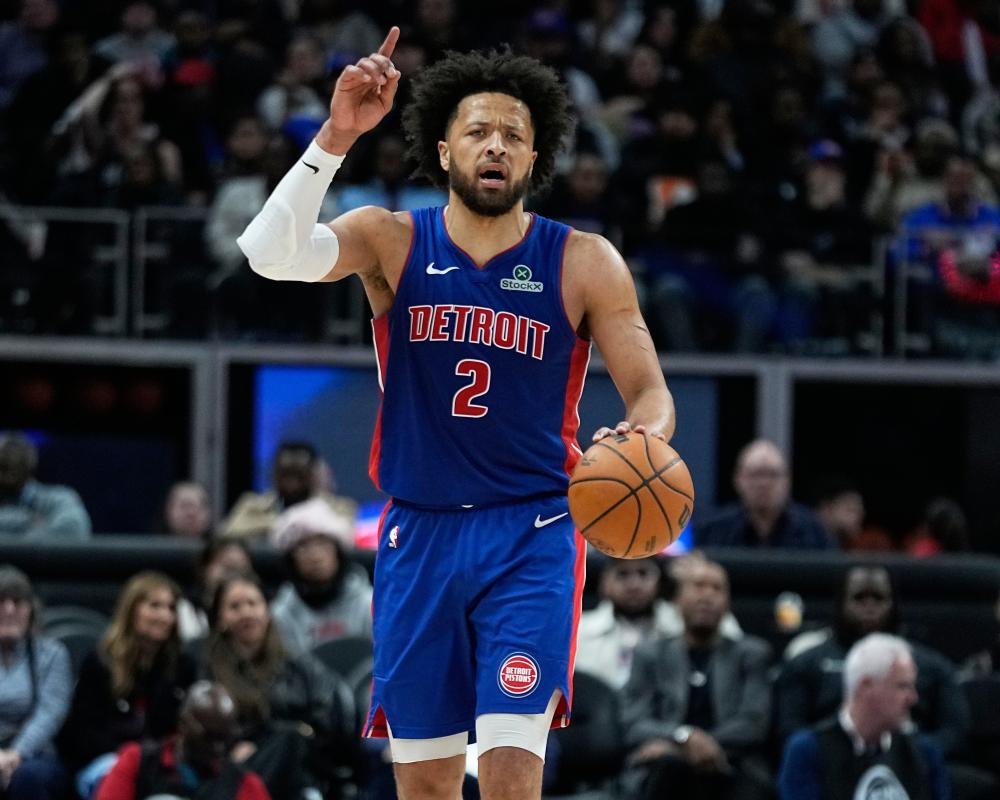
North Texas has also cultivated rising stars drafted outside the 14 lottery spots, including Liam McNeeley, Keyonte George, Ja’Kobe Walter and Marcus Sasser. Then there are the two superstars: the Philadelphia 76ers’ Tyrese Maxey, who starred at South Garland High School, and 2021 No 1 pick Cade Cunningham – both All-Star starters this year. Born and raised in nearby Arlington, Cunningham played his first two years of high school ball at Bowie High School before transferring and eventually being drafted first overall by the Detroit Pistons. He was the first No 1 overall pick from the Dallas-Fort Worth area in more than 20 years, since Kenyon Martin in 2000.
Digging further past the high school, the highway delivers you to the second basketball mecca: Duncanville Fieldhouse. For decades the building, a state-of-the-art sports facility and events venue with six full-sized hardwood basketball courts, has functioned as both proving ground and sanctuary – a cathedral of sweat. College coaches, NBA scouts and generations of future pros have cycled through its courts, long before anyone knew their names – Trae Young, De’Aaron Fox, Desmond Bane – stacking eras atop one another in a living archive of Dallas basketball.
Come back next weekend, and you could be watching a future NBA All-Star in the making.
These tournaments turn Duncanville Fieldhouse into a reunion. Former teammates spot each other across courts, dap up and argue about who cooked whom a decade ago, adding another stratum to the region’s mythology, sons repping the same jerseys their fathers and grandfathers once did. Dallas basketball history unfurls in real time as the smack-talk swells. The lineage doesn’t stop at one gym.
Less than 15 minutes from Duncanville sits Faith Family Academy, wedged between South Dallas’ Laurel Land Cemetery and the ghetto-fabulous mall, Big T Bazaar. Faith Family is caught between death and hustle, daring kids to dream bigger. In Dallas basketball, a few miles is no distance at all – just another exit, another set of jerseys, the same stakes.
Like Duncanville, Faith Family has long been among the country’s most accomplished and relentlessly dominant boys’ basketball programs. A distinction that tends to sound hyperbolic until one begins listing years. Between 2019 and 2024, the school assembled four UIL state championships – an ascent that spanned classifications as Faith Family moved upward, defying the gravity of Texas high school sports. That run was echoed and then surpassed by another three-peat in Class 4A from 2022 through 2024, placing the program among the select handful of Texas schools to have won three straight state titles.
Last season, its first beyond the confines of the UIL, Faith Family, an Oak Cliff–based charter school, entered the Elite Interscholastic Basketball Conference – among the nation’s most unforgiving prep leagues – and promptly claimed the league championship. In the 2026 state rankings, Faith Family alone places two players inside the Texas top seven: twins Gavin and Gallagher Placide, an interior pairing signed to play together at Wake Forest. Nor are they an anomaly. Across the Trinity River, Dynamic Prep accounts for three top-12 Texans; farther north, Frisco Heritage adds two top-nine prospects, including the son of former NBA All-Star Josh Howard – evidence that the gravitational center of Texas, and the nation, basketball has shifted decisively toward Dallas.
Both Duncanville and Faith Family are projected to yield picks in the 2026 NBA Draft. Faith Family alumnus JT Toppin, who carried Texas Tech to the Elite Eight last season, is now a sophomore and appears pro-bound. Duncanville’s KJ Lewis, a former teammate of Black and Holland, now plays at Georgetown. Toppin follows a path already worn by rising Boston Celtics forward Jordan Walsh, another Faith Family alumnus.
What Dallas has consistently molded is modern NBA wings: long, pliable athletes who blur positional lines. These 6ft 6in to 6ft 9in initiators defend multiple positions, handle the ball, create off the dribble, and orchestrate offense in real-time. Players like Cunningham and Black are the architects of the new game, excelling as two-way threats in a league that prizes size and versatility above all else.
This season, the Dallas pipeline has reached the league’s highest tier. Cunningham and Maxey sit among the NBA’s MVP candidates, while George continues to ascend into a star role. Dallas is shaping the league’s center of gravity. Even last season’s NBA Finals featured two area players facing off: Wallace for Oklahoma City and Myles Turner for Indiana.
Why Dallas? The city is different because its basketball ecosystem is unusually integrated, not fragmented. In most major cities, elite talent splinters between private schools, sneaker circuits and suburban flight, while public schools are drained of continuity. North Texas does the opposite. Public schools like Duncanville, charters like Faith Family, AAU programs and prep powerhouses all orbit the same geography, often the same neighborhoods, feeding one another instead of competing. Talent stays local longer, playing against peers of equal caliber night after night. It’s created rich density. For thousands of kids here, basketball is one of the few systems that still rewards imagination with something resembling upward mobility, proving American alchemy still has the ability to turn a leather ball into a key.
Former players have come to Dallas to invest in its basketball future, most notably Jermaine O’Neal, who founded Dynamic Prep. The program has started this season strong, earning the No 1 spot in the SC Next Top 25 team rankings as of early December. Dynamic Prep is led by the top-ranked national prospect in the 2027 class: Marcus Spears Jr, son of the Dallas Cowboys legend. Two of the school’s former stars, including O’Neal’s son, are now freshmen at Southern Methodist University. Another notable area connection is Dawson Battie, the nephew of NBA legend Tony Battie, who plays for Dallas’ St Mark’s and is ranked as the 11th-best player in the 2027 class.
Perhaps most integral is the deep-rooted AAU culture in South Dallas. At its center is Urban DFW Elite, led by Jade Colbert, the first and only Black woman to serve as an AAU CEO in the country. Urban DFW Elite has become its own pipeline, producing NBA talent including Marcus Sasser, Darrell Arthur and Dink Pate.
This season, 19 of the league’s 30 teams roster at least one North Texas player, from MVP candidates in Cunningham and Maxey to rising stars like Black and George. While those numbers may not seem remarkable for a large metropolitan area, Dallas has often been ignored as a basketball city when compared with places such as Atlanta, New York and Atlanta. Dallas players extend across the league like highways, connecting the NBA back to the heat of a North Texas summer.
Those roads all trace back to the same kind of Dallas neighborhood: unremarkable stretches of urban sprawl where some of the most consequential basketball institutions in Texas – and arguably the country – call home. No coastline, just churches and cemeteries. And hallowed basketball gyms, where one generation after another learns the work. In all that ordinariness, the extraordinary emerged. Of all the different roads that lead to the NBA, Dallas has become the most heavily traveled highway in the state.
Read the full article here