


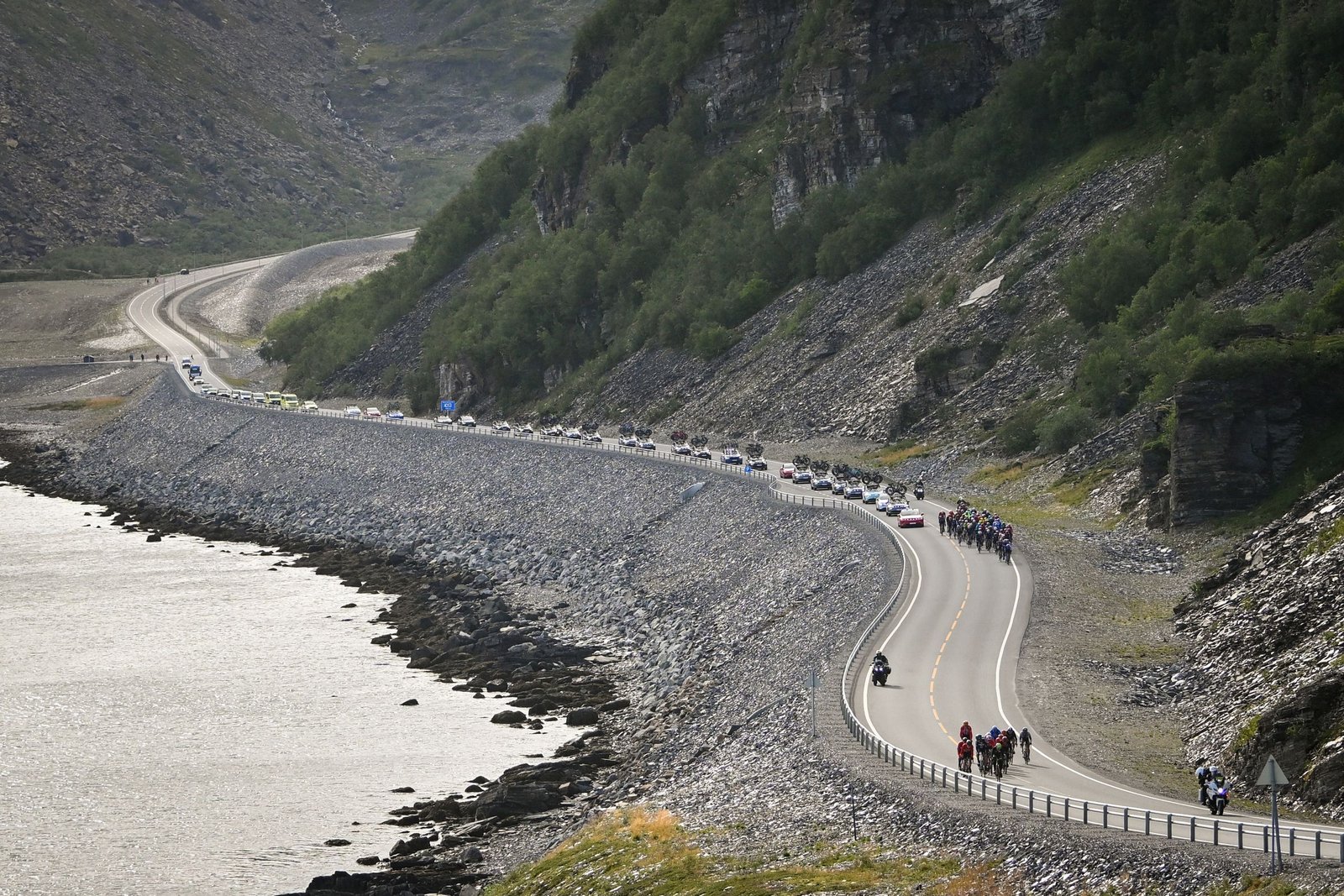
After a scorching Tour de France, a few damp days of 14 or 15°C at the Arctic Race of Norway (ARN), from 13 to 16 August, may come as a relief to the pro peloton. But not even Norway can guarantee a post-Tour ice bath any more; temperatures at the 2024 race won by Magnus Cort, averaged 25°C, the hottest on record for Arctic Norway. The 2025 edition, when Tom Pidcock finished second to Corbin Strong, took place after the country’s most severe heatwave on record, in what turned out to be its warmest recorded year, taking the country as a whole.
This July, Rjukan, in Telemark county – considered one of the best ice climbing areas in Northern Europe – and Drammen, southwest of the capital Oslo, peaked at 33°C. A few days later, fire tore through Drammen, destroying a hundred homes. Meanwhile, in the far north, the Svalbard archipelago, Norway’s northernmost territory midway between its northern coast and the North Pole, is heating faster than anywhere else on the planet.
This week 18 teams, along with organisational staff and media, arrive at the Arctic Race for four days of racing at what is being heralded as a groundbreaking race. In 2021 the organisers achieved certification from Norway’s Eco-Lighthouse organisation, which helps businesses improve their environmental impact and reduce waste, and it is one of the 80 founding signatories of the UCI Climate Action Charter in 2022.
Latest Videos FromCycling Weekly
Central to both schemes is transport, and here, ARN has indeed been groundbreaking. In 2023 the ARN became “the first cycling race to transition to a fully electric fleet,” as cycling’s world governing body, the UCI, recalls in a recent website report, “The Green Breakaway: Arctic Race of Norway, electrifying the far north.”
However, viewed with a modicum of skepticism, ARN’s 130-car Electric Vehicle (EV) fleet reflects Norway’s unique market conditions. Norway incentivised EV adoption in the 1990s and became the world leader in about 2013. By the end of 2025, 96 per cent of new cars purchased in Norway were fully electric, compared with just 23.4 per cent in the UK and 20% in France.
Plus, current race transport sponsor Hyundai sells nothing but fully electric cars there. A glance at the race’s environmental audit shows that, as well as the 130 EVs, the 2025 Arctic Race still needed the services of 92 diesel vans and heavy vehicles, 690 national and international flights, and 18 speedboat trips. All of which highlight the difficulties the UCI is having in making any progress in enforcing the rule that all teams become carbon neutral by 2030.
The portrayal of the Arctic Race of Norway as pioneers in green event management has to contend with a glaring paradox. As Marius Heide, Norwegian Green Party councillor for the north Norwegian town of Harstad – the home of the race’s co-organiser Arctic Sport – wrote in an article for local newspaper iHarstad after last year’s edition: “The electric cars in the Arctic Race may save 10 or 15 tonnes of greenhouse gas emissions, but they’re promoting Equinor, which exports oil and gas that cause 280 million tonnes of greenhouse gas emissions in other countries every year.”
Equinor, known as Statoil until 2018, is the Norwegian state-owned oil and gas giant. As Statoil, it sponsored the first five ARNs. When Equinor’s current sponsorship deal with ARN expires in 2030, it will have completed 18 years of continuous partnership.
Joined at the hip
(Image credit: Getty Images)
Equinor and the Arctic Race of Norway are inseparable, joined, if not at the hip, then in the town of Harstad, population 21,000. Harstad is the hometown of the event organiser Arctic Sport, which held a race around the island of Andørja, just east of Harstad, in the year 2000, grew in ambition, and took plans for the Arctic Race to Paris in April 2011, where ASO (Amaury Sports Organisation), the owners of the Tour de France, gave them a warm reception. Harstad is also where, in 1976, Statoil opened its first office outside its headquarters in Stavanger. As Equinor, it now operates four oilfields in the Norwegian and Barents Seas from the town.
Yet the UCI website report extolling ARN’s green credentials doesn’t mention Equinor. The website of the 2026 Arctic Race of Norway describes its main sponsor without using the word “oil,” preferring to call it “an international energy company committed to value creation in a low-carbon future,” alongside a photograph of an offshore windfarm.
Ninety-nine per cent of the energy Equinor produces comes from fossil fuels. The sports-washing reveals a great deal about the current predicament of professional cycling and its contradictory stance towards its role in the global climate crisis. The fossil fuel sector remains one of the most lucrative in the global economy and Middle Eastern money has flooded into the sport over the last ten years.
Equinor, which sponsors ARN overall, as well as the general classification and best young rider competition, recently announced record profits of $11.5bn (£8.6bn) for the three months to the end of June, compared with $6.54 billion for the same period in 2025. In a retreat that mirrors moves by BP and Shell, Equinor recently announced plans to actually cut its renewable energy activities while increasing oil and gas production.
Exactly how it does the latter is of immediate interest to the north Norway communities that welcome the Arctic Race every year. Harstad stands 250 km north of the Arctic Circle and 1020 km from Oslo, at the north-eastern end of a spectacular 200 km archipelago jutting out into the Norwegian Sea famous for deep fjords, jagged peaks and quiet fishing villages: the Lofoten, Vesterålen, and Senja Islands, known collectively as LoVeSe. Undersea reserves off the LoVeSe Islands are estimated to hold 1.3 billion barrels of oil.
Environmental groups campaign against Arctic oil drilling, partly because of climate change, but also because of the vulnerability of the area. The seas off the LoVeSe Islands are the spawning grounds for the world’s last large, robust cod stock, while the Røst Reef, the world’s largest known deep-water coral reef, is just 100 km to the west. The extreme conditions, with 50 foot, ice-covered waves make it almost impossible to clear up Arctic spills.
Environmentalist Lars Haltbrekken, the climate spokesperson for Norway’s Socialist Left Party and the former head of Friends of the Earth (Norway), told Cycling Weekly, “Most of the islands’ inhabitants are against oil drilling there. Around the year 2007, all the municipalities voted against oil drilling in these areas. All the local mayors were against oil drilling. Nothing suggests there has been any change in these attitudes.”
The only political parties in favour of drilling in LoVeSe are the Conservatives and the far right Progress Party. In some polls, they have a majority. If they form a government after the 2029 general election, Halbrekken says, “I think they’ll start planning for oil drilling in these areas.”
If it happens, the history of Equinor’s involvement in the Arctic Race of Norway and community involvement may lose some of its local support.
(Image credit: Getty Images)
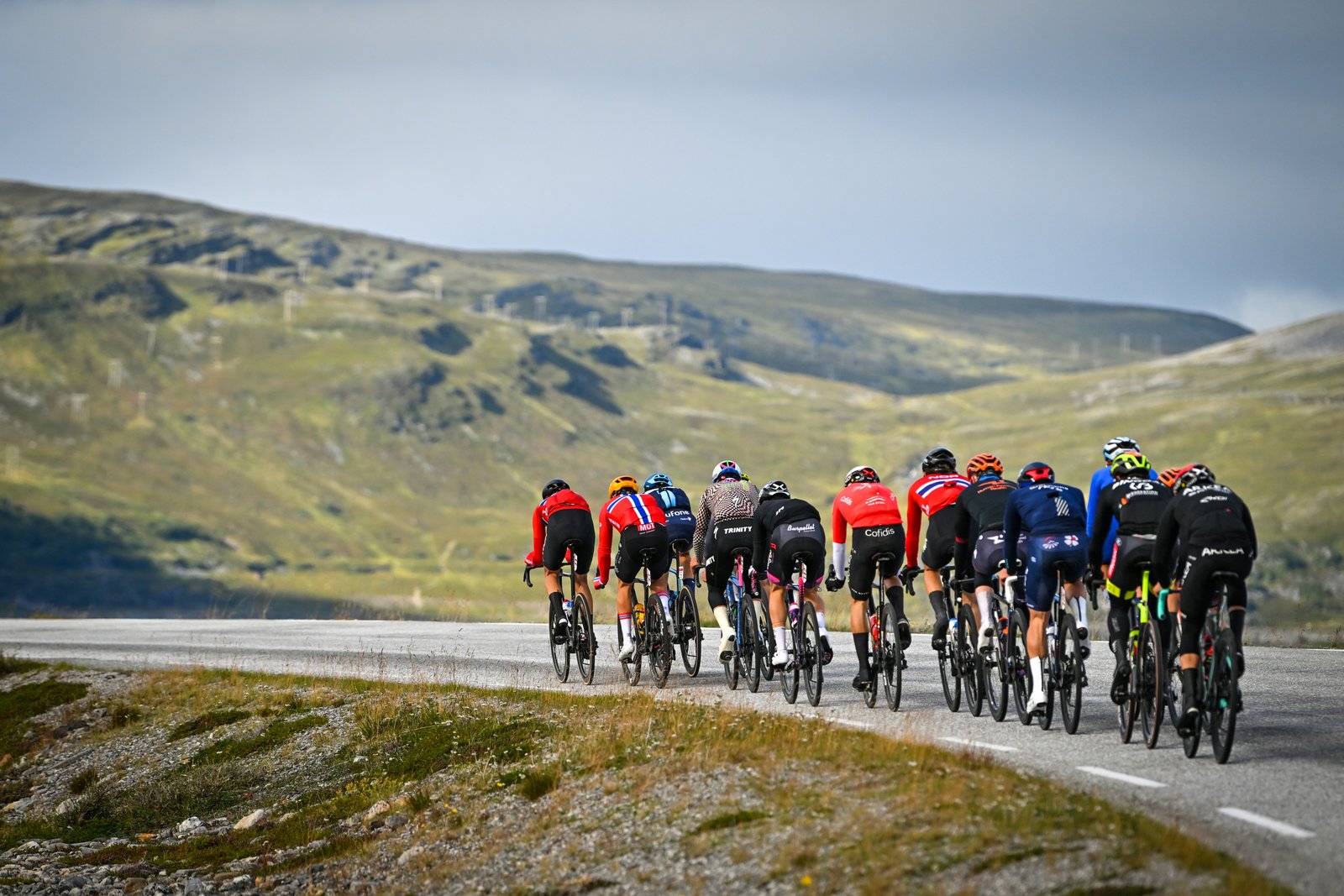
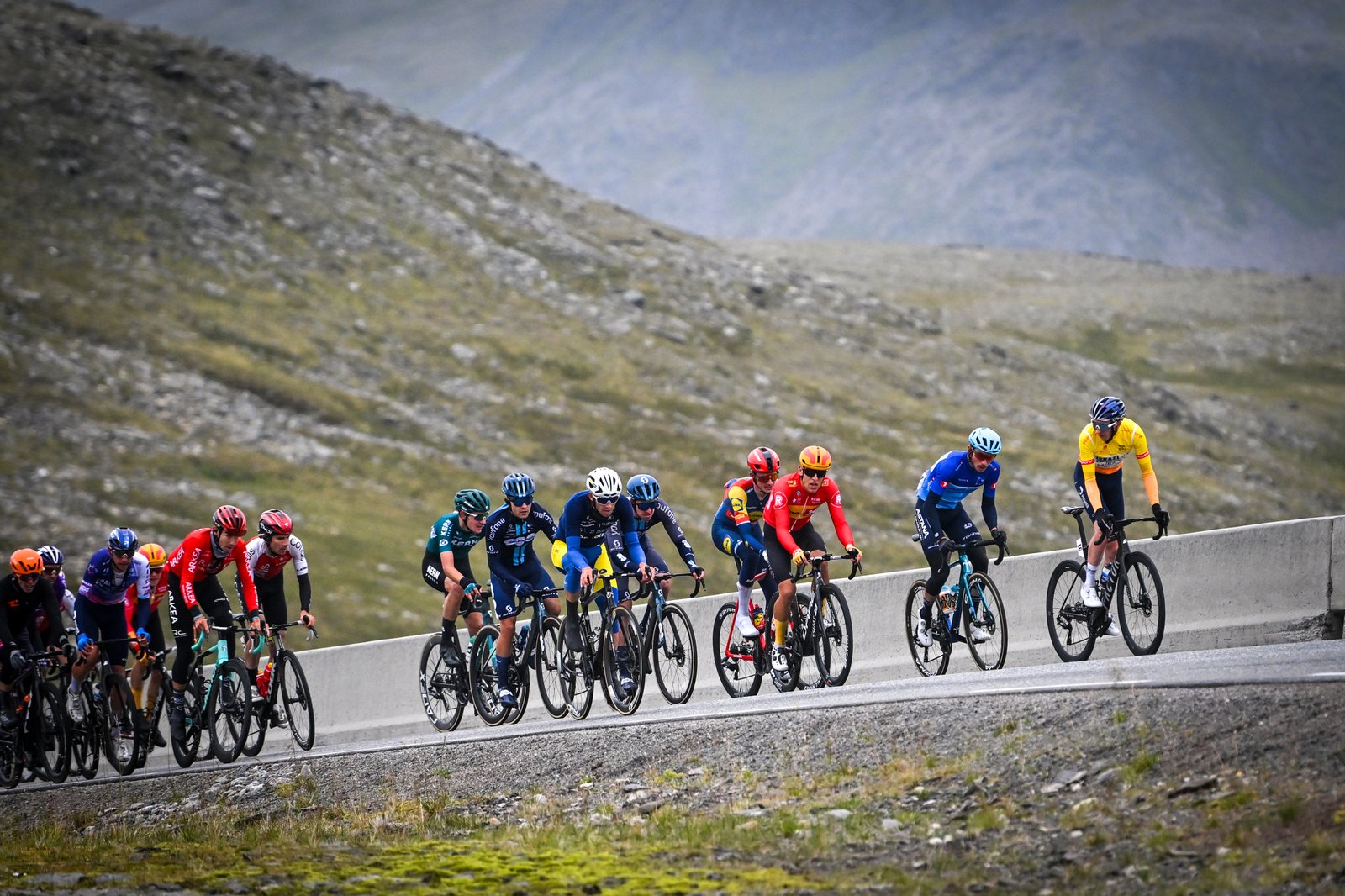
As much as it is a bike race, the Arctic Race of Norway is a series of community parties; an institution in northern Norway. Harstad has seen national heroes Thor Hushovd and Alexander Kristoff win stages there. The race returned last year to see Corbin Strong take the uphill sprint on stage one, before going on to win the race overall. Not even controversial sponsors like Equinor or Strong’s team, Israel-Premier Tech, could dampen the spectators’ spirits.
Kimi Nie-Nilssen, a 19-year-old Norwegian Green Party youth politician brought up in Harstad, grew up attending community festivals sponsored by Statoil or Equinor, which are held all the time, all over Norway. “Many people feel there is a shortage of family events and things to create a good atmosphere downtown, so, when something finally happens in Harsted, people don’t want to think about genocide or rising sea levels,” Nie-Nilssen told Cycling Weekly.
As Nie-Nilssen says: “When I was in ninth grade, the whole school went to the Equinor offices, and they talked about work opportunities and how they are solving global warming.”
A recent poll has shown that a majority of Norwegians under 24 years old favour leaving oil in the ground because of the climate crisis. Equinor’s sponsorship, not only of the general classification but also of the best young rider jersey, together with a competition for pupils at schools along the race route to design the trophies, looks like part of a longstanding effort to combat disaffection among the young.
(Image credit: Getty Images)
Cycling offers an opportunity for major oil companies, which have been forced to rethink their sponsorship strategies in recent years.
For Equinor, 2024 was a particularly difficult year. Before a deluge of climate activism opposing high polluter advertising in sports and culture, Equinor terminated longstanding sponsorship agreements with Norway’s football federation (which dated back to 1993), its ski federation (2009) and its largest cultural festival – the student festival UKA in Trondhjem (2007) – as well as the interactive children’s gallery, WonderLab, at the Science Museum in London (2016).
Announcing the end of their agreement, the Science Museum specifically cited Equinor’s failure to lower its carbon emissions enough to align itself with the Paris Climate Agreement goal limiting global warming to 1.5°C.
Professional cycling has no such reticence, it seems, and clings to its current business plan of packaging up public goodwill and selling it to petrostates, oil and gas giants and high-polluting petrochemicals companies. But at least the peloton will be served by electric vehicles.
ASO and the UCI were contacted for comment in relation to this article, and we’ll update the piece should the organisations respond.
Read the full article here