



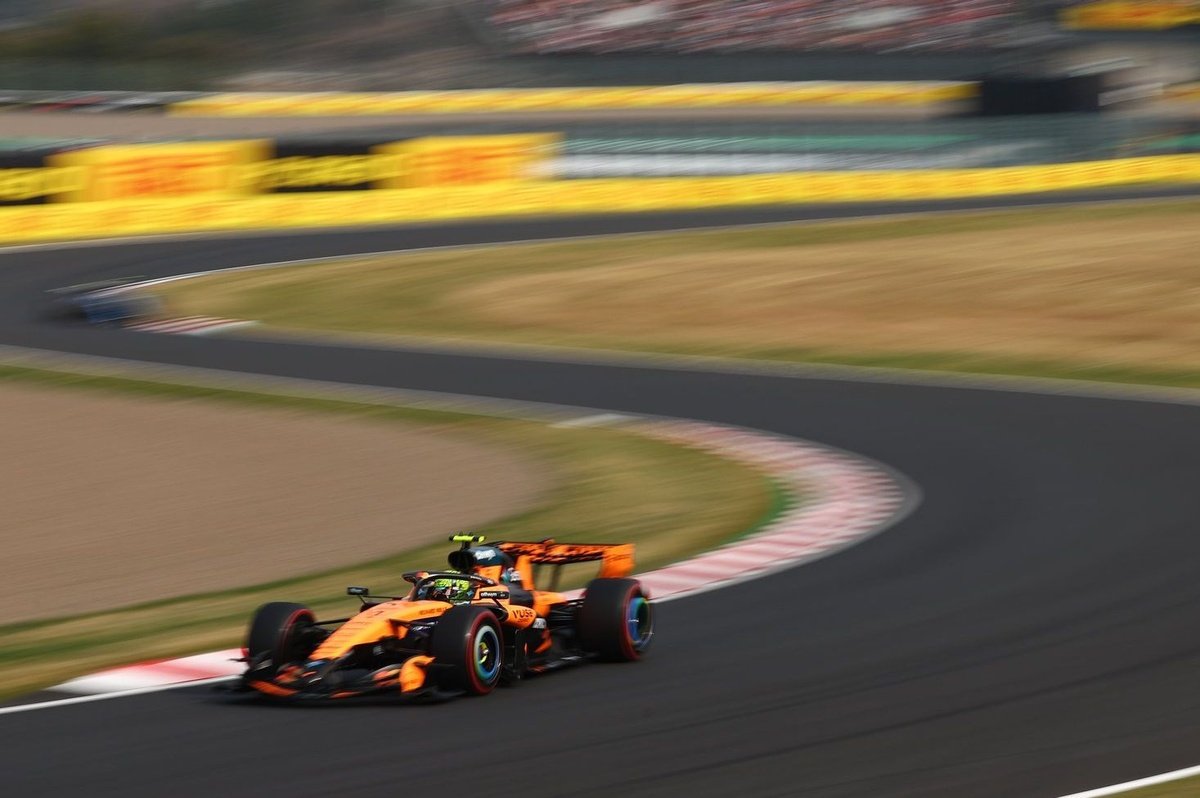
After a month-long hiatus, Formula 1 returns to the track in Miami for a unique weekend, marked by the debut of the changes made to the 2026 technical rules. These changes, introduced based on insights gathered during the opening three grands prix, have two clear objectives: enabling drivers to push to the limit once again in qualifying and reducing speed differentials during wheel-to-wheel duels, all without compromising overtaking opportunities.
The FIA and the teams believe these objectives have been achieved without the need for drastic measures, so there was no desire to alter the foundations of the new regulations, most notably the 50/50 power split between the internal combustion engine and the MGU-K. This was a calculated decision, aimed at safeguarding the investments already committed by manufacturers and acknowledging that a fundamental shift of such magnitude would require prohibitively long lead times, likely pushing any implementation to 2027.
The changes introduced in Miami will nonetheless have a significant impact on both qualifying trim and race dynamics, compelling teams to rethink their approach to overtaking. McLaren has already analysed this shift in detail, providing graphs of how the race weekend is set to change.
Less lift and coast and super-clipping in qualifying
Compared to 2025, the 2026 cars tackle a lap in a completely different manner. Using the 350kW provided by the electric motor, top speeds on the straights are not only significantly higher but are also reached sooner, thanks to MGU-K’s instantaneous torque. However, the battery remains the bottleneck; given how limited it is, it tends to use the available energy quickly. This results in a progressive drop of the power delivery from the electric motor before the system inevitably transitions into recovery mode.
These dynamics, as seen in the opening sector at Suzuka, occasionally forced drivers (and their ECUs) to sacrifice cornering speed, effectively transforming turns into recharging zones rather than a true test of driving skill. This trend prompted many drivers on the grid to argue that, with regulations so heavily skewed toward energy management, qualifying had lost some of its appeal.
The FIA has worked to put the driver back at the centre of the performance. The first solution was to reduce the amount of energy recoverable during a lap, thereby making techniques like lift-and-coast and super-clipping (used to recharge the battery) less invasive. The less energy the PU can recover, the lower the incentive to resort to extreme recovery tactics.
However, there is an important clarification to be made: super-clipping, the process where the MGU-K works against the internal combustion engine at full throttle on the straights to recharge the battery, will be increased from 250 to 350kW, making it actually more effective. Nevertheless, the reduction in the total amount of energy allowed to be recovered means the necessity to rely on super-clipping will actually decrease. According to FIA estimates, its usage will drop lap times to approximately 2-4 seconds per lap.
How qualifying is going to change
But how will qualifying unfold with these latest updates taking effect in Miami? To provide a deeper look, McLaren has released a series of comparative charts, overlaying the actual telemetry trace from this year’s Australian GP (in orange) with a simulation of how the new regulatory framework would impact performance on the same circuit (in green).
Photo by: McLaren
As the data illustrates, the changes debuting at the Miami GP mean that, with a reduced energy, cars will inevitably reach lower top speeds. This triggers two interconnected effects: since less energy can be harvested, the recharging phase becomes less aggressive. Consequently, this will mitigate the pronounced speed drop at the end of straights previously triggered by lift-and-coast or super-clipping.
This will result in energy being redistributed across the full length of the straight. Although peak speed will be lower, the cars will actually arrive at the braking zone carrying more speed than in the opening three rounds. This shift occurs because the internal combustion engine (ICE) will be regain its primary function, rather than being used to recharge the battery via super-clipping.
The combination of these two elements ensures that the loss of speed on the straights will be more contained than before, even if it still carries a cost in terms of lap time. According to McLaren, the average deficit will be around two to three tenths of a second, though this figure will vary depending on the specific characteristics of each track. Furthermore, there will be adjustments to how and when the ECU cuts power from the MGU-K, ensuring that any minor driving errors do not have a disproportionate impact on energy consumption.
“[The impact] Is relatively small, a few tenths if that. It’s a little bit track specific. So in qualifying as we saw in that example it comes a little bit from loss of some deployment on the straights. In the race, I didn’t show it, but as you may be aware we’ve got a reduced level of power in regions of the track that don’t include a straight mode zone so we will lose some lap time in those. But then actually also you use a little bit of energy there and you use that energy elsewhere. So two or three tenths, but it is track specific,” Mark Temple, McLaren’s technical director – performance, said.
How duels are going to change
These regulatory adjustments extend beyond qualifying. In the wake of the incident between Oliver Bearman and Franco Colapinto at Suzuka, the FIA and the teams have collaborated to minimise the speed differences between attacking and defending cars. The objective was to enhance safety without compromising the overtaking and counter-overtaking dynamics that provide the ‘show’.
Two specific measures have been implemented to address this issue. First, in track sectors where active aerodynamics are restricted, electric power deployment during the race will be capped at 250kW, even when ‘overtake mode’ is engaged. Conversely, on straights where wings can open for the straight mode, output will remain at full 350kW. Furthermore, the overall effectiveness of the boost function has been changed to ensure that speed deltas between drivers remain within a safer, more manageable threshold.
In this regard, McLaren has produced a graph illustrating the evolution of race dynamics and overtaking manoeuvres in Miami. With a reduced total energy quantity that the car can use, the strategic deployment of the MGU-K will carry more weight than it did under the initial iteration of these regulations.
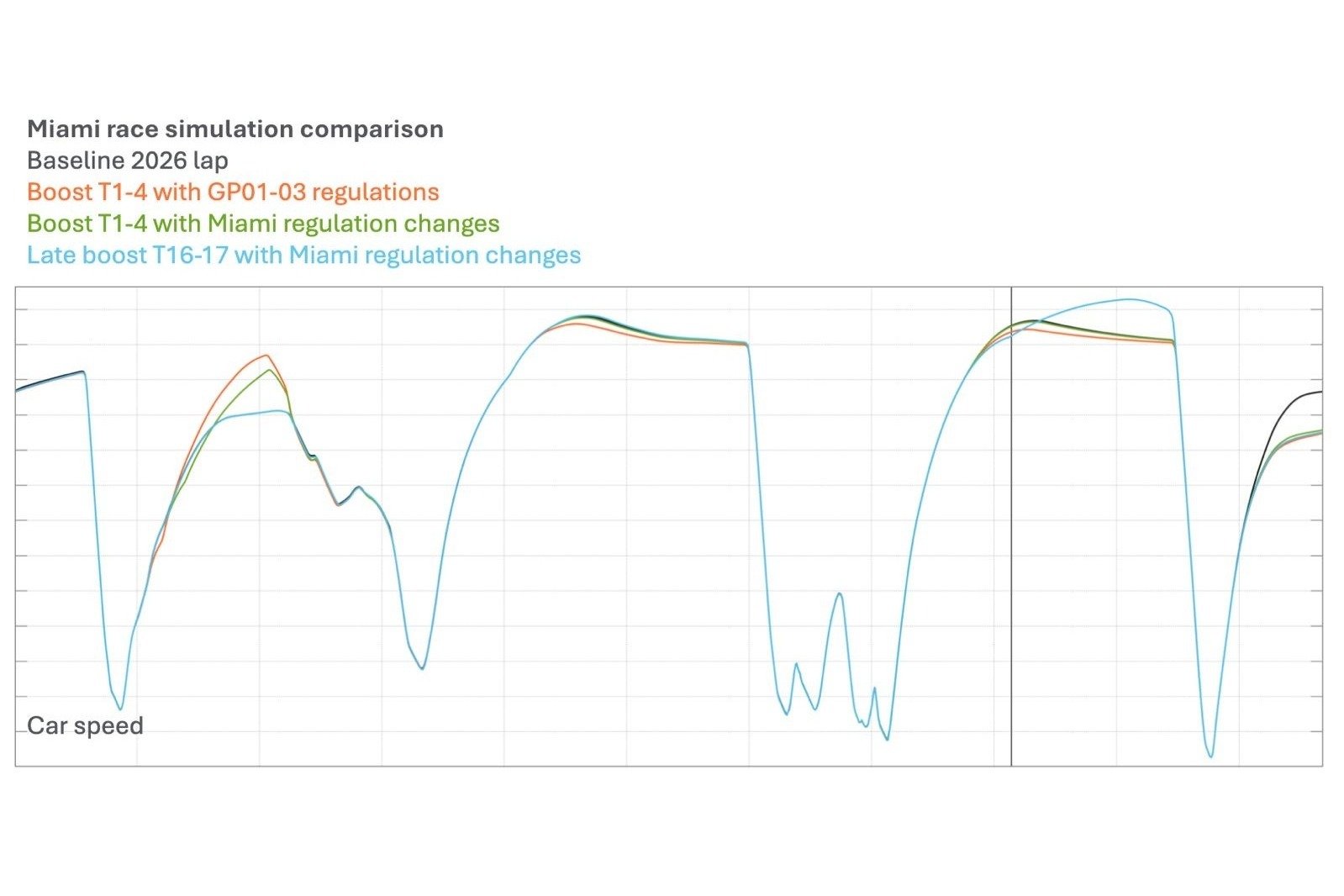
Photo by: McLaren
“Let’s take from Turn 1 to 4. If you use the boost in that region then with previous regulations you would gain a very high amount of straight speed, as you see in orange, and then with the reduction in power from 350 to 250 kilowatts you get the green one. So there’s a reduced speed advantage on the baseline car. So in those areas then it will be harder to overtake. And that’s really the intent because the judgment is that if there’s not a straight mode there then it’s a less appropriate place for overtaking,” Temple added, referencing the graph above.
“The other change is applicable everywhere which is that now if you do a later boost, so as the power peaks at the start of straight and then starts to ramp down, previously if you pressed the boost button you were getting the full 350 kilowatts whereas now that’s reduced so that you either maintain the power level that you have dropped to or if you’re below 150 kilowatts it will come back up to 150 kilowatts.”
For instance, the collision between Bearman and Colapinto occurred in a sector where active aero was restricted. Under the new rules, should a similar scenario unfold, engaging the boost would no longer trigger the full 350 kW MGU-K output; instead, it would be capped at a lower threshold, effectively reducing the closing speed. Consequently, overtaking is expected to shift back towards more traditional zones, similar to last year, where drivers are permitted to deploy maximum energy.
“I think we will see less chance of maybe opportunistic overtakes in some of the more unusual places, but I think that’s the right compromise for safety. But I think on the main straight it will be largely unaffected,” Temple concluded.
“I think there is still that possibility if we think about two long straights one after the other, so this kind of long straight into Turn 17 and then down to Turn 1, you could still have a car that is essentially doing a bad job of overtaking and using too much energy and then being repassed on the next straight. Personally, I actually think that is quite a good thing because it forces a little bit more of a strategic element to overtaking. The driver has to think more and it will reward the drivers who are thinking about and learning from and optimising what they’re doing.”
We want to hear from you!
Let us know what you would like to see from us in the future.
Take our survey
– The Autosport.com Team
Read the full article here