



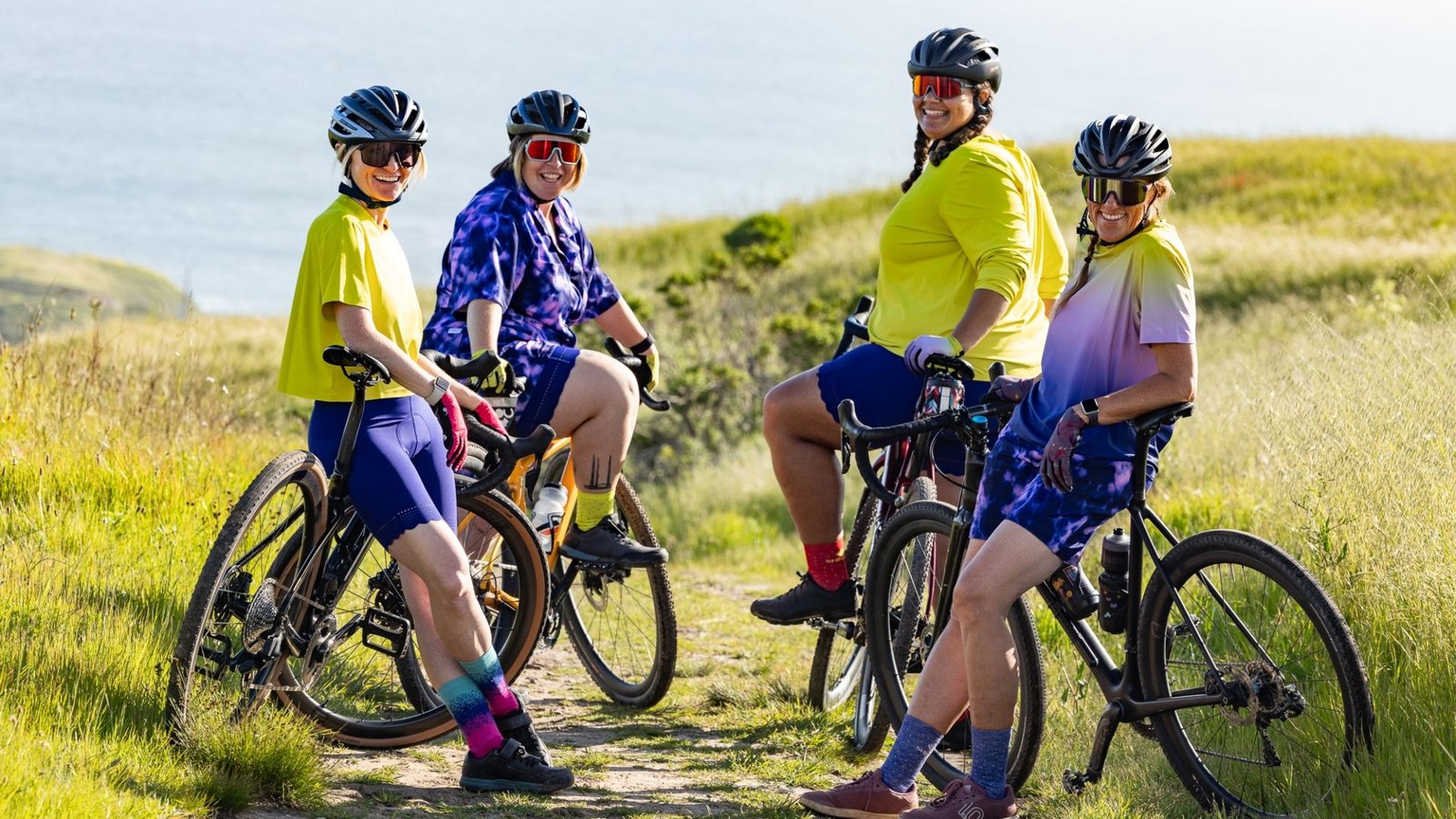
Wild Rye founder Cassie Abel’s Out of Office message says it all:
“I’m lobbying for fair and balanced trade policy + protection for public lands in DC for the week. I’ll get back to your email as time allows.”
The week before, Abel was at the Sea Otter Classic, assisting women in the brand’s tent as they tried on shorts, overalls and tops designed to make cycling a more enjoyable and welcoming activity. Abel was in her element, but she was also fretting about having to go to DC to lobby for trade policy again—something that she never saw herself doing when she decided to start a women’s cycling brand.

When it comes to advocacy, Abel believes small brands are increasingly doing the work larger companies won’t or can’t. The recent tariff battle merely exposed a reality that has existed for years: when cycling needs someone to speak up, it’s often the smallest businesses that show up.
Abel had always planned to run a values-driven business. Since its inception, Wild Rye has been outspoken about women’s reproductive rights and land conservation. Advocating for tariff relief feels like a distraction from those core values, but as Abel sees it, trade policy has become a matter of survival.
At the People for Bikes Leadership Conference earlier this year, tariffs dominated the conversation. But when Abel took the microphone during a Q&A session, she noticed something missing. Much of the discussion focused on bike manufacturers and hard goods, but what about the soft goods? What about the businesses that may not have been affected by the cost of aluminium, but also can’t just move their production to a country with a lower tariff rate, until this ‘blows over’?
“The cycling industry isn’t just about the bikes themselves,” says Ash Lovell, Ph.D., Vice President of Government Relations at PeopleForBikes. “It’s about the entire ecosystem around them.”
Abel’s question at the conference ultimately led to the creation of an apparel working group, ensuring that clothing brands had a seat at the table.
For apparel companies, the challenge is unique. A brand like Wild Rye can end up lumped together with fast-fashion giants despite operating in a completely different market.
“Educating legislators on the unique nature of the outdoor industry, cycling industry, our performance fabrics and complicated construction techniques in order to create garments at the performance standards that we need, is very unique to our industry,” Abel says. “We’re helping them understand that while apparel coming out of China in general might be made in excess, for outdoor apparel and cycling apparel, that’s not the case.”
For founders like Abel, the frustration is that trade policy is only one of many issues demanding attention. Inflation, economic uncertainty and shifting regulations are already challenging small businesses. At the same time, issues like public land access, public health and environmental protection continue to shape cycling’s future.
“There’s so much that we have to advocate for right now, it’s insane,” says Abel.
Wild Rye has historically been a vocal advocate of reproductive health care, but those efforts have been moved to the back burner as the fight for survival takes precedence.
“We can only do so much…right now we’re really focused on trade, because that’s survival for us, and we can’t do the other good work if we aren’t in business,” Abel says.
And survival is no exaggeration. Lovell says that the tariffs, as first proposed, would have “crippled the industry.” She praises the smaller brands for their “scrappiness” and boldness when it comes to advocacy work, while recognising that for many, it is not a choice.
“They have to do it because it’s make or break for them,” she said.
SHREDLY founder Ashley Rankin explains that the brand simply does not have the resources to shift its supply chains as nimbly as a bigger brand. Thus, trade policy hits hard.
“We don’t have the luxury to make some of the decisions that the bigger brands could make. From an advocacy point of view, we’re more at risk in so many ways,” Rankin explains.
While tariffs brought advocacy to the forefront, small cycling brands have always been among the first to take public positions on issues they care about. Whether it’s Wild Rye advocating for reproductive rights and land conservation or SHREDLY championing size inclusion, founder-led businesses often have more overt points of view than their larger competitors.
Why? Partly, because they can.
Large corporations are accountable to boards, investors and shareholders, making public positions on contentious issues harder to take. Smaller companies operate differently. They can move faster, be more vocal and make decisions that reflect the values of their founders.
SHREDLY, for instance, is accountable only to Rankin, and while that comes with its own challenges, it allows her to make decisions that align with her values, not just a bottom line.
Of course, advocacy isn’t free. It takes time, money and energy. Yet, there is arguably a distinct upside for brands that are willing to put their money and time where their values lie: Advocacy can be authentic marketing, without any ad spend.
Consumers increasingly expect brands to stand for something beyond the products they sell. A 2020 survey from 5WPR found that 83 percent of Millennials said it was important for the companies they buy from to align with their beliefs and values. A 2025 survey from Lightspeed found that 96 percent of Gen Z consumers shop intentionally, while 66 percent said it is important that their purchases reflect their values.
And this is where small brands have a unique opportunity.
“If you’re a small business and you are entering this market, you have to have a reason for being that makes you a little bit different from the bigger brands,” says Rankin.
“For us, if we’re going to be a women’s brand, then we better make apparel for all women. Making the size range that we do sets us apart from some of the bigger brands, even if it’s more expensive for us. It ultimately is part of why we can exist, because we can set ourselves apart, and we can do things a little bit differently.”
Similarly, Wild Rye loudly champions women’s reproductive rights (when not busy fighting tariffs).
“We lost a few customers over reproductive health care in particular, but that was something we were willing to do because that’s just so important to our team, and to our core community,” Abel says. “It actually strengthened the relationship with our existing, loyal fans. And so I believe that it was the right position to take.”
Of course, advocating for fair and balanced trade policy isn’t a sexy way to grow your fan base, but choices like standing up for women’s rights, pushing forward with diversity, equity and inclusion initiatives, or advocating for public lands can all help create a cohesive brand identity and pull in like-minded consumers who aren’t just comparing price tags.
Yet it’s becoming increasingly difficult to spot real advocacy versus performative activism. Yes, advocacy is speaking up on social media and making your stance clear, Abel says. But it’s also making phone calls (a nightmare for a Millennial like herself, she admits), writing emails and letters, showing up in DC and at the state capital to meet with various legislators.
Ultimately, advocacy is a matter of survival for these brands—and perhaps for the industry as a whole.
“I think the cycling industry, if it wants to survive, needs to change,” says Abel. “And it needs to change at a faster clip. I know a lot of great humans in the industry, and it requires those great humans to stand for something bigger than themselves, bigger than their brand.”
Rankin agrees: “I believe that today, with the uphill battles that we are facing with climate change, with the unfair and disproportionate distribution of wealth, you have to have a moral compass as a brand, and I do think it needs to be authentic and genuine.”
Read the full article here