




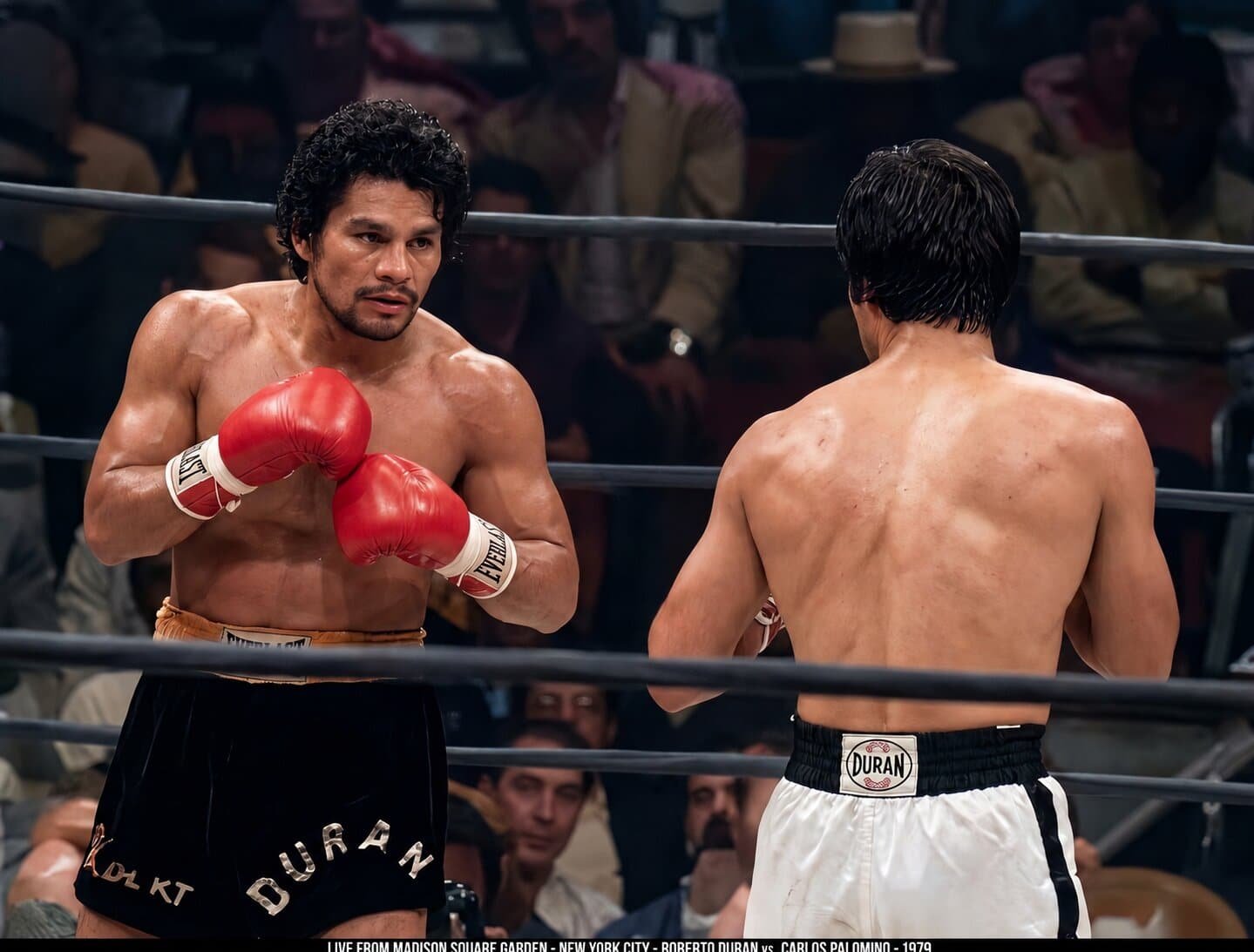


Palomino represented the right test. The former WBC welterweight champion had lost his title to Wilfred Benítez by split decision five months earlier and remained frustrated over not receiving a rematch. He believed Durán had looked soft in previous welterweight appearances, although the Panamanian arrived at the weigh-in looking sharp at 146 pounds. Palomino weighed 145.
Although the 7-5 favorite, Durán did not fight like a lightweight depending solely on aggression. He mixed pressure with feints, jabs, counters, and subtle changes of distance. His head and shoulders were rarely still, allowing him to slip punches without giving up his place inside the pocket.
That upper-body movement disrupted Palomino’s straight punches. Durán kept his head away from the center line, letting the jab pass before answering. At other times, he parried it with his rear hand or stepped inside with a right over the top. Palomino was accustomed to using the jab to set his rhythm, but Durán turned the punch into an opening for his own offense.
Speed soon became decisive. Palomino wanted to time Durán between combinations, yet his counters arrived too late. Durán could step in, finish his work, and change position before Palomino answered. He occasionally smiled, seemingly enjoying the freedom of competing without draining himself to 135 pounds.
Along the ropes, Durán’s work was just as measured. He did not waste energy throwing wide punches when Palomino covered up. He placed hooks into the ribs, brought short right uppercuts through the guard, and used his head and shoulders to keep Palomino from creating room.
Those clinches also answered questions about Durán’s ability to handle a natural welterweight. He did not try to overpower Palomino with muscular strength. Shoulder nudges, forearm leverage, and superior head position allowed him to turn his opponent or free one hand for short punches. His effectiveness there came from balance and technique, not size.
A right hand dropped Palomino early in the sixth round. Some accounts described the knockdown as the finish to a left-right combination, while others credited an overhand right to the chin. Palomino rose immediately and took referee Arthur Mercante’s mandatory eight-count. He survived despite cuts near his right eye and below his left ear.
The former champion produced his best work in the seventh, landing hooks at close range. Durán responded by sweeping the final three rounds. Freed from the severe lightweight cut, he maintained his pace and punch output through the tenth instead of slowing after building a large lead.
Palomino later said Durán’s hand and foot speed had surprised him. He also maintained that Durán thumbed him twice in the right eye during the inside exchanges, neither seen by Mercante.
Mercante and Harold Lederman each scored it 99-90, while Tony Castellano had it 99-91. The cards reflected Durán’s dominance. The contest was one-sided without becoming dull because he continued creating exchanges instead of protecting his advantage.
On HBO, promoter Don King placed the bout beneath Larry Holmes’ WBC heavyweight title defense against Mike Weaver. The card drew 14,136 spectators and a gate of $771,982, with many fans particularly interested in Durán against Palomino. After television networks and Madison Square Garden passed on Holmes-Weaver, King rented the building for $150,000. Durán and his manager reduced their original $250,000 guarantee to $100,000 against a later bill to help keep the promotion together.
Such a thorough victory established Durán as more than a dominant lightweight, carrying his reputation into a larger division. Palomino had been a world champion only months earlier and had never previously been handled in that fashion. Durán showed that his aggression worked because it was supported by defensive movement, timing, balance, and faster feet.
The performance also supplied an early version of the tactics Durán would use against Sugar Ray Leonard in Montreal the following year. Against both men, he slipped his way into punching range, interfered with their jabs, and used technical infighting to keep them from working comfortably. Palomino could not escape that attack. Leonard would later discover how difficult it was to impose his own rhythm once Durán dictated the terms.
Durán and Palomino embraced after the decision. Durán then appeared alone on the July 2, 1979, cover of Sports Illustrated, pictured in action against Palomino beneath the headline “Durán the Boxer.” Palomino retired shortly afterward, while Durán continued toward the defining welterweight victory of his career.

Read the full article here