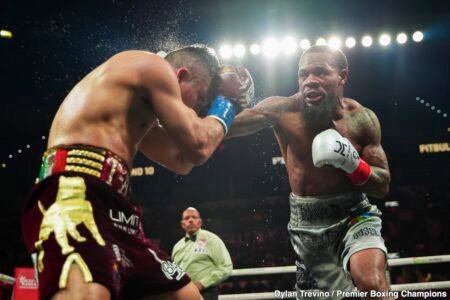





Titles still carry value. That value now depends on visible opponents, major platforms, and wins that carry authority beyond the result itself. Hitchins has handled his assignments cleanly. He has not been given the stage or the opposition that converts technical control into wider pull.
That problem is sharpened by stylistic overlap with Shakur Stevenson. Both operate from range, limit exchanges, and win by control rather than spectacle. The difference has not been ability. Stevenson accumulated recognisable victories on prominent broadcasts, where his dominance was clearly absorbed by the audience. Hitchins’ wins have been quieter. They landed, but they did not travel.
The opponent pool at 140 no longer corrects that. Teofimo Lopez once represented the most obvious commercial fight. Even then, there was little indication of genuine interest from his side. After being clearly beaten by Stevenson, Lopez no longer carries the value that once made him useful. A diminished name does not unlock purses or justify risk, particularly for a champion who needs visibility rather than validation. That fight was unlikely before. It offers even less now.
What remains at junior welterweight is a narrow and unattractive set of options. Fighters such as Ernesto Mercado and Gary Antuanne Russell present real danger. They do not bring the audience or revenue that offsets it. That equation used to be tolerable when belts carried automatic force. It no longer holds. Fighters now make those judgements early.
Welterweight presents a different calculation. Attention and money are moving there. Devin Haney, Conor Benn, Ryan Garcia, and Keyshawn Davis are all orienting toward that division in one way or another. Even secondary fights benefit from proximity to those names. Broadcast opportunities improve. Earnings increase. Fighters who require explanation are easier to place on a larger stage.
Hitchins’ interest in moving up is expressed in practical terms, centered on opportunity. That distinction matters. It reflects an understanding that progression now follows exposure rather than hierarchy.
There is also a practical limit to staying put. Hitchins is good enough that there are fighters at 140 who can beat him on the wrong night. None of them bring the upside that justifies remaining. At 147, the risks change, but so does the ceiling. That trade off defines modern career planning.
The broader point is clear. In the current era, titles open conversations only after popularity does. Hitchins reached the belt without the momentum that now tends to come first. Once that happens, waiting rarely solves it. Fighters move toward where the audience already is.
For Hitchins, leaving junior welterweight is not abandoning something unfinished. It is recognising that the division no longer advances him, and that recognition, more than possession of a belt, is what now determines a career’s direction.
Read the full article here