



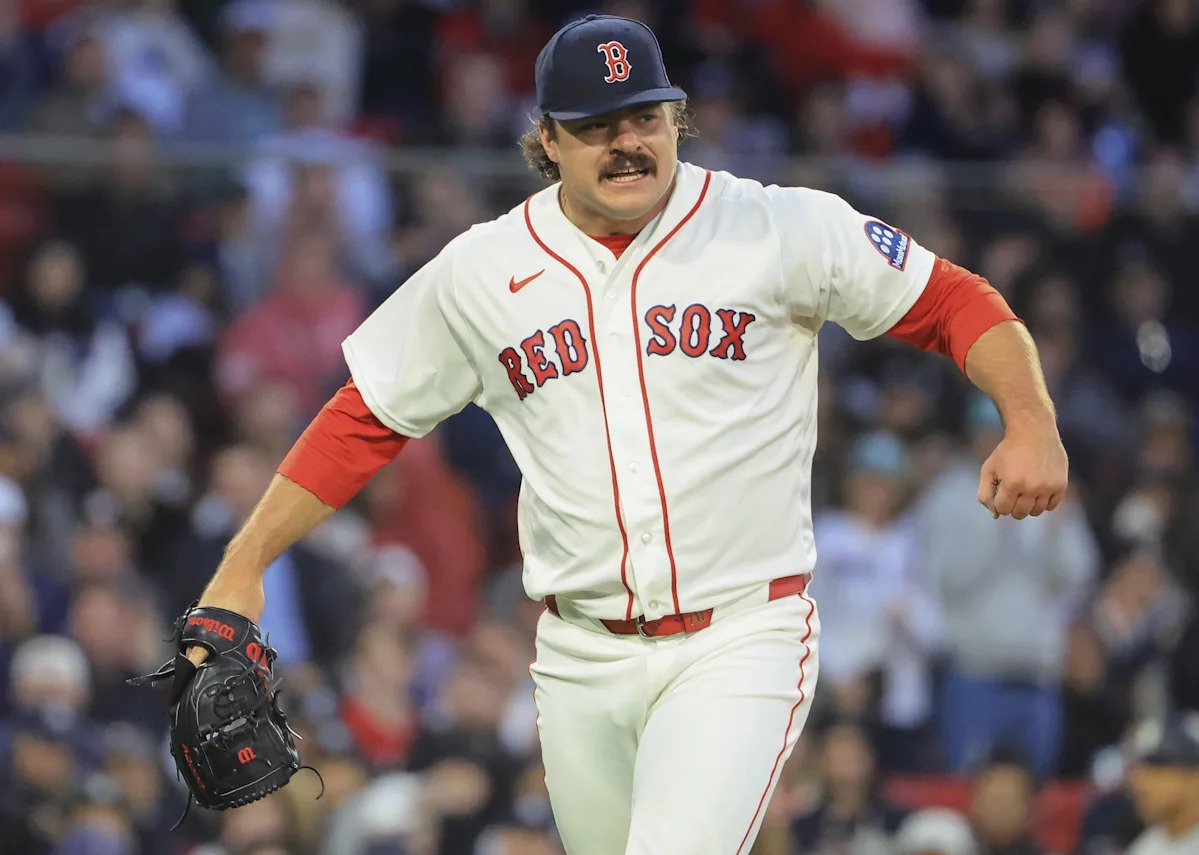
The camera loves Payton Tolle. He’s constantly giggling his way through interviews, or comparing being in the major leagues to eating a steak or something. During games, he’s shown celebrating at the top step of the dugout or in the middle of some shenanigan. From afar, it seems like each time he’s on camera for an interview is the first time he’s ever been interviewed. That obviously isn’t the case, but from a professional baseball career perspective, he’s still very young. He flew through the minor leagues, debuting in his first professional season. In his first career start, he bullied the Pittsburgh Pirates with his four-seam fastball, striking out eight over 5 2/3 innings. It was as if he were the only kid who had hit puberty in Little League, throwing the ball as hard as he could to opponents who had never seen anything like it before. In his second start, he joined the travel team and went on the road to Arizona, where the Diamondbacks rolled out a lineup of post-pubsecent boys who punished the fastball and exposed Tolle’s lack of a Plan-B.
The rest of Tolle’s 2025 season was up and down, with the Red Sox shying away from him as a starter and moving him to a lower-leverage relief role as he learned to handle major league hitters. He started 2026 with a chance to win a spot in the major league rotation, but ultimately lost out to Connelly Early and Johan Oviedo. With Oviedo out, Sonny Gray going down, and setbacks for Kutter Crawford and Patrick Sandoval, the southpaw got his shot on Thursday against the New York Yankees. Tolle, who apparently hates bus rides and the city of Worcester, Massachusetts, turned in a six-inning, one-run performance and pleaded to Craig Breslow to let him fly on the charter to Baltimore. Breslow was busy with other, less fun matters.
Tolle’s four-seam fastball is always going to be the star of the show. It averages 97 mph with about 7.5 feet of extension. Its average perceived velocity is the highest among left-handed starters, while the low release and 16 inches of induced vertical break give it an excellent vertical approach angle. Those metrics mean his command doesn’t even need to be that good; it just needs to be in the upper half of the zone.
Although it’s one of the best fastballs in baseball, his 64% usage rate in 2025 was too high to survive in the big leagues. Familiarity makes a pitch easier to hit, and hitters saw his fastball a lot. On Thursday, it still led the way, but only accounted for 49% of his pitches. He supplemented the four-seam fastball with sinkers, curveballs, cutters, and a couple of changeups.
While his fastballs led the way, it looked different than 2025. I don’t think Tolle has ever lacked confidence — his cocked elbow at the set position and Tom Selleck mustache give him a certain swagger — but his confidence in his secondary pitches was unlike anything I’ve seen from him before. It also gave him more options. Last season, late in counts with Tolle behind (2-0, 3-0, 3-1, 3-2), he threw 67% four-seam fastballs and 25% cutters. He had more home runs allowed than whiffs induced on those fastballs (3 to 1). Hitters knew they were getting fastballs and jumped all over them. In his 2026 debut, he had 16 pitches in those counts and only threw eight four-seams. The two curveballs he used in those counts tied his number from 2025. In even counts, the usage shift was similar.
Overall, he threw 15 curveballs on the night, most of which came with two strikes. His command wasn’t that polished, but it was better than he’s commanded any breaking ball before.
They were mostly spotted below the zone, with a couple that backed up onto the arm side for misses and a few in the dirt. The only mistake over the plate was an 0-2 pitch to Trent Grisham, who hit it directly into the ground. Of the 15 curveballs, 10 of them induced swings, seven of which were chases out of the zone. Seven of the ten swings also returned whiffs. Those numbers will come down, partially because they’re insane, and partially because curveballs will be a more prominent piece of the scouting report, but just the ability to land a curveball near the zone will help keep hitters off the four-seam. Here’s one of those against Aaron Judge in a 1-1 count.
The prior pitch was a 1-0 curveball that Judge swung and missed at, a sign he was looking for a fastball. At 1-1, Tolle drops the curveball on the outside edge and gets the call for strike two. Last season, Tolle doubled up on pitches that weren’t his fastball or cutter just 11 times. He did it twice with his curveball on Thursday, once against the best hitter in the world.
It wasn’t just the curveball, too. Here’s my favorite pitch of the night from Tolle.
The bases are loaded with nobody out. It’s a 2-2 count against the very dangerous Giancarlo Stanton, who knows that Tolle doesn’t want to run the count full with nowhere to put him. He’s expecting a fastball. Last year, he would have gotten a fastball. There’s a pretty good chance he would have crushed said fastball. This year, Tolle has the confidence balls to throw his first changeup of the game. He’s never shown good command of a changeup, and he’s able to spot this one just below the zone for a huge strikeout. A degenerate gambler wouldn’t know about Tolle’s changeup command, so they’re irrelevant. An educated one, however, would likely have bet that the pitch is noncompetitive and goes for a ball. That pitch is not one he would have thrown in his debut season, and it’s a really exciting development. He’s not going to be Tarik Skubal all of a sudden, throwing 25% changeups, but simply having the ability to use the pitch to get out of a jam here is a step forward. It’s also not a four-seam fastball (there’s a theme here).
I’ve barely even mentioned the sinker. He threw 18 of them, which averaged 96 mph. It came with seven fewer inches of induced vertical break and an additional eight inches of horizontal movement. That profile is close to Garrett Crochet’s, which has proved nearly un-square-up-able when thrown on the inner part of the plate against lefties. I sound like a broken record, but it also gives him another pitch to keep opponents off his four-seam. It went for 61% strikes on Thursday, which isn’t as high as we’d like to see, but it was enough. I’d expect that number to increase as he throws it more.
Why is this all important, you ask? You don’t need me to tell you that pitchers are better when they’re ahead in the count. Hitters had a 1.809 OPS when ahead of Tolle and a .321 OPS when behind. Now, he’s shown the ability to use his curveball or his changeup to climb back into counts. Again, the 70% whiff rate on his curveball won’t last, but landing it for a called strike at 0-0 or 1-0 when hitters are looking for something else is a win for Tolle. It isn’t flashy, but dropping in a 1-1 curveball for a called strike is going to go a long way in keeping the lefty out of trouble.
Tolle struck out almost 26% of hitters last season. That mark would have placed him in the top-20 in baseball if he qualified. If he continues to be sharp with his secondaries, that number will go up even further. In 2025, opponents fouled off nearly 30% of his two-strike four-seam fastballs. He had more foul balls against the pitch with two strikes than strikeouts recorded. Although it’s just one start, he struck out six Yankees with fastballs, and they fouled off three (18%). If it can be dominant when hitters know it’s coming, imagine what it can be when they can’t hunt one. This was one pitch after a called strike with the curveball. Caballero never had a chance.
Is it repeatable? Was it just a moment of good command? It’s impossible to say. He’s never commanded a breaking ball as well as he did on Thursday before, and he’s never thrown a breaking ball that much in a game. The feel for the pitch might come and go, but that’s to be expected of a young pitcher who’s still developing. On his day, when the curveball is working and his fastballs are landing in the zone, he’s a top-20(?) starter in the league. I know that sounds hyperbolic, but the stuff is truly that good, y’all.
Read the full article here