



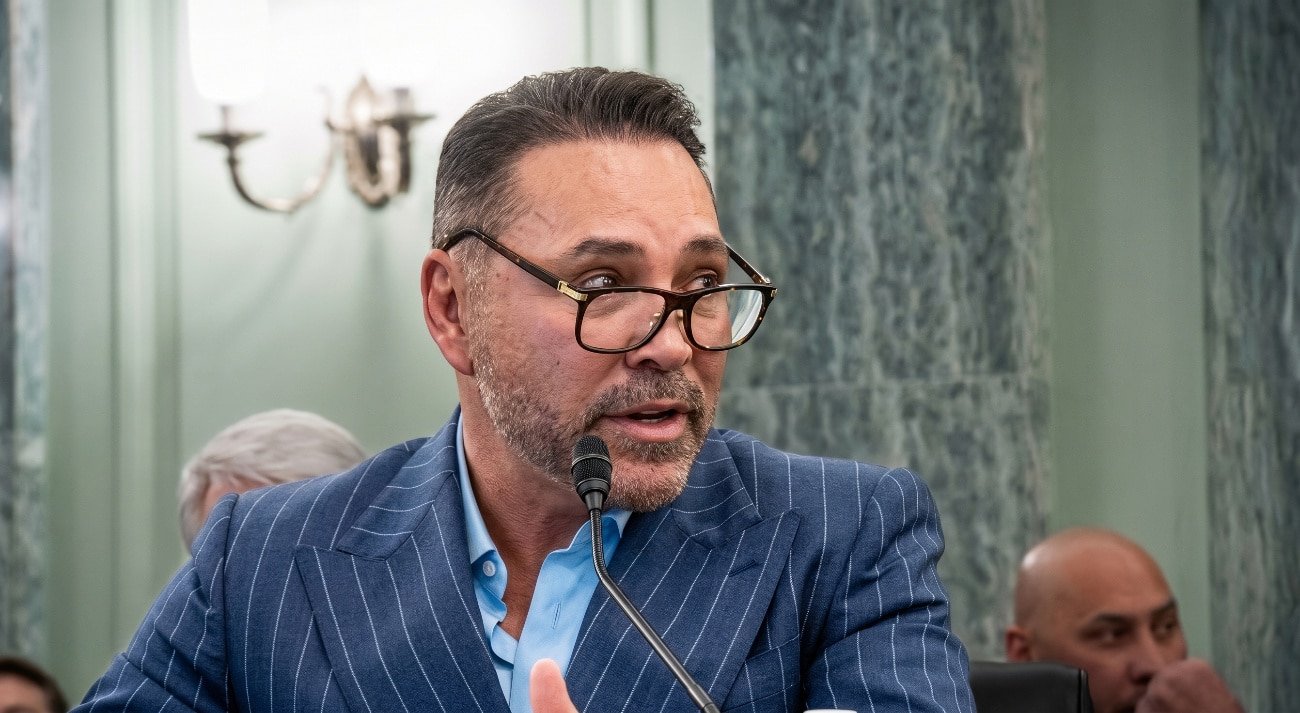

“If this bill passes, fighters will have fewer choices, less leverage and less control over their careers,” De La Hoya told the committee. “When that happens, it will not be the sport that failed them. It will be us.”
De La Hoya also rooted his opposition in personal experience, saying he signed his first professional contract when he was young without fully understanding it and later realized he had been taken advantage of. He said many fighters still enter boxing in the same position, trusting the wrong people and getting trapped in poor deals.
He argued the new proposal would create two different standards inside the same sport, with traditional promoters still bound by disclosure rules while unified boxing organizations would gain broader control.
“One system operates under transparency and accountability while the UBOs do not,” De La Hoya said.
The concern is no longer hypothetical. Zuffa has already attracted names including Jai Opetaia, Richardson Hitchins, Jose “Rayo” Valenzuela, Conor Benn, and Edgar Berlanga, showing it is moving quickly to establish a roster.
Muhammad Ali’s grandson, Nico Ali Walsh, backed De La Hoya’s position and said the issue goes beyond branding or nostalgia.
“When one system controls access, choice becomes theoretical, not real,” Walsh told senators. He later added that the revised bill should not carry his grandfather’s name.
Nick Khan, speaking in support of the proposal, argued boxing’s current structure already pushes fans away. He said the WBC alone recognizes 163 champions across 18 weight classes and pointed to major broadcasters such as HBO, Showtime, ESPN, Fox, NBC, ABC, and CBS leaving the sport over time.
Khan’s argument was built on the “163 champions” problem. He isn’t wrong that the average fan is exhausted by the alphabet soup of belts, WBC, WBA, IBF, WBO. His pitch is that a “Unified Boxing Organization” (UBO) creates a product people actually want to watch, which theoretically brings more money into the sport.
Supporters are dangling better medical coverage and guaranteed pay per round to sway lawmakers who care about athlete welfare more than promotional politics.
That may appeal to fighters looking for a cleaner route upward. Others will hear something else: one company trying to own the road to the top. Boxing has long sold freedom, even when it came with chaos. This fight is about whether that freedom is about to get much smaller.
De La Hoya’s strongest point was about the loss of leverage. By highlighting his own early-career struggles, he reminded the committee that the Ali Act was created specifically to stop the “one company, one boss” model that he argues Zuffa wants to replicate.
Oscar was very direct about the funding, comparing the Zuffa/TKO push to LIV Golf. He presented it as a corporate takeover funded by foreign capital that would strip away the independent contractor status that boxers have fought for decades to maintain.
Nico’s argument was about the legacy of fighter rights as well as business. When he said that “choice becomes theoretical” under a centralized system, he hit on the exact fear many purists have: that boxing will become a “take it or leave it” league like the UFC.
The bill already cleared the House with a unanimous vote, which is a massive hurdle to have already cleared. With Senator Ted Cruz chairing the Commerce Committee and the general political momentum toward “modernizing” sports to compete with the MMA model, Zuffa has a very clear path.
The sentiment in the room seemed to be that while Oscar and Nico won the “emotional” battle, the “business” battle might already be decided. If the Senate views boxing as a “failing” industry that needs a corporate savior to survive, they’ll likely move the bill forward.

Read the full article here