



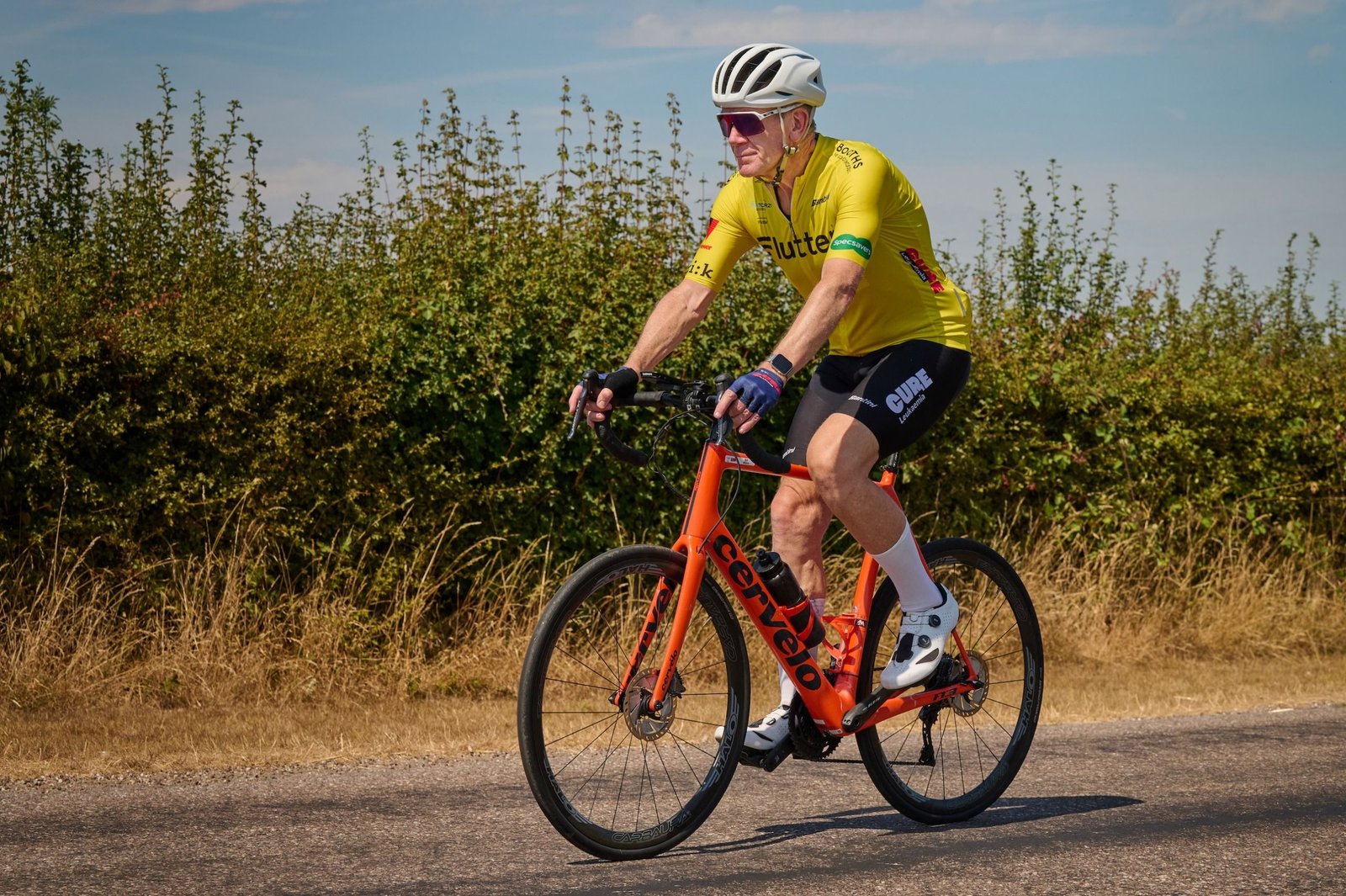
A decade had passed since I last spoke to Bob Munro, and it seems rude to admit it, but I’d assumed he was dead. When we spoke in 2016, he told me he was living with multiple myeloma, a rare form of blood cancer that affects the bones – a diagnosis with grim statistics: one in five patients died within three months, and nearly half within five years. Munro was approaching the five-year mark, and he told me he felt lucky to be alive. How, then, was he still around 10 years on?
His email arrived shortly before this year’s Tour de France, with “Blast from the past” in the subject line – and “blast” was no mere figure of speech. Munro was getting in touch not to tell me he was still alive, nor just that he was still cycling, but that he was about to ride the full route of the Tour at the age of 66. Unable to find a polite way to ask “How the hell is this possible?”, I suggested we catch up properly when he got back.
A month later, the man who appears on my screen from his home in Windsor – once he has worked out how to use Google Meet – is tanned, lean and as vibrant as when we spoke a decade ago. But his astonishing health must wait. First, I want to hear what it was like climbing Alpe d’Huez twice after nearly 3,000km of riding. “It took me bloody hours to get up there,” says Munro with a wry grin, describing the finale of stage 19. “It was horrendous. But it was the best day and the worst day cycling all at the same time.”
Latest Videos FromCycling Weekly
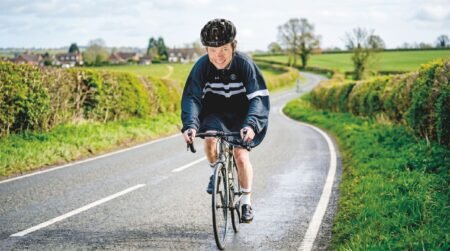
Bob Munro first appeared in Cycling Weekly in 2016
(Image credit: Future)
That has been the theme of Munro’s life since we last spoke: terrible lows and incredible highs in rapid succession. Just five years ago, he was broken and housebound, but by the end of last year he had signed up for Cure Leukaemia’s ‘Tour 21’ challenge – riding the full route of the 2026 Tour one week ahead of the pros. As it turned out, it was even more difficult than he could have anticipated. Temperatures soared into the high 30s every day and, as the oldest rider in the 12-strong group, he was relying on the only two slower than him for company at the back – until both crashed and had to abandon. “That left me as the weakest link, the lanterne rouge of the event,” Munro says. “It just put extra psychological pressure on, knowing I was the one effectively setting the time limit every day.”
As if that burden were not enough, towards the end of the second week his legs began to swell, and the rest of his body soon followed. “I spoke to the doctor who was with us,” he says, “and we concluded that it was probably fluid retention from overdosing on electrolytes – I’d been putting two tabs in every bottle.” At its peak, the swelling added 10kg to his weight – far from ideal before a stage featuring 5,400m of ascent. Thankfully, there was plenty of descending in the meantime. “From the Col de Noyer, it was sweeping downhill for what felt like most of the rest of the day,” he says, still revelling in the memory of stage 19. “The scenery on those descents, it was just brilliant. The best day of cycling I’ve ever had.”
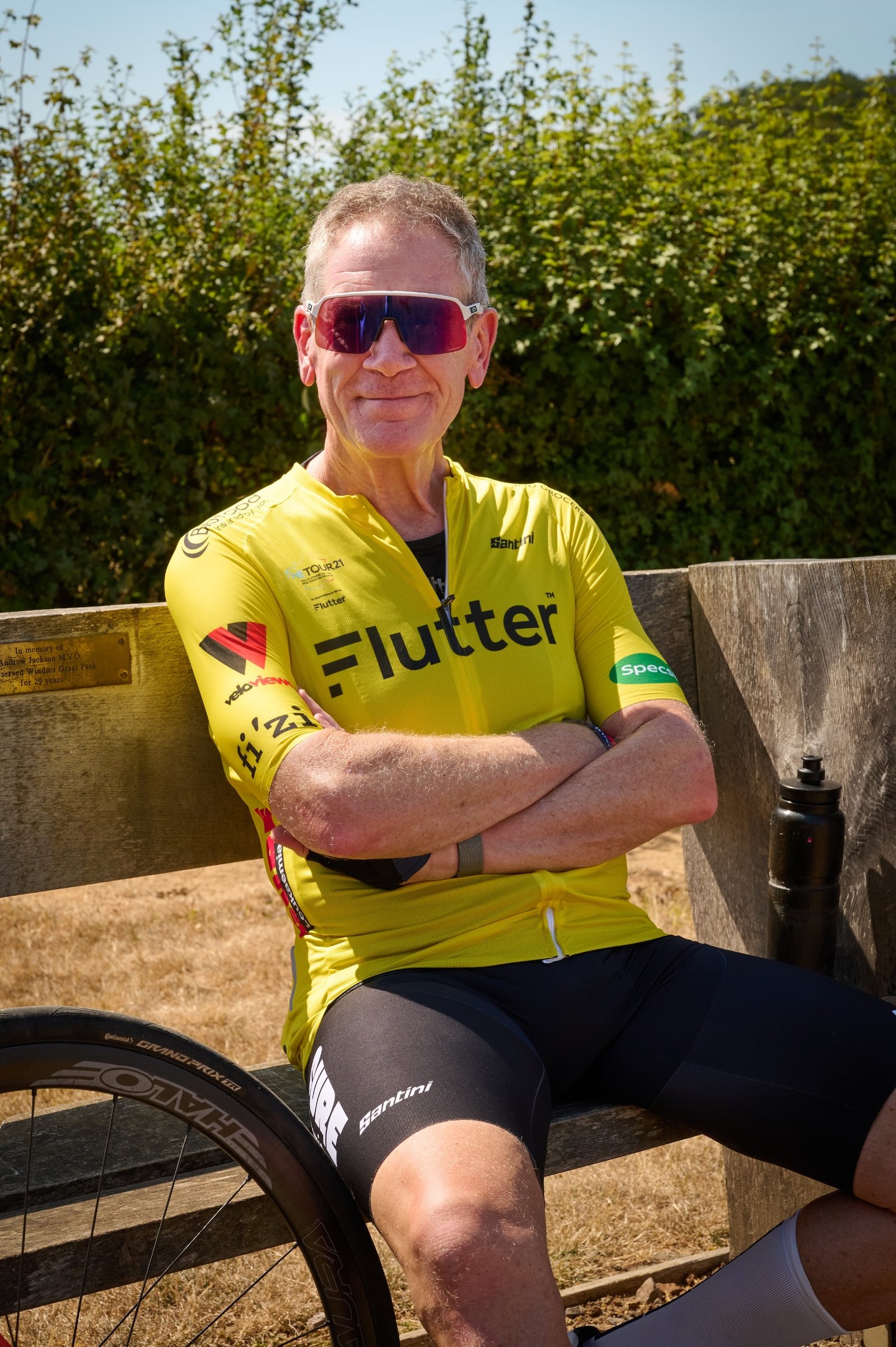

Ten years on, Bob Munro is happy, healthy – and fitter than ever
(Image credit: Richard Butcher/Future)
Munro is refreshingly no-nonsense about struggles on the bike. He has known true suffering, more of it than anyone should have to go through. On a 2019 trip to France, for instance, he sustained an excruciating injury. “Descending Col d’Izoard, I hit a pothole and the pain went straight through my back. I thought, ‘Oh shit, I think I’ve got a collapsed vertebra.’ I was in so much pain that I had to stand on the pedals the whole way down.” That evening he could barely sit or lie down, yet the next morning he was back on his bike. “I was thinking of Geraint Thomas, that time he rode a Tour stage [in 2013] with a cracked pelvis – and I rode my best-ever time up Alpe d’Huez with a collapsed vertebra. Having said that, I didn’t cycle again after that day for about nine months.”
“Coughing or rolling over in bed was enough to break a rib”
Bob Munro
That back injury, Munro soon realised, was a sign that the drugs had stopped working and tumours were forming again, weakening his bones. “I’d taken about 10 different lines of treatment, and I’d run out of options,” he says. “My bones were breaking so often – I had eight fractured ribs in the space of 18 months, as well as the collapsed vertebra, a fractured arm and a fractured leg. Just coughing or rolling over in bed – or even a wave hitting me in the sea – was enough to fracture a rib.”
By 2021, Munro was running out of hope. “I remember my wife and I sitting in a cocktail bar celebrating our wedding anniversary, and I said, ‘I’m glad we’re having a nice time because I think this is probably our last anniversary.'” His wife was taken aback by his uncharacteristic pessimism, but one drug after another had failed to work in the long term, and the reality had become impossible to ignore. A glimmer of hope arrived the following February when he was invited to join a clinical trial of a new immunotherapy treatment at the Royal Marsden in London. The impact was punishing but ultimately remarkable. “I had a really bad year of side effects,” says Munro, “but by the end of that first year [2022], I was in complete remission – for the first time in 11 years of continuous treatment. It’s just a miracle, really.”
For the past four years, Munro’s monthly scans have detected no cancer, and he’s back to being “Mr Optimistic”. “It’s still not classed as a cure, but I’m daring to believe it might be,” he says, adding that he has voluntarily stopped taking the “miracle” drug to avoid the side effects. As soon as he was feeling better, Munro’s thoughts returned to cycling. In our original interview in 2016, he told me about founding a London–Paris fundraising ride for Myeloma UK – an event that has since raised more than £1.7m. Riding the full route of the Tour de France naturally appealed as an even grander challenge; the only question mark hung over raising the minimum £30k in sponsorship.
Munro laughs at the irony: living so much longer than expected had begun to make him worry about how far his savings would have to stretch. But he need not have worried. Having twice cycled from Land’s End to John o’ Groats as a ride leader the previous summer – and having personally raised more than a quarter of a million pounds over the past decade – upping the fundraising ante proved well within his capability. Ultimately, he would go on to raise more than double the target.
Securing the cash was arguably the easy part. To prepare for the formidable physical toll of the route, Munro drew up a plan with coach Jake Hollins (topp-cycling.com). “From the start of the year I was doing at least 200 miles every week, 80% at Zone 2, and throwing in the odd 100-miler.” The work saw his FTP rise from 275 to 298 watts, and his weight drop from 93 to 88kg. Seeking benchmarks among previous participants, he tracked down the heaviest and oldest riders to have completed all 21 stages. “Both happened to be Americans – the big guy told me he was 265lb, which is 120kg. The oldest guy was 69, three years older than me. So, in both cases, it gave me a bit of encouragement.”
“My friends have all retired but I’ve gone back to work”
Bob Munro
Munro has continued working as a cycling tour leader, has his own charity tour operation (grandtourcycling.org), and has even qualified as a Bikeability instructor. “I’m now a professional cyclist – I get paid to ride my bike,” he jokes, but beneath the humour lies a serious point: he is loving life. “I’m 66, and while my friends have all retired, I’ve basically gone back to work.” Munro previously worked in foreign exchange in the City until illness forced him to step away. I wonder whether, in a strange way, he is happier now than he was before cancer. “Absolutely, yeah,” he says. “It’s incredible. It’s such a turnaround. I mean, I wouldn’t advise anybody to use the method I used to get there, but I’m still thankful for it.”
The perks of a City income evidently pale beside an extra 10 years of life. “I remember when I was diagnosed, it was my younger son’s 21st birthday, and obviously it was ruined – Dad was in hospital. But since then, my eldest has married, and we have grandchildren, two girls, [aged] three and seven. I just feel so lucky.” Wedding anniversaries are no longer overshadowed by the fear that each might be his last – just in time for the couple’s upcoming 40th. Recalling that uncharacteristic moment of pessimism in the cocktail bar, he tells me he made it up to his wife the following year with a special card. As he holds it up to the camera, I feel less guilty about assuming I would never hear from him again. It is plain black except for three words in white block capitals at its centre: “NOT DEAD YET.”
To donate to Bob Munro’s fundraising appeal, visit: shorturl.at/KuYru. Entry details for next year’s Tour 21 available here: shorturl.at/eMtUN
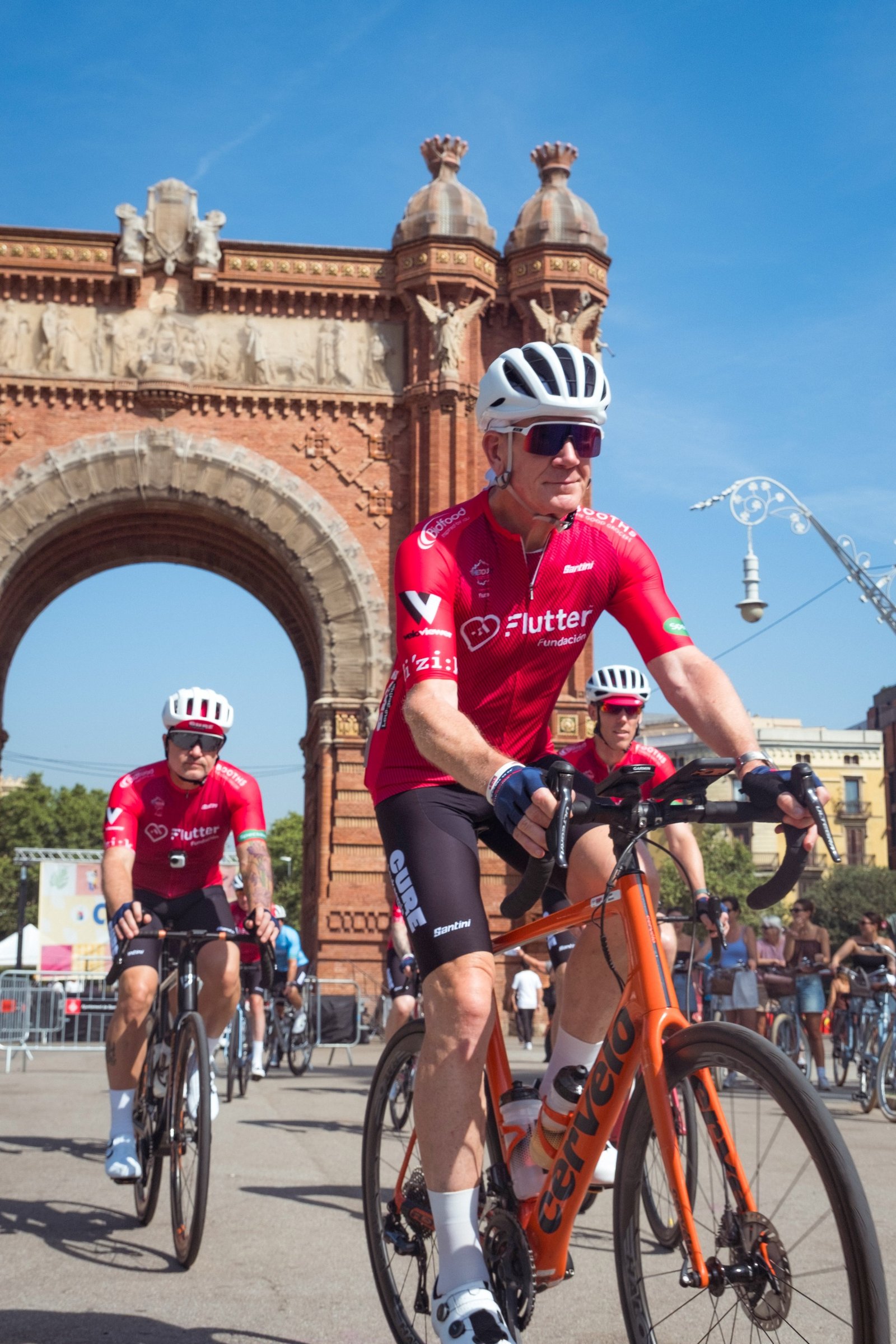

Mission accomplished – the charity team roll into Paris
(Image credit: Bob Munro)
Team-mate’s view: ‘His smile kept me going’
Fellow ‘Tour 21’ rider Jeff Davis, 53, from Redondo Beach, California, had his own deeply personal motivation for signing up to the challenge
“My daughter [Lucy] was diagnosed with leukaemia three years ago, when she was 17. Having been a cyclist for nearly 30 years, I turned to cycling to ease my sorrows – it has really helped me cope with what we’re dealing with as a family.
“I saw a mini documentary [about ‘Tour 21’], which inspired me to step forward. It felt like a good way to pay it forward and to do something good with my passion while helping other families.
“I had a bike crash about two months before the event and had surgery on my shoulder, so I was battling the consequences of that. The weakness on the affected side made me adjust my position on the bike, meaning my lower back was screaming at me every day.
“Bob was an inspiration to me – just seeing him battle adversity day in, day out was such a motivator. Seeing his smile every day really, really helped me get back on the bike and keep going. Getting to know him, and hearing that a medical trial saved his life, has given our family some hope too.”
This article was first published in the 27 August 2026 print edition of Cycling Weekly magazine – available to buy on the newsstand every Thursday (UK only) while digital versions are available on Apple News and Readly. Subscriptions through Magazine’s Direct.
Read the full article here