

This is a chaotic week in the basketball world.
The transfer portal is churning. Friday is the NBA Draft declaration deadline, and a handful of potential first rounders — Duke’s Patrick Ngongba, UConn’s Braylon Mullins, and both Florida’s Alex Condon and Thomas Haugh — have already elected to return to college. Others remain undecided, weighing NIL offers against draft-slot expectations. The Portsmouth Invitational just wrapped up, quietly reshuffling the second round. Front offices are still trying to sort out who’s actually in this class. At least they know the draft order, now that the NBA has determined tiebreakers.
Oh and by the way, the Pistons, Celtics, Spurs, Knicks, and Nuggets all just dropped one of their first two games at home in the first round.
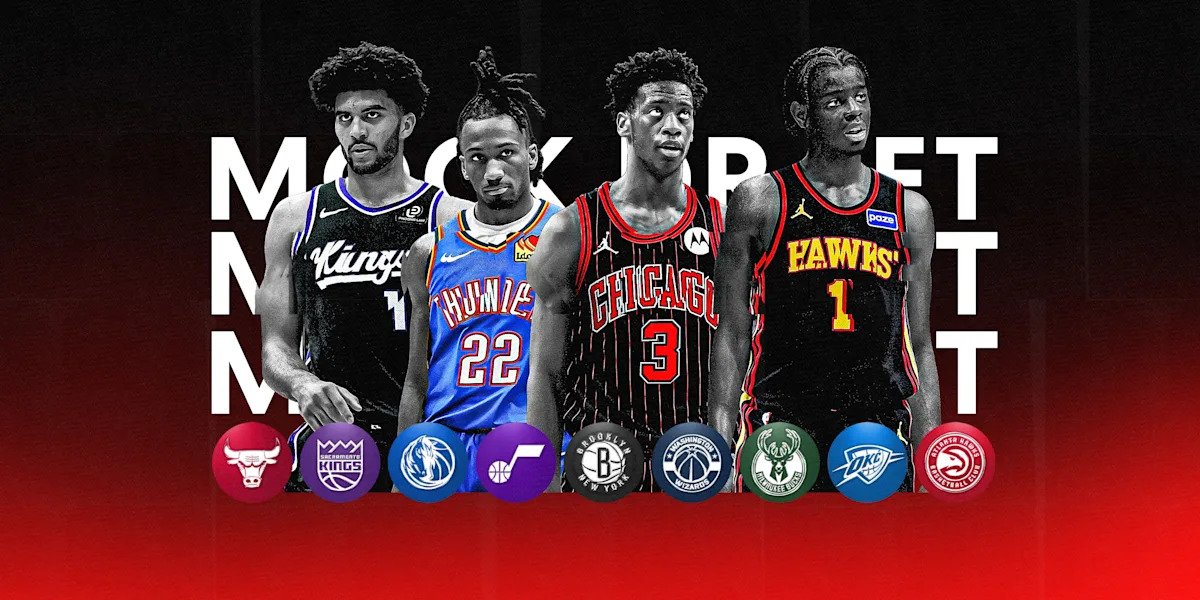
So this mock matches the wild mood. We’re maximizing the chaos. What happens if all three teams with the 14% flattened odds fall out of the top four? What happens if — gulp — the Thunder move into the top four? Here’s my full two-round mock draft with analysis for every single pick. Let’s get to it:
(Henry Russell/Yahoo Sports Illustration)
AJ Dybantsa, 6-9, BYU freshman forward
Artūras Karnišovas and Marc Eversley got fired. And Billy Donovan decided to decline his option as head coach. But what really changes? The team felt no different under them than it did with Gar Forman and John Paxson leading the front office. The common denominator: The Reinsdorf family is still in charge. But maybe all they really need is some lottery luck to escape the middle. If the Bulls are lucky enough to move up from the ninth-best odds, it’d be hard to imagine them taking anyone but Dybantsa, who led the nation in scoring as a freshman by averaging 25.5 points for a top-25 team.
At 6-foot-9, players his size are not supposed to move with the herky-jerky elasticity that Dybantsa does. He can dunk over defenders. He can stop on a dime and fade away from midrange. And he can catch fire from behind the line too. BYU head coach Kevin Young said Dybantsa’s scoring talent is “in rare air with some of the greats.” Over the course of his freshman year, he began to make dramatic progress as a passer, too, as shown with his cross-court, pinpoint passes to find shooters. But with the Bulls, there’d be less of a need for his playmaking with point guard Josh Giddey on the roster. Matas Buzelis can handle the ball too. And all of them are tall. The three of them would have the upside to become an unstoppable trio given their blend of size and skill.
Caleb Wilson, 6-10, North Carolina freshman big
Front office executives around the NBA increasingly believe Wilson could be the second player taken in June’s draft. While his exact spot won’t be clear until after the Draft Lottery, once each pick is determined, some teams value the high-flying North Carolina freshman above the more ground-bound Cam Boozer from Duke. Others view Wilson as having similarly high upside as Kansas guard Darryn Peterson with dramatically lower downsides due to Peterson’s availability concerns.
If there’s one thing the Hawks could use it’s an athletic big to pair in the frontcourt with Onyeka Okongwu, or serve as an alternate lone big on the floor. And Wilson is arguably the most gifted athlete in the draft class. He’s 6-10 with springs for legs, and when he’s flying above the rim, finishing through contact, and chasing down everything in his area code, he looks like a future cornerstone. But the case against Wilson is pretty clear too. Despite all his positives, he hasn’t shown consistency as a shooter at any level. That would matter less on the Hawks, though, given they can utilize lineups with shooting at every other spot on the floor. Wilson’s other defining traits on their own would provide star-level upside to an already emerging Atlanta roster.
Cameron Boozer, 6-9, Duke freshman forward
The Kings need a leader. Boozer fits the bill. He’s a do-it-all offensive talent who can post up, run pick-and-rolls, set screens, spot up, and crash the boards. He doesn’t need to rely on bully ball to make an impact as a scorer or passer. That said, the acquisition would almost certainly signal the end of the Domantas Sabonis given their overlapping strengths and weaknesses. Defensively, some of the questions about Boozer popped up in Duke’s Elite Eight loss to UConn: He wasn’t big enough to defend Tarris Reed, and he got smoked by Alex Karaban on a key 3-pointer on the perimeter. But he plays hard and has improved at every weakness in his game so far. That approach is exactly the type of player Sacramento needs to bring into its organization.
Darryn Peterson, 6-6, Kansas freshman guard
Can you imagine? There’s a 7.1% chance the Thunder move into the top four. While OKC could still find a difference-maker in the 12th spot, moving up would undoubtedly be the most chaotic possible event on lottery night. Because here, there are possible franchise-changers, including Peterson with his gifted shot-making upside. He can pull up from anywhere and get to his spots. Plus he’s 6-6 and plays with a fluidity that just screams superstar. After playing a largely off-ball role at Kansas, he could shine in similar responsibilities early in his career for the Thunder. This would give him the ability to play with one or both of Shai Gilgeous-Alexander and Jalen Williams. Not to mention he’s a defensive playmaker with the tools to guard multiple positions and the approach to impact the game even if he’s not scoring. Between the cramping saga, the missed time, the lack of apparent athletic pop, and the stretches where he played heavy minutes but struggled to produce offensively, there’s a lot to be concerned about. But the pre-draft period could answer any questions. And for the Thunder, he could be worth the swing anyway. Because if he’s a hit, SGA-Peterson would have the upside to be the NBA’s best backcourt for the next decade. And if he doesn’t, SGA-Williams already does.
Keaton Wagler, 6-6, Illinois freshman guard
It would be devastating for the Wizards to fall four spots for the second consecutive season. But maybe, just maybe, Wagler could end up far exceeding expectations just like he did as a freshman at Illinois. Wagler was never expected to be a one-and-done, and yet he led Illinois all the way to the Final Four. He’s not an elite vertical athlete, as evidenced by his zero dunks on the year. But he is 6-6 with a long wingspan, has elite footwork, can decelerate on drives, and has an excellent feel for the game. He and Tre Johnson could grow into a dynamic duo for the Washington backcourt for years to come.
6. Los Angeles Clippers (via Pacers)
Mikel Brown, 6-5, Louisville freshman guard
Tyrese Haliburton told Pacers fans not to get used to no games being played in April, May, and June. Odds are he’s right. But it sure would help to keep their top-four protected pick that was sent to the Clippers in the Ivica Zubac deal. But in this mock, congrats Los Angeles!
That said, picking here would be an odd spot for the Clippers. They already have Darius Garland at point guard. And the players most projected in this range are also small guards. Are we sure an upside forward like Karim Lopez or a national champion like Yaxel Lendeborg won’t leapfrog them?
Nonetheless, we’re sticking with a guard in this mock. There is some logic to creating a high-powered scoring backcourt. When Brown is in the zone, he has an unstoppable pull-up jumper, shows an ambidextrous finishing ability, and makes quick reads to rifle passes before the defense has time to react. He had a 45-point breakout performance in February, but a back injury dogged him throughout his freshman year. If Brown had stayed healthy, he might feel like less of a reach at this spot over guards typically projected ahead of him. And maybe he’ll play his way into that through pre-draft workouts. But for now, the absences muddy the evaluation and leave real questions about his consistency that may not get answered until he’s fully healthy.
Darius Acuff, 6-3, Arkansas freshman guard
Acuff is a wiry scorer who can get a bucket from anywhere on the floor with a quick trigger, slippery handle, and a feel for manipulating defenses. He can also thrive off-ball as a shooter and cutter, which would be vital for a Nets roster already full of ball-handlers. Acuff would have the highest upside of them all, though. He entered college with a scoring reputation, but has emerged as a skilled, low-turnover playmaker; he looks like a future All-Star who can toggle between a score-first or pass-first approach. Plus, he displays leadership qualities. The Nets are still badly in need of a lead dog. Acuff could be that guy.
Brayden Burries, 6-4, Arizona freshman guard
Good thing the Jazz won their coin flip! But falling to this choice would put them in a strange position given it’s largely guards projected in this range. With Keyonte George already leading the backcourt, drafting another one might be less than ideal. But Burries doesn’t need the ball to make an impact. He stays pedal to the metal with hustle plays all over the floor. He also flashes stardom as a shot-creator, which helped him earn his spot as a potential lottery pick. He plays with physicality and can beat you from all three levels. He’s a methodical creator rather than an explosive one. If he doesn’t turn into a star scorer, Utah has plenty of other on-ball talents anyway which would allow Burries to slide in as a Swiss Army knife in the backcourt.
Kingston Flemings, 6-4, Houston freshman guard
After staying stagnant most of the year with the eighth-best odds, Dallas and New Orleans picked up some late wins to help the Grizzlies slip into the sixth spot, which comes with 3% better odds at the first pick, and 11% better odds at the top four. This difference better positions the Grizzlies to find their replacement for Ja Morant. And the answer could be Flemings, who entered the season as the least-heralded of Houston’s stacked freshman class, but played his way into the top-10 conversation while his higher-ranked teammates played their way out of it. He’s a 6-4 ball-handler who can get to his spots, make advanced passes, and limit turnovers in a way that resembles a veteran guard. If he lands with Memphis, he could grow alongside a center like Zach Edey, a wing like Cedric Coward, and a long list of young talents still under 25 years old.
Labaron Philon, 6-4, Alabama sophomore guard
Beating the Blazers, Lakers, and Bulls over the last nine games of the season has to sting, at least if you’re a Mavericks fan who was rooting for better lottery odds. Falling two spots on lottery night would especially hurt. But Philon could be an extraordinary consolation prize. The Alabama sophomore is a shifty, score-first point guard who turned into one of the best guards in college basketball as a sophomore. He doubled his scoring output with buttery floaters, a deceptive handle, and a feel for running an offense, while also beginning to shore up the shooting questions that once clouded his projection. If he lands with Dallas, it’s hard to imagine a better situation. Kyrie Irving could serve as a mentor, and Philon could grow alongside a future MVP candidate in Flagg.
Yaxel Lendeborg, 6-9, Michigan senior forward
Bucks general manager Jon Horst has historically taken younger, theoretically higher upside prospects. Once that player turned into Giannis Antetokounmpo. Other times he’s turned into Thon Maker. Drafting Lendeborg, who will be 24 as a rookie, would go against the grain. But every player’s journey is different. Despite his age, he offers do-it-all upside. He fills the stat sheet with points, boards, and everything else, he can play multiple positions, and he has a 7-foot-4 wingspan at 240 pounds with a genuine handle. Lendeborg got better every year as a 3-point shooter in college and ended up making 37.2% on 4.5 per game as a senior. The heart he showed playing through injury to help lead Michigan to a national championship cannot be understated. Whether or not Giannis is in Milwaukee’s future plans, Lendeborg would offer a path forward.
Karim Lopez, 6-8, New Zealand Breakers forward
The Warriors are awaiting Steve Kerr’s decision on his status as head coach of the team, but general manager Mike Dunleavy Jr. received a contract extension. He’s at the controls once again. By draft night, he’ll have clarity about Kerr’s future — and likely about the futures of Stephen Curry and Draymond Green too — but it may not impact his approach with the player he selects. One player who has gone under the radar throughout the pre-draft process, since he spent two seasons in the NBL’s Next Stars program, is Lopez. He averaged 12 points and six rebounds playing his games against grown men, and got better in each of his two seasons. He’s a smart cutter who finds scoring lanes within the flow of the offense, a solid shooter, and a versatile defender. That two-way versatility would work well with the Warriors, who need to replenish the roster with some upside. If Green sticks around long term, he could actually be quite a good mentor for Lopez, given they’re both hard-nosed players who make a winning effort at all times on the court.
Hannes Steinbach, 6-11, Washington freshman big
Erik Spoelstra just doesn’t have any trust in Kel’el Ware. Even if things work out, it wouldn’t hurt making another investment in the frontcourt with the type of player that has all the qualities that Spo admires. Steinbach played professionally in Germany before enrolling at Washington, and he’ll enter the NBA with some ready-made skills as an interior scorer and rebounder. He has massive hands that he uses to grab every possible rebound and finish effectively around the basket. He also showed legitimate touch on 3-pointers in flashes, which would turn him into a very different player if it becomes real. Given how successful the Heat were at helping Bam Adebayo develop his 3-pointer, Steinbach could see the same trajectory in Miami. Additionally, Steinbach probably needs a Bam type next to him in the frontcourt since he’s a bit of a modern tweener himself. Steinbach is not a true 7-footer, and there are specific matchups where he gets targeted in space. He needs to be the right kind of center for the right team. That could be Miami.
Aday Mara, 7-3, Michigan junior center
While Michigan awaits Mara’s decision whether to enter the draft or return for a chance to repeat as national champions, the Wolverines are exploring transfer portal centers like Georgetown’s Vincent Iwuchukwu and Cincinnati’s Moustapha Thiam. The NBA is similarly awaiting Mara’s choice. For now, he remains in the mock as a projected late-lottery or mid-first-round pick.
Mara stepped on UCLA’s campus as a lottery-projected center from Spain. Then he fell off draft boards during two forgettable seasons there before transferring to Michigan and becoming one of the best true 5s in the country. He reads the floor like a guard, finishes with both hands, and swats shots with elite timing. The complication is he doesn’t shoot from outside, makes below 60% of his free throws, and opponents are going to attack him on the perimeter. But the Hornets need size. As good as Moussa Diabate is as the team’s starting center, they drafted Ryan Kalkbrenner to provide size off the bench. But he’s only fine. Mara offers significantly higher upside.
15. Chicago Bulls (via Portland)
Christian Anderson, 6-3, Texas Tech sophomore guard
What a win for the Bulls that the Trail Blazers advanced to the playoffs, since this pick is now theirs — and what an extra special bonus it’d be if they also move up to the top-four like they do in this mock draft to select Dybantsa. With this pick, they get Anderson, who showed up at Texas Tech as the 101st-ranked recruit and has played his way into the first round behind dynamic pick-and-roll creation and knockdown perimeter shooting. The Bulls have a lot of smaller guards on their roster, but no one is guaranteed to stick. That’s where Anderson could help right away with his ability to thrive with the ball — and without the ball, when Dybantsa, Giddey, and Buzelis have possession. At his small stature, he hasn’t shown a consistent ability to get to the rim with any regularity, though, and he struggled to create his own shot when Texas Tech lost in the tournament. Any small guard will always be a target on defense, too, so there’s a lot of pressure on his shot translating to the next level. But at least he’d have long-armed wings around him in Chicago.
16. Memphis Grizzlies (via Orlando)
Dailyn Swain, 6-8, Texas junior wing
Swain would be another upside play for Memphis. He played two competent seasons at Xavier, transferred to Texas, and somehow became the most efficient isolation scorer in the entire country. He’s relentless getting to the rim, creative as a finisher, and active enough defensively to project as a switchable wing. But the reason he lives at the rim is because his jump shot is genuinely ugly. He has stiff mechanics, bad percentages, and a reluctance to even attempt it that goes all the way back to high school. Until his shooting becomes a credible threat, defenses are going to pack the paint and dare him to beat them from the outside. With Coward, Flemings, and tons of other shooters on the roster, there’d be plenty of space for Swain to operate inside the arc, though, providing a balance with his downhill attacking.
17. Oklahoma City Thunder (via Philadelphia)
Koa Peat, 6-8, Arizona freshman forward
Oh look, another pick for the Thunder. Why not take a swing here on a player who was expected to be a lottery pick? Peat’s bloodline is so loaded with offensive linemen that it’s almost funny he ended up playing basketball. His father played nine NFL seasons. His uncle was a Pro Bowl tackle. Two brothers played college ball on the line. And you can absolutely see it in how he plays: powerful, physical, relentless, and it genuinely takes something special to stop him from getting to where he wants to go. But he also shoots like a football player. He took only 20 shots from 3 and made just 62.3% of his free throws, which is the whole reason why he’s not a lottery lock anymore. But the Thunder have a way of making everyone learn how to shoot. And if he figures it out someday, there’s star upside.
18. Charlotte Hornets (via Orlando)
Nate Ament, 6-10, Tennessee freshman wing
Tennessee fans are waiting for Ament to choose whether to return to college or head to the NBA. League front office executives tell me that his agency, LIFT Sports Management, is split on the decision because they believe that Ament could be the No. 1 pick in 2027. If Ament falls outside of the lottery, he’d be playing for less money this year and potentially hurting his future earnings. For financial reasons it may make sense to return, and more importantly, for his own development to get one more year to improve physically and progress his skills.
If Ament stays in the draft, he could very well end up in the lottery as he was expected to prior to the season. But there’s also a strong possibility he slips. It would be hard for the Hornets to pass at this point, though. Players who can handle, shoot off the dribble, and stand at 6-10 don’t grow on trees. This physical foundation kept Ament in lottery consideration even after a dreadful start to his freshman season when he struggled to score efficiently and make an impact defensively. But over the second half of the year for Tennessee, he flipped a switch and shots began to fall. He averaged 23.8 points over a six-game stretch in January and February that reminded everyone why he was a top recruit in the country. Then he dealt with an ankle injury that ruined his momentum entering March. At some point, a team will bite, though.
Stirtz feels the game at a different frequency than everyone else on the floor, and yet still makes scouts squint because he doesn’t look the part athletically. At age 24 for a rookie, he’s also on the older end. The question isn’t whether he can play, though. After transferring from Drake to Iowa, he kept cooking with bullseye passes, pump-fakes, and shooting touch off the dribble from NBA range. The odds are that’ll carry over to the next level, especially if he lands on a team like the Raptors that can surround him with size, length, and versatility. And Toronto needs another engine to the offense; if Stirtz adjusts to the physicality and speed of the NBA, he could thrive as both a floor general and off-ball connector.
20. San Antonio Spurs (via Atlanta)
Allen Graves, Santa Clara freshman forward
The analytics love Graves. He came off the bench and scored only 11.8 points, but he filled the stat sheet, hit over 40% of his 3s, and could find himself in the mid-first if he decides not to stay in college. The Spurs could go so many different directions with this pick. That’s the benefit of having Victor Wembanyama as the centerpiece. With plenty of downhill attacking thanks to their point guard trio, adding another role player to help someday succeed Harrison Barnes could be a wise move. And that’s why Graves would make all the sense in the world.
21. Detroit Pistons (via Minnesota)
Isaiah Evans, 6-6, Duke sophomore wing
Evans is a legitimate sharpshooter with the off-ball chops to thrive without even running any offense for himself, which is a perfect fit in Detroit, where Cade Cunningham needs live targets in the corners. The Pistons were 29th in 3-point attempts and 17th in 3-point percentage this season, so more shooters like Evans are needed. With the Pistons down 1-0 to the Magic, what felt missing? Secondary creation. As a sophomore, Evans made great progress on-ball as well, getting to the rim with a greater frequency while showing flashes as a playmaker. In the long term, he could have higher upside as a shot-creator.
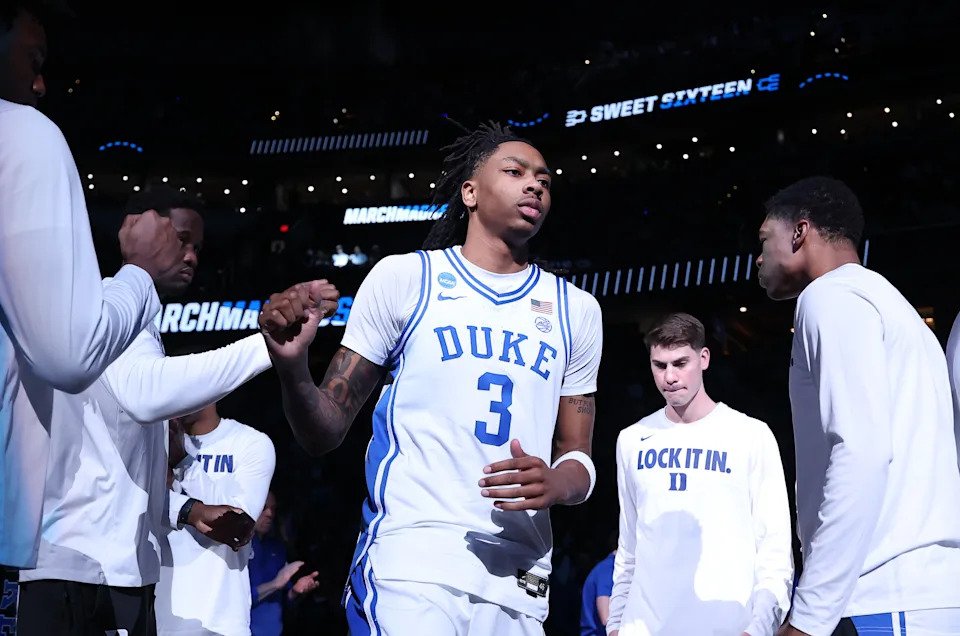
Isaiah Evans was Duke’s second-leading scorer, averaging 15 ppg. (Photo by Scott Taetsch/NCAA Photos via Getty Images)
(Scott Taetsch via Getty Images)
22. Philadelphia 76ers (via Houston)
Motiejus Krivas, 7-2, Arizona junior center
The Sixers just had an epic Game 2 win on the road against the Celtics. Will Joel Embiid return soon? Andre Drummond and Adem Bona have done a quality job filling his shoes, but the Sixers still need a longer-term solution. Krivas is a 7-2 Lithuanian center who does the old-school things by rebounding, protecting the rim, and scoring in the post. But he also brings a modern flair with his ability to make good reads as a passer and the flashes he shows as a shooter. Krivas could anchor bench units when Embiid is healthy, and potentially play a bigger role when he’s not. No matter what happens with Embiid, Tyrese Maxey and VJ Edgecombe are both young pieces who need a big man to support them. Krivas has all the tools needed.
Krivas may not keep his name in the draft, however. Executives say he’s received an extremely lucrative offer to stay in Arizona for next season, one that would be worth more than what he could earn in his slot at $3.4 million as a rookie drafted 22nd. By Friday, we’ll know what Krivas decides.
23. Atlanta Hawks (via Cleveland)
Cameron Carr, 6-5, Baylor redshirt sophomore wing
Carr shot nearly 40% from 3 on high volume, and looked like a 3-and-D role player who also has tantalizing skills off the dribble. With NBA genes in his blood, as the son of former player Chris Carr, Cameron has the skills to make it in the NBA. But at 175 pounds with not a ton of games under his belt, he’s going to get introduced to the NBA’s physicality in a way that might limit his ability to get to his spots as a scorer. The Hawks could use a bit more scoring on the backend of the bench, as long as they can stay patient.
24. New York Knicks
Morez Johnson, 6-9, Michigan sophomore forward
Michigan is filled with so much star power that Johnson is the guy who often gets overlooked nationally. He’s a 250-pound wrecking ball with surprisingly soft hands and the defensive IQ to guard 1 through 5 in a switch-heavy scheme. And he makes constant plays beyond the box score with bone-crushing screens, full-court sprints, and high IQ rotations that blow up the opponent’s action. There’s a chance that Johnson returns to Michigan this year, especially with more scoring chances about to open because of the departure of Lendeborg. But if he stays in the draft, he’d make perfect sense for the Knicks as a bruiser in the frontcourt next to Karl-Anthony Towns.
25. Los Angeles Lakers
Amari Allen, 6-7, Alabama freshman forward
As a 6-7 wing, Allen does a little bit of everything without needing touches, rebounds like a big, and displays incredible defensive versatility. The concern is purely about his upside, since he hasn’t shown many star flashes. But the Lakers already have the on-ball creation handled by Luka Dončić, Austin Reaves, and LeBron James. Allen could slide in as a perfectly fitting role player.
26. Denver Nuggets
Chris Cenac, 6-11, Houston freshman big
Cenac checks every box on paper as a superb athlete who moves like a wing, has the length to alter shots, and has a habit for shooting from the perimeter. But the Cougars fell short again, in part because Cenac struggled to stay out of foul trouble, couldn’t score efficiently, and was overeager to play on the perimeter despite having the body of a bruiser. If the Nuggets draft him, he’s more of a developmental project. But there’s no harm in taking a swing when the roster has roles already occupied. Plus, Peyton Watson will be entering free agency this summer, so the Nuggets may need to fortify the forward spot. The Nuggets can afford to be patient, deciding to bet on his development, with the hopes that he someday becomes a reliable shooter. Just like Watson.
27. Boston Celtics
Jayden Quaintance, 6-10, Kentucky sophomore big
Quaintance is going to get drafted based almost entirely on what he looked like before his knee exploded. As a freshman at Arizona State, he was blocking everything in sight, showing defensive instincts and mobility that players with his 6-10 frame aren’t supposed to have, and he was 17 years old doing it. Then came the ACL, the meniscus, the fractured knee, the transfer to Kentucky, persistent swelling, and a shutdown for the remainder of his sophomore season. Now teams have to make a decision after 28 games of great defense and eyesore offense. He might not fall this far. But if he does, it’d make perfect sense for the Celtics to scoop him up and hope he can stay healthy. If he does, he has the potential to be the steal of the draft.
28. Minnesota Timberwolves (via Detroit)
Ebuka Okorie, 6-2, Stanford freshman guard
Okorie is a live-wire guard with a tight handle, the burst to turn the corner, and the pull-up range to keep defenders honest. Mike Conley isn’t getting any younger in Minnesota, Rob Dillingham is gone, and Bones Hyland is no guarantee to stay next season. So Okorie could become quite useful in Minnesota, and a potential building block next to Anthony Edwards. At only 6-2 with an average wingspan, he’ll get hunted on defense. But at least he’d have long-armed wings and bigs around him as support in Minnesota.
29. Cleveland Cavaliers (via San Antonio)
Henri Veesaar, North Carolina junior big
Veesaar is an agile big with real shooting touch, connective playmaking, and baseline big skills with the ability to set screens and catch lobs. He also offers rim protection and is a locked-in help defender. He might not even enter the draft, as he remains undecided. But if he does, it’d make perfect sense for the Cavaliers to scoop him up since he could operate as a big man next to either Jarrett Allen or Evan Mobley.
30. Dallas Mavericks (via Oklahoma City)
Tounde Yessoufou, 6-5, Baylor freshman wing
After landing Philon in the lottery as their point guard of the future, the Mavericks can use this pick to find a go-to scorer on the wing to pair alongside Flagg. Why not Yessoufou? He entered Baylor as a projected lottery pick with freakish athleticism, a relentless motor, and the kind of physicality that makes scouts dream. But Baylor missed the tournament, and when quality opponents took away his drives, there wasn’t much left in his arsenal. He’s still a shaky shooter, and he needs to improve his passing feel and defend at the level his physical tools suggest he should. But at the end of the first round, no prospect is perfect. And none offer much upside more than him.
SECOND ROUND
31. New York Knicks: Alex Karaban, UConn senior forward
Karaban will be 24 as a rookie, but he’s just a winner. He cuts. He passes. He’s a high IQ defender who’s always in the right position. He doesn’t create his own shots, but the Knicks have plenty of guys who can do that. What Karaban would add is winning intangibles to a team trying to take the next step.
32. Memphis Grizzlies: Juke Harris, Wake Forest sophomore wing
Harris reportedly has some lucrative NIL offers to stay in college, meaning he may not even end up in this draft class after averaging 21.4 points last season as a highly versatile shooter with a 6-7 frame. But if he does stay, he’d make perfect sense as another investment in the Memphis backcourt.
33. Brooklyn Nets: Tyler Tanner, Vanderbilt sophomore guard
Tanner can probably make himself a lot more money if he stays in school. But as a high-flying, sweet-stroking small guard he finds himself still in the late-first-round conversation, and the early second at worst.
34. Sacramento Kings: Sergio De Larrea, Valencia guard
De Larrea is a tall playmaking guard with a major feel and a knockdown jumper who thrives within team concepts. With size, smarts, and defensive versatility, he could carve out a rotation role if his limited sample proves scalable.
35. San Antonio Spurs: Meleek Thomas, Arkansas freshman guard
Thomas is a talented shotmaker who can provide microwave offense. And he’s an active defender too. The Spurs have a good amount of guards, but Thomas would bring a different type of skill set worth investing in.
36. Los Angeles Clippers: Luigi Suigo, Mega center
The Clippers won’t be able to start Brook Lopez forever. Why not take a 7-2 mammoth who displays mobility and hits some 3s? You never know what guys like Suigo can turn into.
37. Oklahoma City Thunder: Dame Sarr, Duke freshman wing
Sarr is exactly the type of player who will probably return to school. But for now, we’ll keep him in the mock. The Thunder could stash him, only to see Sarr turn into the new Lu Dort three years from now.
38. Chicago Bulls: Zuby Ejiofor, St. John’s senior big
So far in this mock the Bulls have taken a forward in Dybantsa, a guard in Anderson, and now they get a big in Ejiofor, who brings an edge to the floor. It’s really in his name.
39. Houston Rockets: Tarris Reed, UConn senior center
Reed is an interior bruiser, rebounder and shot-blocker. Steven Adams is getting old and injury prone. Reed is an investment in a future without him.
40. Boston Celtics: Keyshawn Hall, Auburn senior forward
Hall became a do-it-all weapon for Auburn, and in the NBA his 6-7 frame and reliable stroke from 3 give him 3-and-D potential. He’d fit like a glove in the Boston rotation.
41. Miami Heat: Joshua Jefferson, Iowa State senior forward
Jefferson can pass out of the post, make connective reads, and guard multiple positions. He just needs his shooting progress to prove to be real, and right now there’s not enough of a sample to be sure it is. The Heat can help him there.
42. San Antonio Spurs: Michael Ružić, Joventut forward
It’s hard to imagine the Spurs keeping all of these seconds. If they do, a draft-and-stash would be necessary. Ružić is a raw Croatian forward who was born in France and now plays in Spain. He projects as a quality shooter with passing feel, though he’s incredibly raw.
43. Brooklyn Nets: Trevon Brazile, Arkansas senior forward
Brazile once had some believers that he could end up a first-round pick in the NBA before injuries set him back. But as a senior, he finally looked like the bouncy, versatile forward that put him back on draft boards.
44. San Antonio Spurs: Adam Atamna, ASVEL guard
As mentioned above, the Spurs would have to draft-and-stash some of these picks. Atamna would make perfect sense after playing for Tony Parker’s ASVEL in the EuroLeague, showing shooting upside with a 6-5 frame.
45. Sacramento Kings: Alijah Arenas, USC freshman guard
Arenas would be better served returning to school to improve his draft stock. But staying in California to hone his scoring talents at the professional level could have appeal too.
46. Phoenix Suns: Malik Reneau, Miami senior forward
Reneau is a 6-9 bruising forward who came home to Miami after three years at Indiana and blossomed into an All-ACC scorer behind old-school post footwork, surprisingly slick passing, and a newfound 3-point jumper.
47. Dallas Mavericks: JT Toppin, Texas Tech junior forward
Toppin is a defensive stalwart with elite athleticism, quick hands, and the motor of someone who genuinely cannot stop competing. The issue is he’s limited offensively and tore his ACL, which puts him in a tough spot whether to stay another year in school or go recover in the NBA.
48. Orlando Magic: Milan Momcilovic, Iowa State junior forward
At 6-8, Momcilovic made 48.7% of his 7.5 3-pointers per game. That’s all you gotta know about what he’s capable of as a shooter.
49. Toronto Raptors: Ryan Conwell, Louisville senior guard
Conwell has shot-making skill as a high-volume shooting guard, which could eventually earn him some minutes in Toronto’s rotation.
50. Denver Nuggets: Milos Uzan, Houston senior guard
Uzan is a high-IQ combo guard who knits teams together with his playmaking skills and defensive hustle. The Nuggets tend to value guys in that mold.
51. Washington Wizards: Rueben Chinyelu, Florida junior big
Chinyelu is an elite rebounder and rim protector. He could be a great fit in the frontcourt next to the leaner, more versatile Alex Sarr.
52. Houston Rockets: Braden Smith, Purdue senior point guard
Smith was one of the best point guards in college basketball, but he projects as a rotation guy in the NBA. The Rockets could potentially use his creation off the bench.
53. Los Angeles Clippers: Rafael Castro, George Washington forward
Castro is 6-10 but has guard-like fluidity, speed, and passing feel. But he’s only played at the Atlantic-10 level, and he hasn’t shown an outside shot.
54. Golden State Warriors: Flory Bidunga, Kansas sophomore big
Bidunga is an explosive leaper who dominated the Big 12 as Defensive Player of the Year, though he’s undersized for a true 5 and has no perimeter shot. He has transferred to Louisville, so he could very well stay in college.
55. New York Knicks: : Mouhamed Faye, Paris center
Faye would be another big man for the Knicks, but he’d likely be a draft-and-stash to develop overseas.
56. Chicago Bulls: Baba Miller, Cincinnati senior forward
Miller has long been a fascination of scouts as a 6-11 guy who can handle the ball. But he never really put it together as a shooter. Maybe the Bulls could have better luck than any of the three schools he went to.
57. Atlanta Hawks: Dash Daniels, Melbourne guard
Hey, why not draft Dyson’s brother? Dash can’t really dribble right now but, much like his brother, he’s a fantastic defender. He could be worth the investment for Atlanta.
58. New Orleans Pelicans: Jaden Bradley, Arizona senior guard
Arizona looked hopeless any time Bradley wasn’t on the floor. He’s a stabilizing guard, he hits big shots, and he makes plays on defense. He might be a senior, but he has the tools to get drafted.
59. Minnesota Timberwolves: Richie Saunders, BYU senior wing
Saunders is a hard-nosed, two-way wing who plays with manic energy and a quick trigger jumper. But he tore his ACL and is already 25 years old.
60. Washington Wizards: Izaiyah Nelson, South Florida big
Nelson is a high-flying big man who led the AAC in double-doubles with his elite dunking, rebounding, and help-side shot-blocking.
Read the full article here