



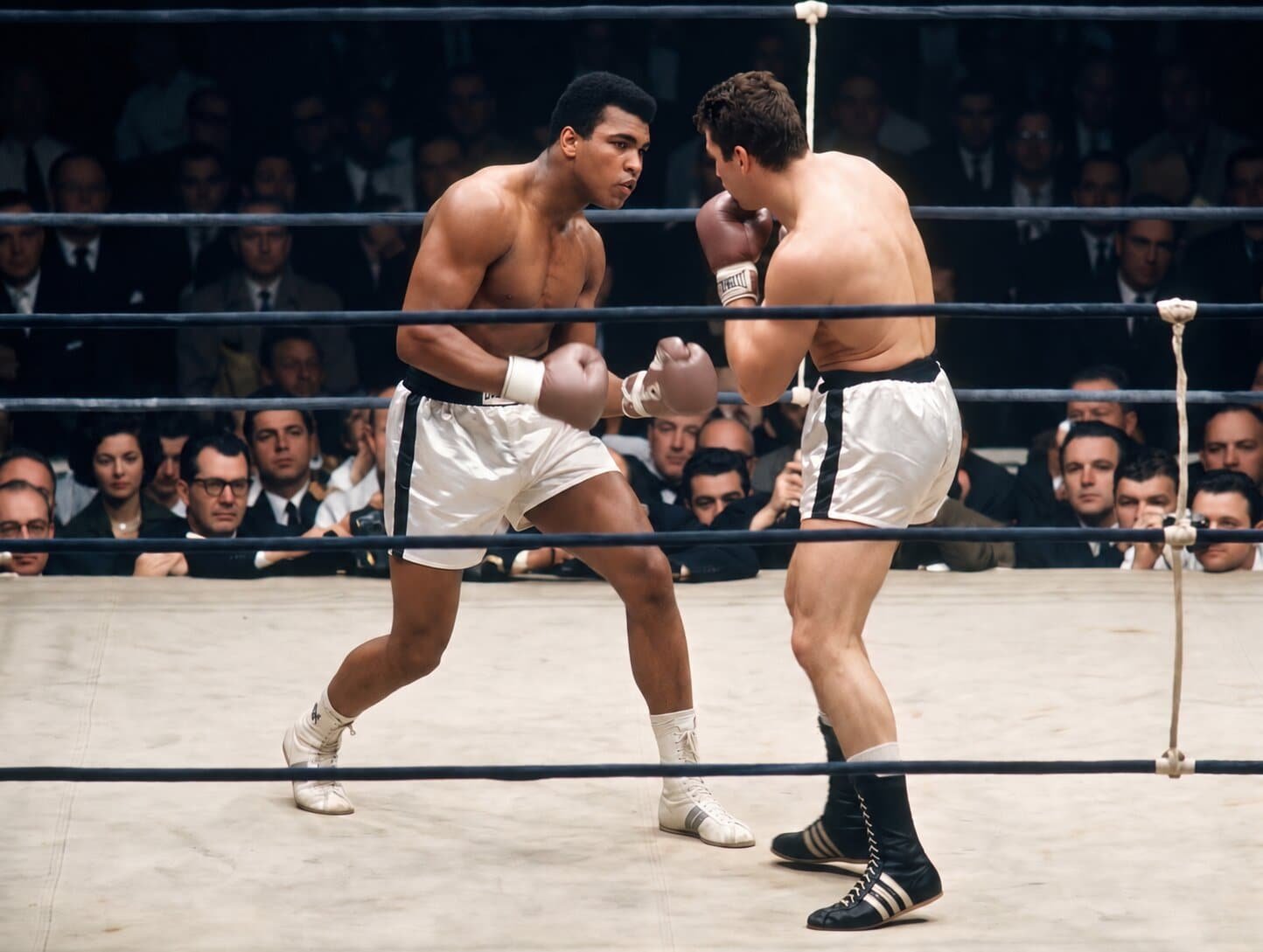

The German challenger pressed behind awkward angles and drove his left hand into Ali’s body. Ali was accustomed to orthodox heavyweights following him around and walking into his jab. Mildenberger’s reversed stance changed the location of the openings and forced the champion to calculate instead of simply performing.
Ali’s jab initially ran toward Mildenberger’s lead shoulder rather than the center of his face. He also had to judge distance against a right foot and right hand occupying positions normally filled by an orthodox opponent’s left side.
The tactical answer came through Ali’s feet. By circling outside Mildenberger’s lead foot and adjusting his pivot, Ali created a direct lane for his straight right across the southpaw jab.
A right hand dropped Mildenberger late in the fifth. His left eye was cut during the sixth and nearly closed by the eighth, when Ali put him down again. Another right sent the challenger tumbling in the tenth. Ali had found the punch that the stance initially concealed.
The adjustment was aided by his extraordinary activity. Mildenberger was his fourth title defense in less than six months, following George Chuvalo, Henry Cooper and Brian London. Modern champions often spend months rebuilding their timing between appearances. Ali arrived in Frankfurt with his legs, reactions and distance judgment sharpened through constant competition.
When the southpaw stance disrupted his familiar rhythm, he possessed the conditioning to keep experimenting without surrendering control of the fight. Mildenberger lacked Ali’s speed, but his southpaw left naturally lined up with the champion’s liver and ribs. Rather than wasting the entire night chasing a moving head, he repeatedly attacked the body.
One liver shot during the tenth hurt Ali badly enough for Angelo Dundee to remember it years later. Dundee’s recollection prevents the fight from being reduced to another comfortable Ali exhibition. Mildenberger found an area where the champion’s reflexes offered less protection. Joe Frazier later turned body pressure into a much harder weapon against Ali, although his methods were different. Mildenberger supplied an early demonstration of the basic idea: take away Ali’s legs by making his torso pay whenever his head escapes.
The challenger’s resistance also challenged the convenient American portrayal of European heavyweights as soft opposition. Mildenberger survived three knockdowns, fought through severe facial damage, and continued attacking Ali’s body after the result had become obvious.
His durability did not make the contest close, but it forced the finest athletic version of Ali to work into the 12th round. It says more about the performance than dismissing Mildenberger as another name on a championship record.
By the 12th, Mildenberger’s courage had become dangerous to him. His face was swollen, both eyes were damaged, and blood was running from his nose. Ali unloaded combinations while the challenger reeled without protecting himself. Referee Teddy Waltham stopped the punishment at 1:30 of the round, giving Ali his sixth successful defense and a 26-0 record. A referee today might have intervened earlier. Waltham allowed Mildenberger to continue through two more rounds after the third knockdown, even with his face badly damaged and Ali landing with increasing freedom. The eventual stoppage was correct, but it also reflected an era in which challengers were commonly given every possible chance to continue.
Ali had not merely beaten a southpaw. He had solved one during the contest. The early body attack and reversed angles caused difficulty, but he adjusted his feet, opened a lane for the right hand, and punished Mildenberger for continuing to advance.
Such improvisation depended heavily on the legs and reflexes Ali possessed at 24. A slower version of the champion faced another southpaw, Richard Dunn, nearly a decade later and relied more heavily on timing and punching authority. Against Mildenberger, he had the athletic freedom to experiment until the correct route became clear.
Political hostility in the United States had already complicated his championship schedule, helping send Ali through Toronto, London and Frankfurt during 1966. The widespread license revocations did not begin until after he refused military induction the following April. Those European dates therefore belonged to an international championship tour rather than his enforced absence from boxing. Germany’s first world heavyweight title fight also carried Ali’s image to a vast television audience through a live satellite color broadcast.
Ali went to Frankfurt as a controversial American champion. He left as a global attraction whose athletic brilliance and growing international audience extended far beyond the United States.
Read the full article here