



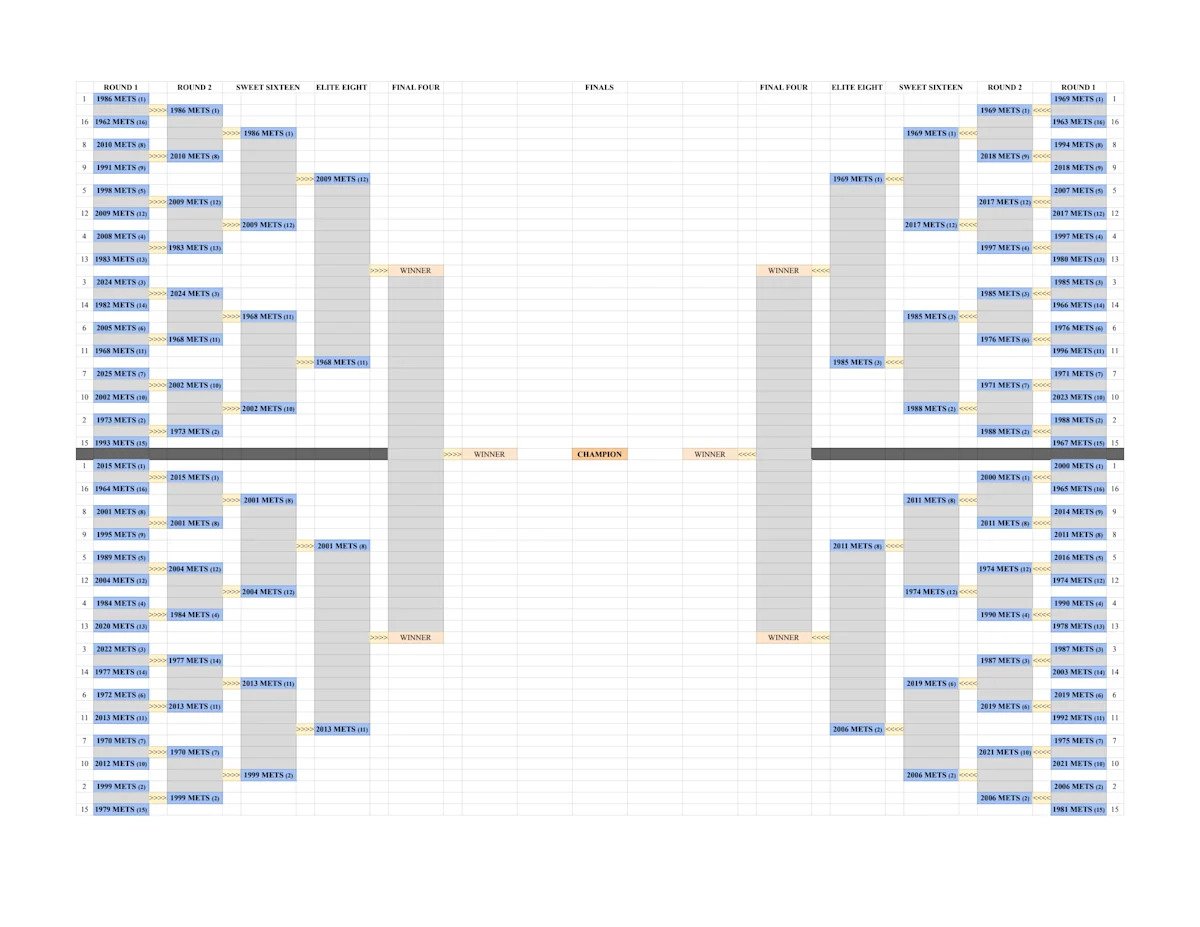
For a detailed explanation/FAQ regarding this tournament, click here.
For the First Round results, click here.
For the Second Round results, click here.
QUADRANT 1
1986 (1) vs 2009 (12)
G1: 7-1, ’09
G2: 15-2, ’86
G3: 44-3, ’86
G4: 3-0, ’09
G5: 4-3, ’09
Series MVP: Johan Santana
The Whiteyball Cardinals couldn’t do it. Mike Scott and the Astros couldn’t do it. Even winning 5-3 with one out to get, the Red Sox couldn’t do it. But there were the 2009 Mets, celebrating at Shea Stadium as the highest-ranked team in Mets Madness — and one of the best teams in baseball history — was finally eliminated. In their previous two series, the 1986 Mets dropped a game early before firing back to win in four games. It seemed that pattern was destined to repeat itself, as after getting shut down by Johan Santana in Game 1, they annihilated the ’09 squad 15-2 in Game 2 (Ron Darling turned in a four-hit, two-run complete game while Gary Carter slugged two homers) and took a tight Game 3 win on homers from Keith Hernandez and Darryl Strawberry. But then, the four-game formula was foiled. The game that will haunt the ’86 Mets forever is Game 4, in which they got shut out by a quartet of relievers (Ken Takahashi, Pedro Feliciano, Sean Green, and Francisco Rodríguez) while letting Carlos Beltrán beat them by driving in all three of ’09’s runs. The best way for an underdog baseball team to win is by having an ace starting pitcher to shut down the opposition, which might be why the ’86 team has done so much better in the back half of series (facing the weaker portion of a team’s rotation) than in the front half. They needed to win Game 4 to avoid seeing Santana again. They couldn’t do it. ’09 scraped out runs by capitalizing on a Mookie Wilson error and executing a successful squeeze bunt. With first and third and one out in the bottom of the ninth, Wally Backman looked to hit a fly ball to at least tie it — but instead, he grounded the ball to Alex Cora, who flipped it to Luis Castillo, who fired it to Daniel Murphy. Champagne in the visitors’ clubhouse after all.
2002 (10) vs 1968 (11)
G1: 8-6, ’68
G2: 5-3, ’68
G3: 5-4, ’68
Series MVP: Greg Goossen
This was a matchup of two teams with two upsets under their belt, and it showed. Each game in the series came down to the wire, packed with clutch rallies and max-effort defensive plays, making it thrillingly balanced — except for the fact that the same team won each one. In Game 1, the 1968 Mets outlasted the 2002 Mets in a battle of ineffective aces Tom Seaver and Al Leiter, with ’02 getting homers from Timo Perez, Ty Wigginton, and Jeromy Burnitz but failing to stack hits in the way ’68 did. In Game 2, a 4-0 ’68 lead turned to 4-3 in the bottom of the eighth inning thanks in part to a pinch-hit homer from Tony Tarasco, but in the following frame Greg Goossen — a future actor who would be traded the following offseason for a player to be named later (eventually Jim Gosger) — delivered a pinch-hit homer of his own for insurance. In Game 3, ’02’s previous Series MVP Mo Vaughn continued to rake with an early 458-foot, 2-run homer, but ’68 fought back. With the score tied 4-4 and the bases loaded in the bottom of the ninth inning, up stepped who else but…pinch-hitter Greg Goossen, who lined a walk-off RBI single to left-center. This MVP could have gone to Ed Kranepool, who hit .583 with two homers and five RBI in three games. It could have gone to Tommie Agee, who homered in Game 3 and went 3-for-5 while making an excellent diving catch in Game 1. But unlike Goossen’s trade value, this particular MVP need not be named later; I bestow it upon him, the pinch-hitter (and actor) extraordinaire.
QUADRANT 2
1969 (1) vs 2017 (12)
G1: 4-1, ’69
G2: 3-1, ’17
G3: 3-2, ’17 (f/11)
G4: 5-4, ’69
G5: 5-4, ’69 (f/13)
Series MVP: Art Shamsky
Upsets? Who said anything about upsets? The 1969 Mets are a one-seed that acts like it! Well, except for the part where they nearly lost this series in four games, and then nearly lost it in five. The 2017 Mets entered hot off a six-game winning streak, and were instantly given a gut check when Tom Seaver steamrolled through their lineup with a complete-game, five-hit, one-run performance in Game 1. ’69 appeared bound to avoid the kind of upset plaguing the rest of the tournament’s top seeds, but they suddenly found themselves staring down elimination after a Jacob deGrom complete game in Game 2 and a devastating extra-inning Game 3 loss (which featured a Wilmer Flores two-out, game-tying hit in the ninth and an Asdrúbal Cabrera walk-off single in the eleventh). In Game 4, they trailed 4-3 in the seventh, but Art Shamsky played the hero by ripping a game-flipping two-run homer off Steven Matz. In Game 5, the ’69 Mets trailed 4-0 in the eighth inning, having been blanked by Noah Syndergaard, but scored three runs on walks and a big hit from Donn Clendenon to make it a 4-3 ballgame. Down to their final out in the top of the ninth, Shamsky came to bat with a runner on third. He slashed an opposite-field, game-tying single just in front of a charging Yoenis Céspedes to keep his team alive. The marathon winner-take-all game rolled on, with neither team able to break through until Wayne Garrett’s walk-off single off Jeurys Familia in the bottom of the 13th inning. And thus, the tournament’s final one-seed lives to fight another day, facing a clearer field than they could have ever imagined. But if this series proved anything, it’s that the Miracle Mets may need to pull off at least a few miracles to win this tournament after all.
1988 (2) vs 1985 (3)
G1: 5-1, ’85 (f/12)
G2: 4-2, ’85
G3: 4-3, ’88 (f/11)
G4: 5-0, ’85
Series MVP: Rick Aguilera
If you were forced to look at the box scores for every series in Mets Madness thus far and guess which one was a matchup of top-three seeds, you’d be right on the money. This exquisite, hard-fought battle of ’80s teams with a total of 198 regular season wins between them lived up to the hype off the bat. 1985 Dwight Gooden and 1988 David Cone each allowed only one run in Game 1, prompting an extra-inning affair which finally ended when the ’85 Mets erupted for four runs off Roger McDowell in the top of the twelfth. Game 2 was locked at 2-2 entering the seventh, when George Foster (who hit a solo homer earlier in the evening) laced a two-run double to give ’85 another win. The ’88 offense jumped on Sid Fernandez early in Game 3, with a Keith Hernandez RBI single and Darryl Strawberry two-run homer bringing home three runs in the top of the first inning. But Kevin Mitchell lifted ’85 up, delivering an RBI double in the sixth and then a two-RBI, game-tying double in the eighth to force extra innings once again. In the top of the eleventh, Kevin McReynolds hit a go-ahead sac fly to win it for the ’88 Mets, but it was the last run they would score. Rookie Rick Aguilera fired a complete-game shutout in Game 4, perhaps giving them flashbacks to when another right-handed starter fired a shutout to vanquish their championship aspirations. For the ’85 Mets — the last of the great ’80s teams still remaining in the tournament — their primary obstacle to a championship now waits in the next round, where they will face the 1969 Mets in a clash of the titans.
QUADRANT 3
2011 (8) vs 1974 (12)
G1: 5-3, ’11
G2: 4-3, ’11
G3: 5-0, ’74
G4: 6-1, ’11
After upsetting the N.L. Champion 2000 Mets in the previous round, the 2011 Mets just kept firing on all cylinders. The starting pitching was excellent, with R.A. Dickey allowing two runs in seven innings, Dillon Gee allowing one run in 6.1 innings, and Jon Niese outdueling Tom Seaver. Let me say that again. Jon Niese outdueled Tom Seaver. It’s sentences like those that make this tournament feel especially mad. Offensively, the ’11 lineup continued to prove its potency, with batting champion José Reyes going 7-for-15, Jason Bay providing extra-base pop, and Lucas Duda recording 5 RBI (including a game-tying single off Seaver in Game 2 and a go-ahead single off last round’s MVP George Stone in Game 4). The ’74 team, after upsetting the ’16 Mets and ’90 Mets, only mustered one win in this series thanks to a shutout compiled by Jerry Koosman, Tug McGraw, and right-hander Harry Parker in Game 3. Along with the ’09 and ’13 teams elsewhere on the bracket, the 2011 Mets are now providing hope that a rather disappointing era of Mets baseball may in fact take home the Mets Madness championship.
2006 (2) vs 2019 (6)
G1: 5-4, ’19
G2: 6-5, ’06
G3: 6-5, ’19
G4: 7-4, ’06
G5: 6-0, ’06
Series MVP: David Wright
For the 21st-century Mets fan, this series was as dreamy as it gets. On the 2006 side, there was David Wright, Carlos Beltrán, and Carlos Delgado combining for seven homers, while on the 2019 side, there was Pete Alonso, Brandon Nimmo, and Michael Conforto combining for five. Jacob deGrom barely outdueled Pedro Martínez in Game 1, and then Pedro completely outshone deGrom in Game 5. Each side even had its own epic walk-off win. In Game 2, after the score was locked at 2-2 in the bottom of the seventh, each team traded three-run homers — Beltrán blasting one to right-center off Seth Lugo and Nimmo immediately responding — to eventually set up a bases-loaded, two-out at-bat for Wright in the bottom of the ninth against Edwin Díaz. With a 2-2 count, Wright lined a fastball up the middle to win the game and even the series. In Game 3 at Citi Field, ’06 went ahead 5-0 early with the help of a Delgado three-run homer off Noah Syndergaard, but an electrifying Pete Alonso line-drive grand slam in the fifth and Michael Conforto solo homer in the eighth tied it. In the bottom of the ninth, Jeff McNeil hit a one-out single up the middle, and Juan Lagares dashed home just in time to beat Beltrán’s throw to the plate. ’19 did their best to keep pace with the ’06 team in Game 4, but a 3-for-4 day for Wright with a homer and two doubles was too much to overcome. They tried to pull off one last “LFGM”-worthy rally in the ninth inning of Game 5, but Billy Wagner got Todd Frazier chasing on a ball in the dirt to end it. For the ’06 Mets, the next obstacle on what they hope to be a championship journey is the eight-seed 2011 Mets. They didn’t imagine their route out of the quadrant might bypass the 2000 or 1987 teams, but that doesn’t mean they can take their foot off the gas (see pretty much everywhere else on this bracket for evidence). Their path to the Final Four is clear. Now, it’s just up to them to seize it.
QUADRANT 4
2001 (8) vs 2004 (12)
G1: 4-3, ’04
G2: 5-4, ’01
G3: 5-2, ’04
G4: 3-2, ’01 (f/11)
G5: 6-4, ’01
Series MVP: Al Leiter
It was bound to happen eventually, but it was strange all the same: Al Leiter faced Al Leiter twice in this series. In Game 1, 2001’s Leiter was mightier, firing 7.2 innings of one-run ball, but the 2004 Mets still came away with the win thanks to a late comeback fueled by a Cliff Floyd two-run double and Eric Valent two-run homer. The ’04 Mets were one win from advancing, but found themselves on the short side of an eleventh-inning thriller in Game 4. ’04 trailed 2-0 after eight innings, with lefty Glendon Rusch providing a scoreless start for the ’01 team. They were down to their final out in the bottom of the ninth facing Armando Benítez when Víctor Díaz hit a first-pitch, pinch-hit, two-run homer to left field to tie it, sending Shea into a state of jubilant chaos. The score remained knotted until the top of the eleventh, when Piazza hit a solo shot that stood as the game-winning hit. ’01’s Leiter outdid himself in Game 5 (both symbolically and literally), with the eight-seed seizing an early 5-0 lead on homers from Todd Zeile and Rey Ordóñez. Valent homered again, as did Kaz Matsui, but ’04’s reliance on comeback attempts finally caught up with them. Despite their many clutch moments, they never even held a lead in the series’ final two games.
1999 (2) vs 2013 (11)
G1: 3-2, ’13
G2: 5-2, ’99
G3: 6-3, ’99
G4: 11-8, ’13
G5: 6-4, ’13
Series MVP: Matt Harvey
Happy freakin’ Harvey Day, folks. The All-Star Game starter at the peak of his powers was absolutely electric, even while battling a thunderous 1999 lineup, a raucous Shea Stadium crowd, and acts of divine intervention. In Game 1, it became clear what the blueprint for ’99 had to be in this series: get Matt Harvey off the mound. He threw eight innings without allowing a run before the ’99 team began immediately barreling the ball against Bobby Parnell in the ninth, nearly earning a walk-off victory. The next two games played out as planned. ’99’s offense went to work against 2013’s less powerful starters Jon Niese and Zack Wheeler, and scored eight runs in Game 4 — the only problem was, the ’13 lineup shockingly scored eleven (shoutout to David Wright, Daniel Murphy, Lucas Duda, Rubén Tejada, and Kirk Nieuwenhuis for multi-RBI games). In Game 5, Harvey bent but seemed impossible to break, evading a bases-loaded-and-nobody-out jam in the fifth and a first-and-second-and-nobody-out jam in the sixth. Two more men got on to begin the seventh, but just as Harvey was ready to get to work on another escape act…the skies opened up. After a brief rain delay, Harvey returned to the mound likely out of his rhythm, and four pitches later he hung a curveball which Mike Piazza hit over the right-center-field fence. ’99 had gotten their miracle. Harvey was out of the game. In the ninth, they even got a break when David Wright couldn’t handle a John Olerud dribbler due to the wet grass (yes, the OOTP play-by-play did in fact specify this). ’99 might have had the heavens on their side, but ’13 had (Josh) Satin, who reached base three times in the winner-take-all game while Lucas Duda hit a clutch homer late to preserve a narrow lead. Somehow, the 2013 Mets overcame the odds — and the gods — and are advancing to the next round.
Read the full article here