



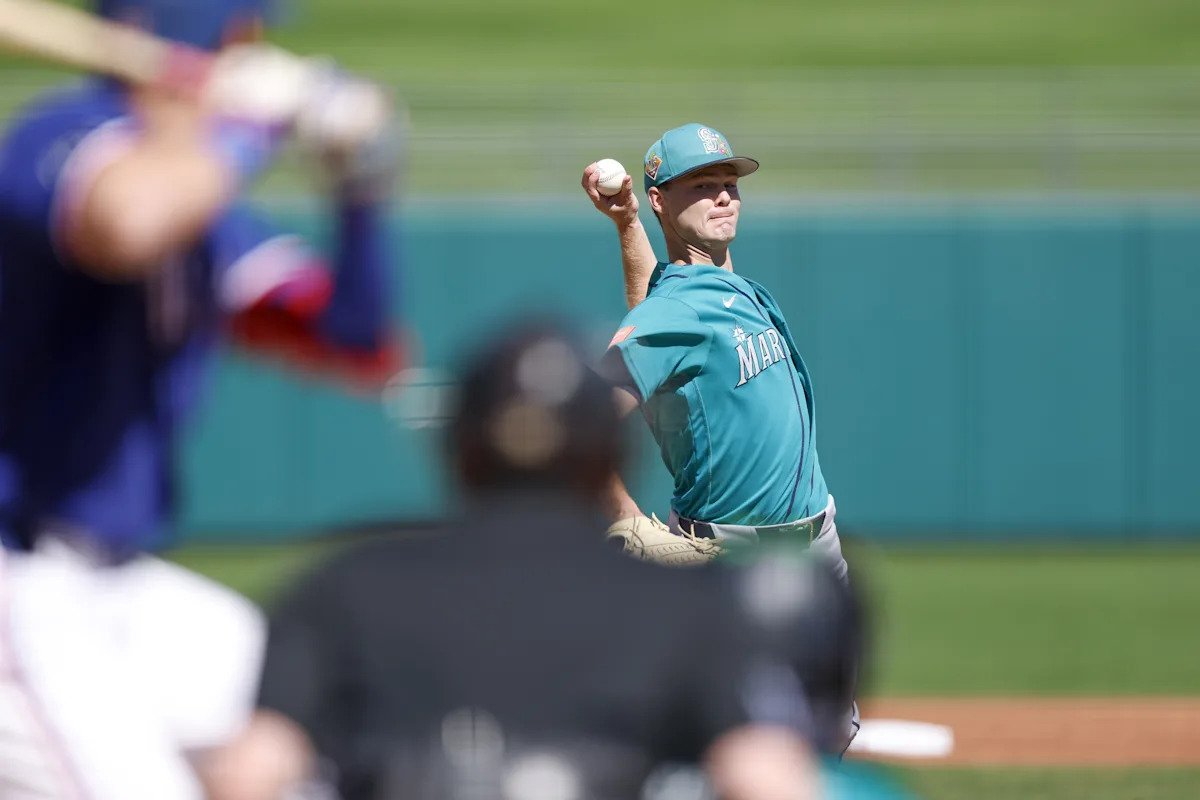
Kade Anderson’s fastball is neither fast nor shapely, but that doesn’t mean it isn’t good.
Anderson’s first two outings this Spring have been somewhat controversial. He’s earned rave reviews from the Mariners and the media, but the underlying data has lagged behind. Public “stuff” models are somewhat skeptical of his arsenal, and his vaunted fastball appears especially disappointing. Here’s a snapshot from Thomas Nestico, whose website I highly recommend for exploring pitching data:
Stuff+ is statement on the physical properties of a pitch, where 100 is average and higher is better. It takes a bunch of data points—velocity, spin, movement, etc.—and estimates the effect of those characteristics on performance. In broad strokes, it works very well, and there’s a reason both public-facing analysts and teams invest in these models. Andrés Muñoz is the Mariners all-time leader in Stuff+, if that helps paint the picture.
Anderson’s fastball so far grades at 91 by tjStuff+, Nestico’s version of the model. (I’m not picking on Nestico here. His just happens to be one of the few models available for Spring, and again, I really enjoy playing around in his website.) For reference, that’s about 10% below league average and would be one of the lesser four-seam grades in MLB. He’s only thrown 28 fastballs—another element of this discourse to keep in mind—but we can see why the models are unimpressed: it’s not very fast. His average four-seamer of 93.4 mph would be below average by MLB standards, and you don’t need fancy statistics to tell you more velocity is good.
The “shape” (or vertical and horizontal movement) of the pitch is also not unique. Great fastballs come in all shapes and sizes, and nothing about Anderson’s movement profile prevents it from being a highly effective pitch. But his fastball doesn’t exhibit the traditional top-rail four-seamer rise to coax whiffs at the letters, nor the bowling ball quasi-sinker that can plop down in the zone. From the perspective of these models, it’s just kind of… generic.
Again, none of this is disqualifying. Plenty of great pitchers have a lesser, nondescript fastball—some pitchers don’t even throw a fastball. But the concern here is Anderson was billed as having a remarkable fastball. FanGraphs, for instance, gave it a 70 grade on the traditional scouting scale. That’s hard to square with what we’re seeing in these models, even in small samples. If the fastball has indeed been overstated, it’s possible there’s some limit to his projection.
But as Nestico or anyone else developing these models will tell you: stuff isn’t everything. It doesn’t capture location, tunneling, and other matters of deception. As Brendan Gawloski noted in his report for FanGraphs, that’s a big part of what makes Anderson’s fastball an elite pitch:
His fastball sits 92-95 mph with vertical ride, and it plays up because his loose arm action hides it until the very last moment. It generated a whopping 35% miss rate in 2025. The way his fastball plays means Anderson’s command of it doesn’t have to be precise; it rides enough to evade barrels in the strike zone.
Jerry Dipoto offered a similar account when Kate Preusser asked him about it on Sunday. Anderson’s delivery naturally hides the ball from the batter until the last moment, Dipoto said. He throws from an unusually high arm slot for a lefty, while still getting solid extension down the mound. It’s just not a “look” batters see very often. Public models can’t capture that, Dipoto said.
And it’s not just Dipoto saying it. Mariners’ hitters have reported issues picking up the pitch in practice.
“It’s got some teeth on it,” Ryan Bliss said. “It’s spinny, it’s sneaky. It’s 93-94, but it feels like it’s 96-97. And he will throw it any time, he’ll throw any of his pitches any time for strikes, so you don’t know what’s coming. It’s an uncomfortable at-bat.”
And look, I’m not going to tell you that I, sitting here in my office, in my sweats, mustard still staining my fingers from lunch, can “see” even the weakest professional fastball. But yeah, I get how this pitch might appear out of nowhere from the perspective of a batter.
The other thing stuff models don’t capture? Arsenals. In addition to the fastball, Anderson throws a slider, changeup and curveball. Each of these pitches grades a more favorably by stuff models, and each gets the same boost from his deceptive arm action. This is one thing we (and by we I mean people much smarter than me) are starting to model publicly, and it does appear to be a big factor in whether a pitch or pitcher is effective. When Anderson releases the ball, batters might expect the incoming pitch to move at four different speeds and in four different directions. They can’t cheat and sit on any one offering, and because of his hocus-pocus delivery, they can’t afford not to cheat. It’s a blender of deception that helps his velocity play up.
…. in theory. We have yet to see the sum of this deception in games that count. We have data telling us one thing, and we have the Mariners telling us another. That’s why there’s dissonance. But while I normally wouldn’t put stock in typical Spring Training chatter from the team, I certainly value action. And the Mariners, somewhat literally, put $8.8 million where their mouth is when they drafted him. That’s worth something, as Justin Hollander pointed out Monday.
“If the Seattle Mariners draft him third overall in the country, you can bet our models like him,” Hollander said.
That’s the strongest point in favor of Anderson’s fastball, in my opinion. To be clear, Kumar Rocker, Max Meyer, and Ian Anderson were also drafted third overall within the last decade, so it’s not quite ipso facto in the way Hollander asserts. But the Mariners are indeed a top five collection of pitching thinkers across the league, and (I’d argue) the best organization at knowing who to draft. They’re aware of the models, and they invested anyways.
This level of scrutiny isn’t entirely fair to Anderson. He is still a prospect after all and has yet to make a professional appearance outside these exhibitions. His stuff is not defined by 64 pitches in any setting, and a few outings while ramping up for the season aren’t representative of his current abilities. Regardless, he’s sure to get better with experience, whether we can measure it or not.
Still, the scrutiny isn’t quite misplaced. The hype heaped on Anderson has been pushed to rare levels, and the emphasis of the narrative is how fast he’s expected to move through the minors. The Mariners are trying to win a World Series this year, and there are legitimate questions about the depth of their rotation. It’s fair to wonder whether the team is serious about accelerating him, and whether he is ready for the jump. Is he now the sixth starter? Seventh? Eighth? I’m not sure. But my sense is Anderson, much like his fastball, will sneak up on us quick.
Read the full article here