



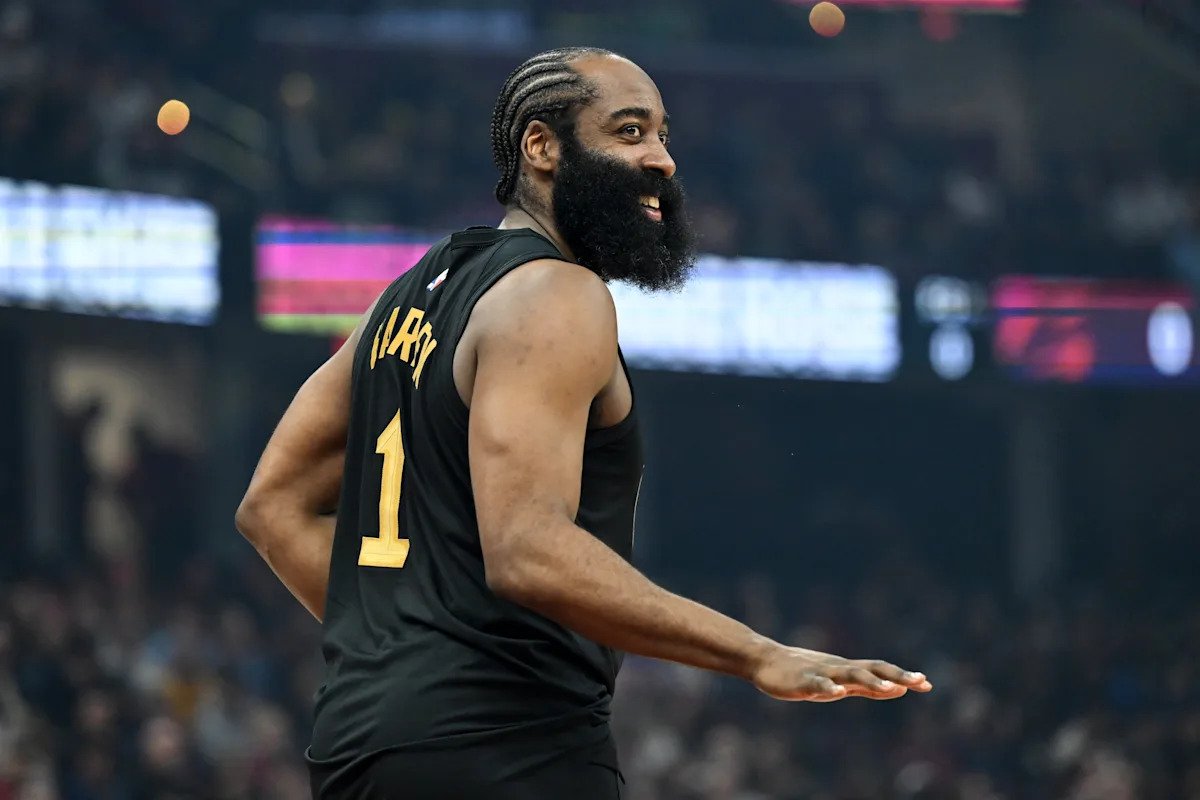
There is no doubt, for now, that the Cleveland Cavaliers are better with James Harden.
“Bringing James on has given us a renewed confidence, if that makes sense,” Cavs coach Kenny Atkinson told reporters on Tuesday, when his charges whooped the New York Knicks 109-94. “We understand that we’re a better team, and that spirit — that confidence, it for some strange reason makes you play harder and compete harder. And compete harder defensively.
“And I felt like we were kind of missing that edge, that belief, so I feel like we’re regaining that.”
We probably should have anticipated this, if we weren’t on the record with it already. This is what happens when Harden joins a new team. He makes his new team better. For a period.
The question is whether the Cavs can capitalize in the meantime. How long that meantime lasts, as Harden turns 37 years old in August, was the risk Cleveland’s front office ran when it dealt 26-year-old two-time All-Star Darius Garland for a member of the NBA’s 75th anniversary team.
When Harden left the Houston Rockets for the Brooklyn Nets a few weeks into the 2021-22 season, the Nets won 32 of 41 games upon landing him, at one point winning 14 of 15, with a historic offense for its time. And then he strained his hamstring, an injury he blamed, in part, on poor conditioning, which ultimately aided in their downfall during his one playoff run in Brooklyn.
[Subscribe to Yahoo Sports NBA on YouTube]
When Harden essentially demanded a trade from the Nets to the Philadelphia 76ers the following season, they won their first five games with him in uniform, finishing 14-7 down the stretch, before he flamed out in the second round of the playoffs against the Miami Heat.
They fared no better the following season, when Harden once again failed to meet his highest standard as a series’ stakes increased, as his Sixers lost a seven-game set to the Boston Celtics.
When the long-term contract offer he desired never came, Harden called Philly executive Daryl Morey “a liar” and sought a trade to the Los Angeles Clippers. He helped deliver a pair of 50-win seasons, only to lose consecutive first-round series to the Dallas Mavericks and Denver Nuggets.
Harden has played in nine Game 6s or 7s since leaving the Rockets, and his scoring averages in those contests — 16 points on 38.1% shooting — are of serious concern, if you believe in track records. After all, Harden’s playoff performances in big games were no different for the Rockets.
Then again, Harden helped get his teams to those big games, and in Cleveland they are hoping Donovan Mitchell can carry them home once they get there. And early returns suggest they can get there. They are 6-1 since scoring Harden, including wins over the Knicks, Nuggets and red-hot Charlotte Hornets. Their lone loss came against the mighty Oklahoma City Thunder.
Harden has helped transform Cleveland’s offense from a solid outfit (117.6 points per 100 possessions) to an elite one (121.7) in a small sample size. This is no different from his efforts for the Nets, 76ers and Clippers. He is one of the great offensive talents in the game’s history.
There is no doubt the Cavs belong among the Eastern Conference’s elite once again. They are now tied with New York for the East’s third-best record, trailing only the Celtics and Detroit Pistons. It would be a shock if those teams were not the conference’s final four standing.
But are any of those teams really scared of Cleveland in the second round? That is precisely where the Celtics and Indiana Pacers have stopped the Cavaliers in each of the past two years.
The Cavs are exhibiting some of the same traits that past Harden-led teams have shown. While the offense is elite in the regular season, they are playing slower and passing less often, so any slippage in efficiency, which often occurs in the playoffs, is only magnified in fewer possessions.
In that same small sample size, Harden’s defensive on/off numbers are the worst in the NBA, according to Cleaning the Glass, as opponents have been 21.6 points per 100 possessions better on offense when Harden is on the floor. He was not much better for the Clips in a larger sample size, as opponents’ scoring increased by 7.9 points per 100 possessions when he was on the floor. He is, essentially, a defensive liability, and we have known this for some time, too.
The Cavaliers traded for Harden with the belief that they can mask that, as well, as both Evan Mobley and Jarrett Allen are rim-protecting forces. With Mobley, Allen and Dean Wade on the court, Cleveland is allowing 101.5 points per 100 possessions, almost five points better than the league’s best defense, regardless of who is on the court with them, per Cleaning the Glass.
But did the Cavaliers really trade a young star for Harden, only to hope that Mitchell can mask his inefficiencies on offense in the highest-leverage situations and Allen and Mobley can make up for his deficiencies on defense? Absolutely not. They traded for Harden not only to get back to the second round of the playoffs, but to advance further — and compete for a championship.
They traded for Harden to come through when it matters most, and the next time he does may be the first. There is beauty in this honeymoon stage, as every team enters its partnership with Harden believing this time will be different, only to be disappointed in the end. Will this time be different? We will not know until the playoffs. Enjoy the love for him in Cleveland while it lasts.
Read the full article here