



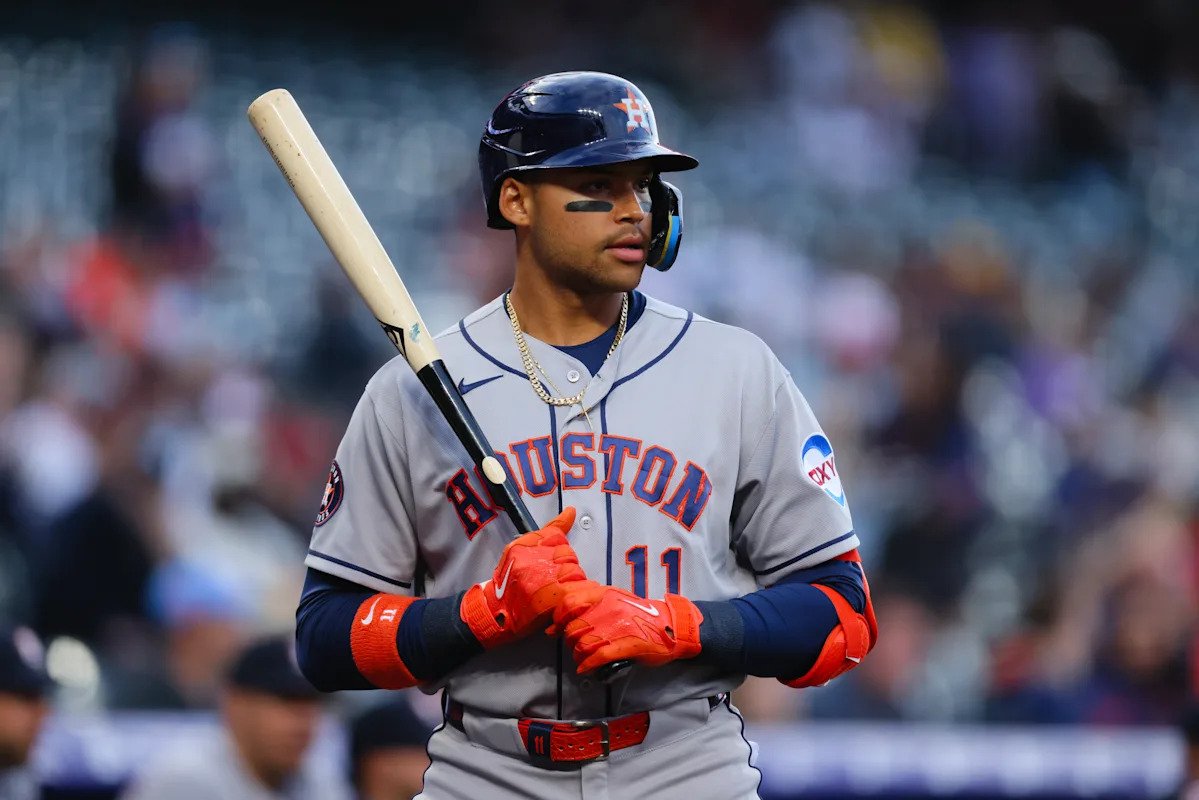
Cam Smith and his development has been somewhat of a lightening rod for Astros fans and their opinions of Dana Brown. Brown infamously bypassed AA and AAA for Smith last year and called him up after fewer than 50 minor league games. Many fans felt this stunted Smith’s development and potentially ruined him as a prospect. Of course, narratives are often just that: narratives. In order to test that, we would need to compare Smith’s 2025 season to how things are currently going in 2026. Is he actually improving?
As you might imagine, the basic numbers and more intricate numbers won’t always say the same thing. If you are a regular reader of this feature then you know we will never settle for the basic surface level story. We are going to dig deeper because the underlying numbers often are better predictors of the future than the basic numbers. In this regard, the sabermetrics field has seen a virtual revolution with the advancement of Statcast. Statcast not only does a better job of telling us what is actually happening, but it also is a better predictor of what might come in the future.
The downside to deeper statistical dives is that the surface level numbers won’t be 100 percent accurate up to the minute. We are taking Smith’s numbers following the completion of the Orioles series. Obviously, you will be reading this following the Red Sox series and thus will have another three games to consider. The funny thing is that the underlying numbers really don’t change nearly as much.
The Surface Level
|
AVG |
OBP |
SLG |
wOBA |
wRC+ |
|
|
2025 |
.236 |
.312 |
.358 |
.298 |
90 |
|
2026 |
.219 |
.317 |
.381 |
.315 |
97 |
Obviously, the Red Sox series will change these numbers some. However, the implications will probably not change. The 2026 basic numbers do not look radically different from the 2025 numbers. Even when we get into the more sophisticated sabermetric numbers (wOBA and wRC+), it doesn’t look that different. I should go into those in more detail before we move on.
wOBA stands for weighted on base average. It is weighted because it accounts for slugging as a part of its formula. It is designed to look like on base average because most fans are able to interpret that. Smith’s 2026 numbers are actually fairly close to the league average. The league average tends to hover between .320 and .330 depending on the season. wRC+ stands for weighted runs created plus. The plus means it is set with 100 being average. So, Smith is slightly below league average this season in both categories.
The components for both are very similar, so they will often come out with similar results. So, people will use the one they find easier to digest. The differences are primarily in how base running is included. wRC+ will also include ballpark effects so that players in extreme run scoring environments (on either end) are accounted for accordingly. Either way, Smith is somewhat better this year, but the difference is not enough to make it look like a major step forward. Let’s see what happens when we shift to the Statcast stats.
Statcast Stats
|
xAVG |
xOBP |
xSLG |
xwOBA |
|
|
2025 |
.235 |
.311 |
.376 |
.304 |
|
2026 |
.252 |
.350 |
.450 |
.348 |
These numbers are significantly different. He was slightly better according to Statcast than his actual numbers, but not overwhelmingly so. This is normal. Given enough runway, the difference between actual production and predicted production will be negligible for most players. There are notable exceptions to this rule. At some point we will have to look at the curious case of Jose Altuve. However, on a long enough timeline the survival rate will drop to zero.
That’s particularly encouraging because the numbers indicate that Smith is due for some positive regression. Will he reach an .800 OPS by the end of the season? It might not be that stark a difference, but you will notice that according to the wOBA he looks like an above average offensive player. The implications of this are obviously crucial when it comes to determining his future. If he is above average at the plate, on the basepaths, and in the field then he will actually be a pretty valuable player overall.
If he continues to be a good base runner, good fielder, and below average hitter then his value will be much more limited. In order to determine whether this is sustainable we should look at the reasons why Statcast is predicting future success and at areas where he can continue to grow. We should start by looking at the quality of his contact.
Contact Numbers
|
EV |
Barrel% |
Hardhit% |
|
|
2025 |
87.9 |
6.9 |
40.8 |
|
2026 |
88.9 |
14.9 |
44.6 |
EV stands for exit velocity. We could go into the league average, but that is not what is important here. For Smith, we are looking at growth from one season to the next. A one MPH change looks miniscule but it is more significant than you might think. Think of a pitcher that goes from pitching 95 to 96 MPH. It can be a huge tipping point. Usually the reverse is even more significant. The harder you hit the ball the more successful you will generally be.
Think of the barrel rate the same way you would think of playing golf. How often are you hitting it on the sweet spot of the club? Obviously, hitting it in the sweet spot doesn’t guarantee success, but the ball generally goes further that way and the results are more consistent. Hitting the barrel in baseball is the same idea. Sometimes you hit a 100 MPH screamer right at the shortstop, but over a long enough sample size you will see more success the more barrels you hit. Smith’s rate has more than doubled this season. Some hitters in history (Rod Carew and Tony Gwynn) could place the baseball, but those players are historically rare. For most players, hitting the ball and hitting it hard is the pinnacle of what they can do. The ones that do it most often are often the most successful hitters.
I should note that his hard hit percentage was already high last season. So, seeing it go up a few ticks is very encouraging. That more than anything should predict future success. The number one rule of baseball statistics (and likely most sports statistics) is that numbers will eventually regress to the mean. In other words, if a player has an expected .250 batting average then eventually his actual batting average will approach that. Yet, the fun thing about player statistics is that players are not fixed assets. They will grow and decay at different points of their career. Where are the areas of growth for Smith?
Areas of Growth
|
Chase |
Swing% |
Contact |
Zone% |
|
|
2025 |
29.6 |
48.4 |
73.6 |
51.7 |
|
2026 |
31.6 |
46.5 |
71.9 |
47.7 |
Hitting and pitching is like a dance. Both are partners reacting to each other’s movements. Smith’s numbers above demonstrate that he is hitting for more power and that can be seen in his basic power numbers. Last season, he mainly hit singles, so pitchers didn’t feel the need to be that careful. If the worst you can do is hit a single off of me then it makes no sense for me to be careful. If there is an increased chance that you may hurt me then I need to nibble more.
Pitchers are throwing fewer strikes (zone percentage) which means that Smith must now react. His plate discipline really hasn’t changed that much. There are more opportunities for him to chase and so he is chasing a little more often. Chasing more often usually results in lower contact rates. Still, the swing percentage indicates he is taking most of those balls outside the zone. His walk rate is up (8.7 percent to 11.3 percent), so the news is mostly good.
Eventually, hitters and pitchers reach a point of equilibrium. Pitchers realize he will take most balls, but they also don’t want to give him anything good to hit. So, then it becomes a part of execution on both of their parts. The best hitters in baseball are making contact 80 percent or more routinely. The elite of the elite are upwards of 90 percent. That’s not likely to be Smith, but if Smith can get to 75 percent this season it would be good progress to go along with the rest of his gains.
The odds of Smith getting there is probably pretty solid. For those that lean on WAR, that probably gets him to three or four WAR. That means that the next general manager of the Astros will have a major decision to make on Smith. Will Jim Crane allow one of those longer extensions we have been seeing other players get at similar points in their career? That remains to be seen.
Read the full article here