




Few could have expected Mercedes to end its first World Endurance Championship with a podium, but Maxime Martin, Lin Hodenius and Martin Berry’s second-place finish in the Bahrain finale was no fluke.
The venerable Mercedes-AMG GT3 was among the pacesetters in the field all weekend, both in race and qualifying trim, and the #61 Iron Lynx crew ultimately came short of victory by less than a second. It was a remarkable turnaround from just seven months earlier, when Mercedes’ first WEC campaign had begun in disastrous fashion in Qatar.
It has not been a smooth journey for Mercedes in LMGT3 so far, but given how late the programme was green-lit, it was never going to be an easy ride.
It was in November last year when Iron Lynx and Mercedes announced a partnership to bring the AMG GT3 to the world championship. The deal between the two parties was agreed over a matter of weeks after last year’s Bahrain round, but this left the pair racing against time to convert the car to LMGT3 regulations, especially with the season start pushed forward to February.
An intensive development phase followed, as Mercedes worked to introduce drive shafts with torque sensors, change engine maps and reprogram the ECU for the WEC. While prior work on torque sensors for the IMSA SportsCar Championship offered a boost, numerous other changes were necessary, including wind tunnel testing. It wasn’t until 9 February that the cars were ready at HWA’s facility in Germany, less than two weeks before the official ‘Prologue’ test. Mercedes conducted a quick rollout at Hockenheim on 10 February before flying the two AMG GT3s to Qatar for the official test and the season opener.
“It was less than one year when [Iron Lynx team principal] Andrea [Piccini] and Giacomo [Piccini] contacted me for the first time,” Mercedes’ head of customer racing Stefan Wendl told Autosport in Bahrain.
#60 Iron Lynx Mercedes-AMG LMGT3: Claudio Schiavoni, Matteo Cressoni, Matteo Cairoli
Photo by: Andreas Beil
“It was hard to get what was needed to be in this professional environment. It was a huge challenge. But I have to say that the ACO, the FIA and the experience from Iron Lynx helped us a lot to squeeze the usual times which are needed to make the homologation, to run the wind tunnel and all those things.
“Everything happened in a very short time, so it also left not so much time in between to optimise everything and to prepare everything properly.”
Early struggles
Mercedes arrived underprepared for the start of the season at Losail on 28 February. Being the only true newcomer on the grid was a handicap, and the compressed schedule added to the complexity, resulting in neither car finishing the race due to separate mechanical issues. The #61 AMG GT3 became an early casualty and although Iron Lynx managed to fix the #60 car after three hours, Matteo Cairoli, Claudio Schiavoni and Matteo Cressoni were not classified after they failed to complete 70% of the race distance.
“With the missing preparation and the missing experience we had, we suffered at the beginning of the season,” Wendl conceded. “[After building the car], we immediately went to Qatar and were in the middle of racing. And we already had in our head that we [needed to prepare to] go to Le Mans the first time, which is the biggest motorsport event in the world.
“In parallel, we focused on running the cars through the championship with some new tracks, in a completely different environment and with new challenges we faced, [which were] more or less on the software side of the car.
“There were new things [to deal with]. We’ve not been stupid. We knew about challenges. We knew that it will be a tough season, but we also knew that this is a multi-year investment from Iron Lynx and from AMG to be here, and that we want to go stronger into the coming season.”
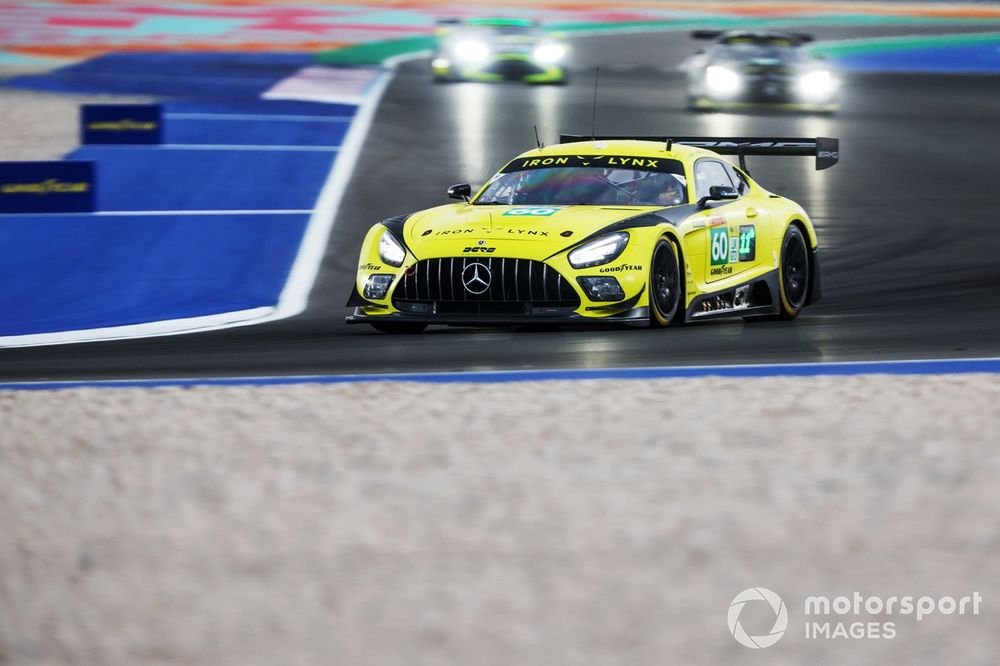
#60 Iron Lynx Mercedes-AMG LMGT3: Claudio Schiavoni, Matteo Cressoni, Matteo Cairoli
Photo by: JEP / Motorsport Images
Mercedes’ first classified finish came at Imola (13th and 15th), and while there was progress at Spa, it still couldn’t open its points account. These results were hard to accept not only for Mercedes – a brand so accustomed to winning – but also for Iron Lynx, which had a proven track record in endurance racing. But Mercedes and Iron Lynx knew they had to accept some early pain before they could start delivering big in the WEC.
“In the first two rounds, it was quite hard to see our cars always in the back end after qualifying,” Wendl admitted. “This is something I’m really not used to. I never experienced [anything like it].
“But it’s a world championship, it’s tough competition. There are new features for everything – the driver pairing, the team was new, and also the software features. Also for the ACO, our car was new and we had to adapt to everything.
“All the questions being raised to myself at the start of the season [were about] how we deal with it. We gave our best. We put all our experience together [with] our what we knew from other race series, with support from our technicians.
“But still it’s a challenge and still there’s good competition here. That’s why it’s not easy to jump in and be there immediately.”
Driver changes
Mid-year driver changes also affected the stability of the team. After just two rounds, Berry was drafted in the #61 car to replace Christian Ried, while an injury for Claudio Schiavoni prompted a complete overhaul of the #60 line-up ahead of Le Mans, with Andrew Gilbert, Fran Rueda and Lorcan Hanafin stepping into the race seat.
Crucially, this meant that there was no gold or platinum-rated driver in the ‘yellow Mercedes’.

#60 Iron Lynx Mercedes-AMG LMGT3: Andrew Gilbert, Lorcan Hanafin, Fran Rueda
Photo by: Marc Fleury
Asked if the mid-season driver change affected the team’s performance, Wendl said: “In a way. As soon as you change drivers, it will change the performance somehow – to the good [or] to the bad. You have stronger ones or less stronger ones. But it was a step which was necessary sadly due to Claudio, who got a back injury. So there was no way around it, and I think they [Iron Lynx] made the best out of it.”
The turning point
As Wendl noted, preparing for Le Mans was a priority for Mercedes, with 2025 marking the German manufacturer’s return to the Circuit de la Sarthe for the first time in more than a quarter of century. To boost its chances for the French endurance classic, it entered an additional car in collaboration with Iron Lynx, with Brenton Grove, Stephen Grove, Luca Stolz sharing the #63 AMG-GT3.
A chassis change prompted by a crash for Grove in practice marked an inauspicious start to the race week, but Mercedes managed to get two of its three cars across the finish line in 12th and 15th places. With only full-season WEC entries eligible for points, Le Mans marked the first points finish for the #61 crew, Iron Lynx and Mercedes as the car was promoted to eighth in terms of cars that could score points.
The upward trajectory continued after Le Mans, with Gilbert, Rueda and Hanafin finishing 10th in the #60 car at Austin and the sister crew followed that up with an eighth place in Fuji.
Then came Bahrain, where Mercedes emerged as a dark horse from the opening day of running. Both Iron Lynx cars made it to the Hyperpole for the first time, with Hanafin going on to qualify the #60 entry on the front row and Hodenius ending up just behind in third.
Mercedes ran first and second during the early stages of the race, and although the #60 car dropped out of contention later, the #61 crew remained in the hunt until the finish. After a late restart, factory Mercedes driver Martin pulled off a great move on the #27 Heart of Racing Aston Martin Vantage GT3 of Mattia Drudi to snatch second place. It was a rewarding result for Iron Lynx and Mercedes after what had been a turbulent first year of the partnership.

#61 Iron Lynx Mercedes-AMG LMGT3: Martin Berry, Lin Hodenius, Maxime Martin
Photo by: Jakob Ebrey / LAT Images via Getty Images
But even before the Bahrain breakthrough, Wendl insisted the project was moving in the right direction, even if the results had yet to reflect it fully.
“Yeah, I think yes,” he said, when asked if he was happy with the progress over the course of the year. “I would have wished we had been there earlier on the podium. We had some learnings to take, and what makes me optimistic looking into the future is that we are steadily getting better and better and better.”
Looking ahead to 2026
With the first podium ticked off, Mercedes is setting the bar high for 2026. With homegrown rival Porsche clinching back-to-back LMGT3 titles this year, it’s only natural that Mercedes wants to challenge for those honours.
Asked what are Mercedes’ targets for 2026, Wendl said: “What else can I say [other] than winning races? This is where we’re here for, and I think Andrea will copy exactly the same. We are here to win races. We are here to win championships and now it’s a question just of the time period when it’s realistic to achieve.”
Mercedes’ partner Iron Lynx has addressed a key weakness that could significantly boost its fortunes next season: its driver line-up. Gilbert, Rueda and Hanafin have all been dropped after the trio managed just one point in the #60 car. Instead, silver-rated Hodenius moves across from the #61 car to team up with WEC debutant Johannes Zelger and returning Iron Lynx driver Cressoni.
While this means the renumbered #73 entry still may lack a pro driver, the #61 entry has been considerably strengthened by the arrival of highly-silver rated driver Rui Andrade. The 2022 LMP2 champion will join the returning Martin and Berry, completing a line-up that could make Mercedes a serious contender in the 2026 WEC.
We want to hear from you!
Let us know what you would like to see from us in the future.
Take our survey
– The Autosport.com Team
Read the full article here