



As Audi prepares for its first ever season as a Formula 1 manufacturer, it has had to transition from Sauber’s status as a long-time Ferrari customer team to a full-works entity.
Part of that transition has involved the union of the Sauber Engineering facilities in Hinwil and Audi’s powertrain facilities in Neuberg. In the prelude to 2026, chief operating officer and chief technical officer Mattia Binotto spoke of the need to install permanent conference-call facilities in both factories to ensure both camps had a clear line of communication between the Swiss and German bases.
Binotto, who had oversight of both powertrain and chassis projects in his oeuvre at Ferrari, believes that Audi’s Neuberg facilities are very much up-to-scratch for the demands of modern F1. Conversely, the Italian believes that the current infrastructure at Hinwil, however, is currently in need of an update and is lacking space for the full scope of what Audi needs from the factory.
In years past, Hinwil was considered one of the more technologically advanced facilities on the F1 grid; Kimi Raikkonen’s move to McLaren for 2002 is said to have at least partly funded the team’s then-state-of-the-art wind tunnel and supercomputer, which ultimately led to BMW taking a majority shareholding between 2006-2009.
But, as teams have swelled in numbers across the past couple of decades, allied to Audi’s recruitment drive for its first season in F1, Hinwil is in need of expansion. Binotto says trying to shoehorn the team’s incoming new simulator into the current facilities is not a reasonable scenario.
“I think in Neuburg the infrastructure is all what we need. We are at the level. It’s a great infrastructure. We’ve got all the dynos and the space required,” Binotto explained.
“In Hinwil, on the opposite, I think still we are lacking space for what we need. We have ordered a brand new simulator, but we need a building for it because the simulator is big. So we need to build that.
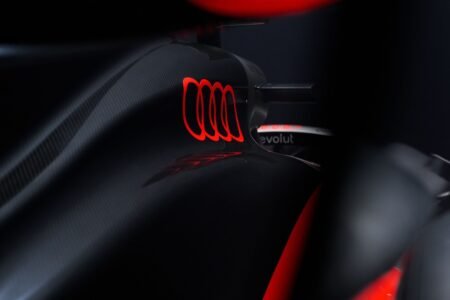
Audi F1 Team R26 livery
Photo by: Christopher Otto
“We need to expand our manufacturing capacity because in F1 it’s important certainly the composite to be manufactured internally for the speed, for the quality, for the cost of the budget gap. So we need to expand manufacturing.
“We need more desks for engineering. So overall we need more space. And together with Audi, as I said before, fully committed, we are looking for enlarging our buildings, our campus, and our current facilities.”
Regardless, Binotto believes that Audi has the ingredients needed to be successful in F1. The team has set itself a five-year plan to be competitive – although F1 history is littered with failed five-year plans and 100-race targets to start winning regularly.
Audi’s first priority is to ensure that its new R26 is finishing races, and that its powertrain can be developed into one that can challenge the established manufacturers – assuming it cannot do so from the beginning. From there, the team will have to continue building upon that momentum.
“It is always difficult to compare to the others I don’t know the others,” he added.
“I know who is Audi, what is Audi, and I think we have got a great team with great energy which is fully focused on our future and our success.
“And I can tell you that I am convinced that we’ve got all what is required to become successful one day. And I am pretty sure that we will be.”
We want to hear from you!
Let us know what you would like to see from us in the future.
Take our survey
– The Autosport.com Team
Read the full article here