



You can’t step into the same batter’s box twice. Well, you can— the rulebook is rather stringent about what qualities a batter’s box has to have. But we’re talking in a Heraclitean sense here. Perhaps it would be more accurate to say that the batter’s box remains the same, but the batter himself does not.
Bryce Harper is going to try to challenge Heraclitus’ opinion in the same way that he challenged Dave Dombrowski’s (though it is doubtful that he will accompany this challenge with a custom t-shirt). Recently, Harper stated that he wanted to walk more in 2026. A lot more. He was one of MLB’s better walk-drawers in 2025, with his 12.1% rate ranking 23rd league-wide. Only 28 players had more free passes than Harper’s 70. But he wants to draw 140 to 150 in 2026. That would be a career-high for him. The closest he’s gotten is 130 in 2018, his final season as a National. Since then, he’s changed his approach at the plate to a somewhat more free-swinging style. It’s brought him success in Philadelphia. But now he’s looking to go back to the past. Can Harper find a way to return to being the Bryce of 2018?
Before we can answer that, we have to ask a different question: who was the Bryce of 2018, anyway? This pre-Philly Bryce was a superstar, albeit one who had not yet discovered the sartorial flair of a good Phanatic headband. But he was a star with a rather different approach at the plate as compared to the Harper of today. 2018-Harper swung 45.7% of the time, as compared to 2025-Harper’s 54.2%. He was significantly more patient than his older self, swinging at the first pitch of an at-bat 40.4% of the time as compared to his current self’s 54.1%. And most of that bygone reluctance to swing was concentrated on pitches outside the zone: 2018-Bryce’s 25.3% chase rate ballooned to 35.6% by 2025. Interestingly enough, the more conservative 2018 Harper was slightly more likely to whiff than the swing-happy 2025 edition (31.4% vs. 30.7%).
Harper getting back to to drawing walks like it was 2018 would take significant effort and focus, though Harper’s determination is not to be doubted. But Harper can only control what he can control. And while he can control what pitches he swings at, he can’t control what pitches he gets. The Bryce Harper of 2018 was seeing a very different pitch mix than the Harper of today. In 2018, just about a quarter of the pitches he saw were breaking balls. In 2025, it was 41.3%. How might that impact his efforts to return to the past?
Here’s Harper’s swings on pitches outside the zone (O-Swing%), by pitch type, in 2018 and 2025, using FanGraphs’ pitch definitions.
|
Pitch Type |
O-Swing %, 2018 |
O-Swing, % 2025 |
|---|---|---|
|
Four-Seam |
27.80% |
26.30% |
|
Slider |
25.60% |
39.10% |
|
Curveball |
27.30% |
49.70% |
In 2018, Harper was just about as likely to chase a breaking ball as he was a heater. His chase rate on four-seamers hasn’t changed much since then. But his chase rate for breaking balls has exploded — which, of course, is why pitchers are so eager to show him more of them. That’s good news for his efforts: if his chase rates on fastballs and breaking balls were similar in 2018, then the change in the pitch mix he’s being shown shouldn’t be a problem, as long as he returns to swinging like he did in 2018.
Easier said than done, of course. And while the passes are free, pursuing more of them comes at a cost. We know what Harper stands to gain by taking more BBs. But we have to look at what he stands to lose as well.
Harper’s increased willingness to chase diminished his walk rate, but it helped him build production in some areas. Here’s his wOBA by zone in 2018 and 2025. The third image shows the difference between the two.
The 2025 version of Harper produced more on pitches inside. All that chasing generally hurt his production outside the zone, but it dramatically improved it on pitches he chased up and inside. The difference may not be as much as it seems, though— note that the gap between his expected wOBAs in 2025 and 2018 in that same quadrant was .104; less than half as much. Still, he really did produce more on those pitches with his 2025 style. He’d potentially be giving that up if he returns to his old approach.
Is that worth it? Well, nostalgia can’t be quantified, but run value can. And we can say that 2018-Harper was more productive than 2025-Harper by that measure.
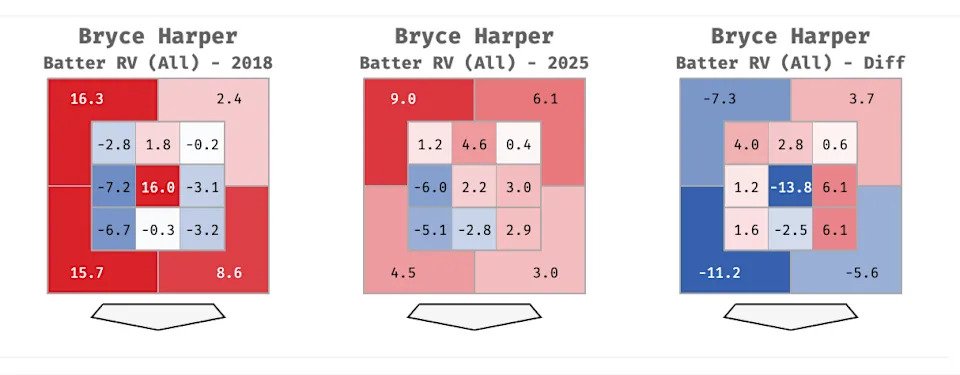
2025-Harper was more productive on pitches in that upper right quadrant. But looking at the whole, he produced 37 runs in 2018, and only 24 in 2025. The gains he made with the new approach were offset by the costs. Granted, his run values in 2023 and 2024, when he was about as chase-happy as he was this past season, were quite similar to his 2018 run value. So perhaps the gap between 2018 and 2025 isn’t as much about the chasing as it was something else. The comparison between 2018 and 2025 is meaningful, but a little narrowly-sliced; there’s plenty of variance within the results of two given seasons. Still, given Harper’s underwhelming 2025, it’s not hard to see why he felt that it was time to return to the old ways.
You can’t really go home again, though. Maybe that’s an odd thing to say in the context of baseball, the sport in where the whole point is to reach home. But it’s true. Even if Harper could perfectly replicate the mentality and approach of his 2018 self, he can’t replicate the body he had 8 years ago. At 33 years old, he’s far from washed up, but certainly at the point where age is being felt. Unfortunately, we only have bat speed data dating back to 2023. But it is probably fair to assume that he cannot swing the bat in 2026 as fast as he did in 2018. That may mean that the exact same approach at the plate would produce different results. Even if he can replicate the walk rate he had in 2018, he may end up with a very different stat line overall. If swinging less doesn’t produce the change he’s hoping to see, Harper will have to look to alternate strategies for reasserting his eliteness. We don’t know exactly what form he’ll settle into by the end of the 2026. We know it won’t really be 25-year old Harper again. But we can be sure he’s hellbent on finding the best version of 33-year old Harper that can be.
Read the full article here