



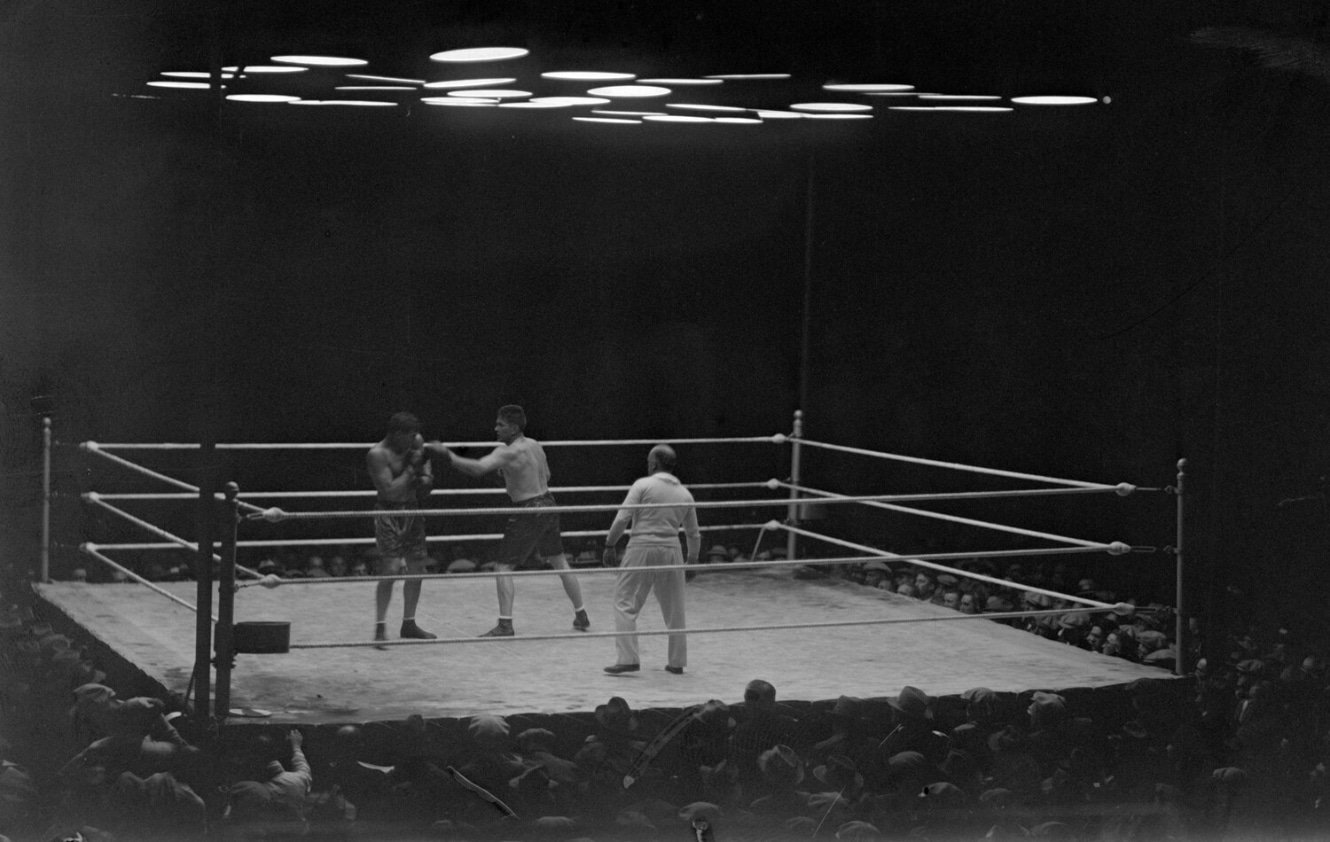
Jack Dempsey’s left hook was most dangerous when he could weave inside and plant his feet. Gene Tunney spent their September 23, 1926, fight making both steps difficult. In the rain at Philadelphia’s Sesquicentennial Stadium, Tunney took the heavyweight championship by unanimous decision over ten rounds.
Dempsey had not defended the title since his 1923 knockout of Luis Firpo. Tunney had remained active and had already fought Harry Greb five times. The layoff invited questions about Dempsey’s timing, but Tunney gave him an immediate, practical problem: getting close enough to throw with full force.
Tunney watched Dempsey come forward and met him with straight punches. A right hand on one of the champion’s early rushes showed the danger of lunging in without making Tunney give ground first. When Dempsey tried again, Tunney changed his position and made him start the attack over. The champion was still dangerous at close range, but he could rarely keep Tunney there.
The rain made the canvas slippery for both men. It is tempting to blame Dempsey’s trouble closing the distance on his footing, yet the wet ring did not stop Tunney from punching and repositioning. Tunney’s timing was the more visible obstacle: he caught Dempsey on the way in, then denied him the stationary target his hooks needed. Contemporary accounts described the fighters slipping on the canvas as the rain grew heavier.
Tunney also refused to spend ten rounds merely fleeing. He stood his ground when he had the opening, drove Dempsey back at times and worked his body as well as his head. Dempsey’s attacks came in bursts, followed by pauses while he searched for another way through. That gave Tunney repeated chances to regain the distance he wanted.
By the final round, Dempsey’s left eye was badly swollen and he was still trying to force his way inside. Tunney continued to meet him with punches. Referee Tommy Reilly and judges Mike Bernstein and Frank Brown awarded the challenger a clear decision.
Dempsey’s three year absence may have cost him sharpness. The fight cannot measure how much. What it showed was Tunney denying him a sustained attack for ten rounds. Dempsey never stopped trying to reach him; Tunney kept making him pay for the attempt.
Stanley Weston / public domain, via Wikimedia Commons.
Read the full article here