



Nick Bayly gains a brief but extremely memorable insight into the Japanese golfing experience on a short trip to Kawaguchiko, located in the foothills of Mount Fuji, where 18 holes is treated with a reverence rarely experienced anywhere else in the world
It was long before my somewhat ambitious application to attend the golf competition at the 2020 Tokyo Olympics was scuppered by a global pandemic that I first harboured hopes of playing golf in Japan.
I’m not entirely sure why my interest was piqued to tee it up in The Land of the Rising Sun, but the very fact that this relatively small, but extremely populous island nation has developed such a deep passion for the game in such a relatively short space of time – most of its 2,200 courses are less than 30-40 years old – has always made me want to find out more. That, and a massive appetite for steaming bowls of chicken ramen and seared Grade A5 Wagyu beef.
Thus it was with a great deal of excitement, bordering on frenzy, that no sooner had an invitation to join of a select group of fellow golf writers on a short, but action-packed trip to play a few courses located around the slopes of Mount Fuji arrived in my email inbox in late December last year, I was winging off an almost immediate reply in the affirmative.
Application accepted, and work/family diary more or less cleared on the basis that my wife was able to join me for a post-trip holiday to see the cherry blossom in Kyoto, it was with more than a skip in my step that I boarded my Tokyo-bound Lufthansa flight from Heathrow in late March to tick another ‘must-do’ off the lengthy Bayly Bucket List.
Some 24 hours after departing London, and after some minor delays in Frankfurt and Beijing – neither of which I will trouble you with the details – I stumbled somewhat bleary-eyed, but still very excited, into the arrivals hall at Tokyo’s bustling Haneda airport. There, I was greeted by our host, George Han, who whisked me off in his Toyota on a 75-mile drive due west to my lodgings for the trip, the somewhat intriguingly named Hanz Outdoor Resort.
BACK TO NATURE
Despite arriving as night was falling, it didn’t take a super sleuth to gauge that I had arrived at a secluded woodland retreat whose accommodation is a mixture of neat brick-built villas and domed glamping pods. George, who as well as being my taxi driver, is Hanz Outdoor Resort’s business development & sales director, and is also the son of a Greek businessman whose idea it was to build a place where stressed-out Japanese families, as well as growing number of international visitors, could unwind in the peace and tranquillity of a woodland glade that enjoys stunning views of Mount Fuji.
With the silence only broken by the sound of swaying pines, calling owls, crackling log fires, and steaks sizzling on barbeques, the resort’s back-to-nature vibe is clearly resonating with a growing number of travellers who find the well-trodden tourist trails slightly overwhelming and want to disconnect from the digital world. So, while there is a decent Wi-Fi connection, you’ll find no televisions here and the activities on offer are all about engaging with the natural environment.
Given that the night-time temperature was in the very low single figures during my visit, I was delighted to be housed in one of the 30-odd villas that are tightly arranged around the central reception, bar and dining area. Kitted out with two double bedrooms, a shower and indoor hot tub, and a patio area that is partially open to the elements, with a BBQ and a dining table, they offer a cosy home-from-home in which to hole up for a few nights between adventures.
GLAMPING IN STYLE
The glamping area is located in a clearing in the pine forest, where a collection of domed tents will appeal to outdoorsy folk who like uncomfortably low beds, wood-smoked clothes and damp towels. In all honesty, the tents get you closest to the great outdoors and are a long way from roughing it. Each ‘pao’, as they are called, sleeps up to four people and comes with framed beds, your own private outdoor kitchen and a large shower room complete with Japanese-style toilet. Inside you have everything you need for a modicum of comfort, including a heater or air conditioner depending on the weather.
For campers and villa dwellers there is a dedicated reception where you can stock up on logs for the open fire or log burner – you can even chop your own wood if you get the urge – and collect your cooking utensils and camping essentials. There’s a bar and seating area where you can cook your own breakfast on a gas burner from a buffet of raw ingredients (bacon, sausages and eggs), along with a range of more traditional ‘continental’ offerings. Dinners are cooked in your own lodgings, with the kitchen happy to supply all the ingredients required for you to rustle up a ramen, although most guests bring their own supplies.
For larger groups, including corporate bookings, or those that want a bit more privacy, the resort also offers a large guest house which has five twin bedrooms, a hot tub, a large open-plan living room with a log burner, a separate indoor dining space complete with an irori (Japanese hearth), and you can even book a private chef to rustle you up a gourmet dinner, which I was fortunate to experience on our final night.
ACTIVITIES ON TAP
Other on-site facilities include a natural onsen (hot spring outdoor bath), along with male and female public baths. There is also a natural well in the form of a tap that provides spring water naturally filtered through the rocks of Mount Fuji to fill your bottles with before heading out for the day to indulge in a variety of outdoor activities, including bike riding, archery and forest walks.
Numerous other adventures await close by, including canoe and speedboat trips on the beautiful Lake Kawaguchiko, along with visits to local wineries, horse riding, and, of course, the opportunity to play golf – the reason for my trip.
MORE HASTE, LESS SPEED: THE ART OF JAPANESE GOLF
The area is host to half-a-dozen private golf clubs where high-flying Japanese executives come to unwind or perhaps get even more tense as they attempt to negotiate their way around the mature tree-lined courses that are a feature of the landscape in this region.
Our trip took in two 18-hole rounds, the first at Kawaguchiko Country Club, a private club located on the edge of a stunning national park just a mile from the north eastern foothills of Mount Fuji, and the second at Narusawa Golf Club, a similarly exclusive venue which also enjoys impressive views of the iconic volcano. Other local options include Fujizakura, Fuji Lakeside, Forest Narusawa and Fuji Akamoto, although you’ll need to book well in advance at all clubs rather than hope to rock up and bag a tee time on spec.
It is not hard to see why golf has become so deeply embedded in Japanese culture, with the game’s obsession with rules, unswerving adherence to etiquette, formal social structures and strict dress codes chiming with the ordered Japanese way of life.
While golf in Japan was once reserved only for the wealthy elite and the business community, the country’s golfing bubble burst with the collapse in the economy in the early 1990s, and while the very top clubs still command annual subs of around £15,000, and hefty joining fees, there are plenty are plenty of courses both private and public that cater for the casual green fee player at affordable rates.
In fact, I was pleasantly surprised at how relatively cheap the green fee was at the courses we played when compared to the eye-watering sums often demanded to play some quite average courses in the UK, especially when you consider the additional services and facilities included in the fee.
CHAMPIONSHIP GOLF WITH FIVE-STAR SERVICE
A round of golf in Japan is very different from anywhere else I’ve ever played. It is something to be savoured, not rushed, with a strong emphasis on etiquette, ritual and socialising. Rounds often take five or six hours due to the numerous tea houses dotted around the course, and the obligatory 45-minute lunch break taken after nine holes, the cost of which is often built into the green fee. A post-round Onsen – a hot – and fully nude – public bath, where golfers ease aching muscles and chat through the highs and lows of the round, is also an essential part of any golf outing here, further extending the experience.
As well as the usual dress code of collared shirts and tailored trousers – shorts are forbidden on some courses – players must wear a jacket to enter the clubhouse, and outdoor shoes are swapped for slippers as soon as you enter the changing rooms.
With increasingly hot summers and cold winters, late spring (April-May) and early autumn (October-November) are the best times to play golf in Japan, so our mid-March trip saw the courses only just coming out of their winter hibernation, with the still-dormant fairways boasting an almost completely yellow hue, which while fine to play off, lacked the visual appeal of the carpet of green that is offered at other times of the season.
ROUND 1: KAWAGUCHIKO COUNTRY CLUB
First opened in 1977, Kawaguchiko Country Club boasts three nines – West, East and South – all of which were designed by Robert von Hagge, a leading American golf course architect who fashioned over 250 courses in over 20 countries before his passing in 2010, with notable layouts including Les Bordes and Royal Mougins in France and Emporda in Spain.
We played the West and East, both of which were thorough tests of golf played in supremely serene surroundings, although it is the South course that many want to play due to the starring role it played in 2003 film Lost in Translation, which did so much to spark many westerners’ interest in visiting Japan. Bill Murray, the golf-loving actor who played the lead role, was filmed in a scene playing the second hole on the South Course at golf at Kawaguchiko, whose its cedar-lined fairway, and iconic tree in the middle, is framed by the backdrop of Mount Fuji, making it an instant bucket-list course for film buffs and international travellers alike.
ROBO CARTS & SUPERCHARGED CADDIES
While walking is allowed, most players opt for a cart/buggy with a caddie, which I strongly recommend, not only for the valuable information offered by the caddie to newcomers, but also for the entertainment value. The buggies are six-seater affairs with room to accommodate four golf bags on the back.
They are also, somewhat disconcertingly, remote-controlled, with the caddie rarely required to drive, as the cart automatically follows a concrete path that features a submerged magnetic cable that prevents it from careering off into the woods or straying onto the fairway.
At first, it’s more than slightly unnerving to be sat in the back seat with the buggy steering itself and traversing some steep slopes and twists and turns without a driver in situ, but it soon becomes all part of the fun. Heated seats and side protection covers all add to the on-board comfort, especially when playing on a cold spring day with the rain coming in sideways.
IMG_7100
Our caddie, a sprightly woman perhaps in her mid-50s – it was hard to tell and rude to ask – was no less impressive than the cart. Not only did she have to keep an eye on four balls and remember which ball belonged to which player, but she also had to carry a selection of clubs to offer each golfer, rake the bunkers, tend the flags, look for balls, offer lines for putts and point out potential hazards off the tees.
She tirelessly jogged between all four of us – always with a smile – and the cry of “nice on!” or “good shot!”, and, in my case, the offer of ‘one more?’ every time I launched a tee shot into the woods and required a reload. It certainly made for a nice change from the usual barrage of abuse normally offered by my regular playing partners.
DOUBLE GREENS & DEEP BUNKERS
One the quirks of the design at Kawaguchiko is that many of the holes feature two greens – some side by side and others over 100 yards apart. In this way, golf traffic is divided between them, while also aiding maintenance and providing a varying challenge for the members. This occasionally led to some confusion among our group, and the excuse of having aimed at one green and the found the other one, only to find it was the right one all along, even if it was actually the left one, but we soon warmed to the concept.
The overall layout reminded me of any number of courses in the Home Counties, and although densely tree-lined, the fairways were pretty wide, and while the occasional hook or slice into the trees was unavoidable, the lack of undergrowth meant that a chip out was all that was required to get back on track.
Despite numerous errant tee shots, or maybe because of them, I did manage to return to the clubhouse with a lot more golf balls than I started out with, many of them premium models that were sitting in plain sight above ground. Japanese golfers are clearly too proud to bother digging around in the dirt for a once-used Srixon.
A SEA OF SAND
Nearly all the tees were elevated, giving first-time players a decent view of the challenge ahead, although a fair number of doglegs meant that finding the right side of the fairway was key to good scoring. Fairway bunkers, of which there were many, made that difficult, obliging players to consider their options carefully before driving – more often than not – straight into the sand.
The greens, which were surprisingly speedy given that we were only just coming out of winter, were equally well protected by bunkers, some almost entirely so, while others added to the challenge by featuring small trees, a common theme in Japanese course design which also adds visual appeal.
7a21ed99-efcb-439c-83fd-104ee00452f5
With Japan’s love of a labour-saving gadgets never far from hand, an escalator had been installed between the eighth green to the ninth tee to transport leg-weary golfers – an idea that I will be submitting to the powers that be my home course, where several steep inclines have taken their toll on the membership over the years.
MID-ROUND RAMEN
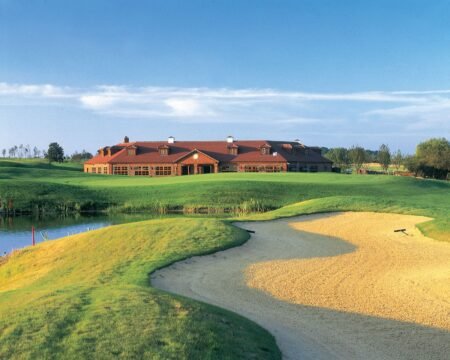
As is always the case when playing golf in Japan, we returned to the clubhouse after nine holes for a 45-minute break for lunch, and although still feeling the effects of a cooked breakfast, I readily tucked into a deep fried pork steak and chips and a couple of cold beers while we took stock of the first half of our round. Kawaguchiko’s impressively proportioned clubhouse is a mock-Tudor affair that also wouldn’t look out of place in the Home Counties, and although less than five decades old it gave off the vibe of somewhere much older.
The back nine, which was the West Course for us, dished out more of the same high quality – towering tree-lined holes, with raised tees and well-designed greens complexes. The par-5 seventh, the longest of the 27 holes on the property, was a standout for me, with its fairway featuring a Y-shaped split to two different greens, both of which are framed by Mount Fuji as the backdrop, although sadly that view was denied us with low cloud persisting during our visit.
ROUND 2: NARUSAWA GOLF CLUB
Suitably refreshed after a soak in the outdoor hot spring back at the resort, a delicious self-cooked ramen packed with wagyu beef, enoki mushrooms and soba noodles, and a good night’s sleep, the following day we took the short drive to Narusawa Golf Club, one of Japan’s top private clubs for our second game.
Welcomed by a team of bowing golf attendants as we pulled up to the clubhouse entrance, it instantly apparent that golf was taken very seriously here. Once checked in, I was handed a leatherbound wallet featuring my name printed in full on the front and a locker key and scorecard contained within, After a quick change of shoes in the locker room, and another memorable experience with one of Japan’s never-less-than thrilling automatic toilets, I headed out to the golf cart to meet out caddie for the day – a supremely fit looking woman of indeterminate age.
WATER, WATER EVERYWHERE
Built in 1993 and designed by Brian Jones, Narusawa’s 7,017-yard, par-72 course, with its generous conifer-lined fairways, gently undulating terrain and raised tee and greens, was not unlike the previous challenge at Kawaguchigo, but the presence of water on a least half a dozen holes provided a key point of difference.
The bentgrass greens were superb, quicker than the previous round, and featured surprisingly subtle borrows that were often difficult to read, which made two-putting a challenge. The greens were aggressively defended by deep bunkers, whose sand was slightly less powdery than I was used to, often making it quite difficult to escape in one.
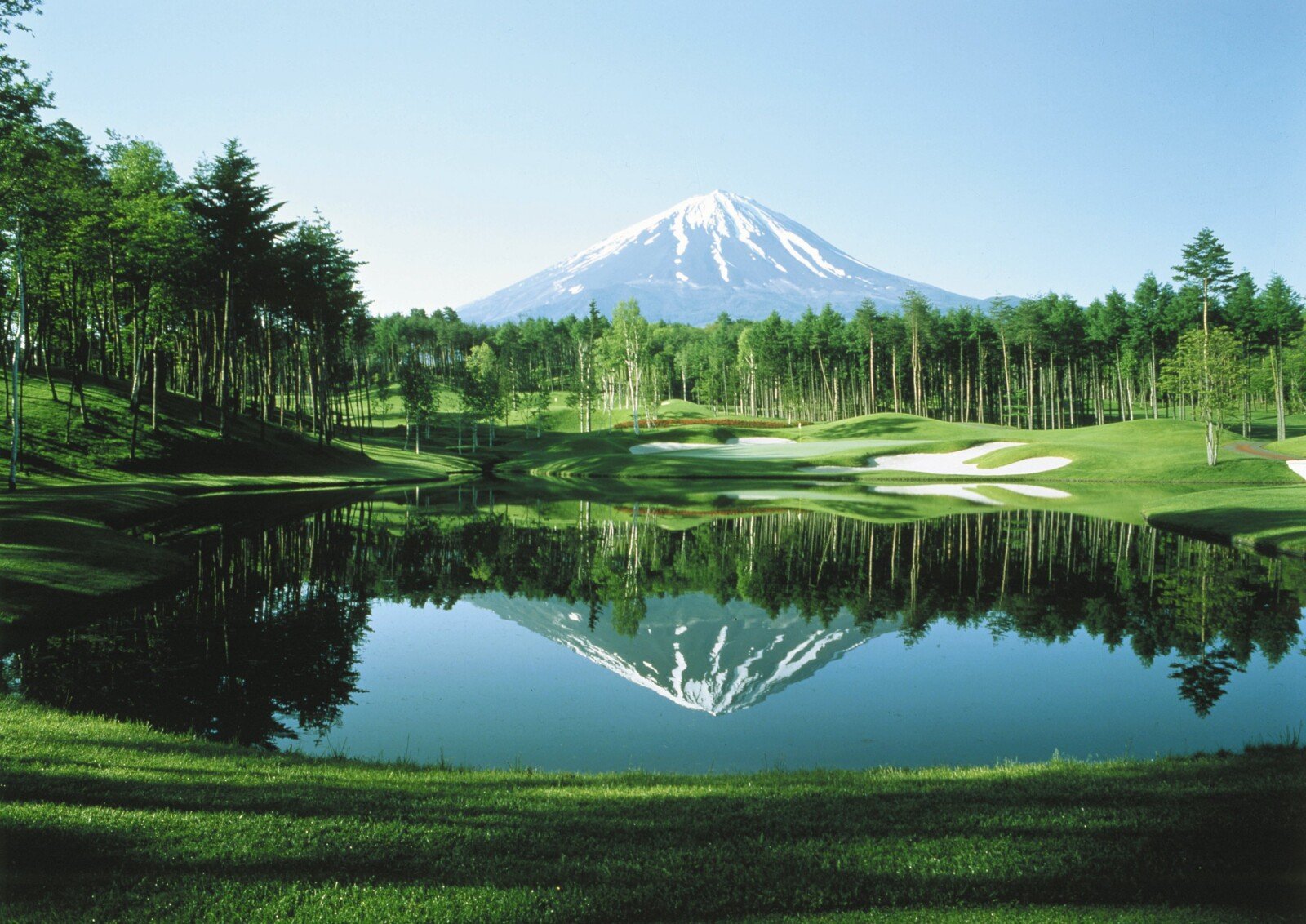
The most picturesque hole is said to be the par-three eighth (see the main picture at the top of this feature), where, on a clear day, Mount Fuji is reflected in the pond in front of the tee. Sadly, I can only take their word for it, as the clouds stubbornly refused to lift during the length of our round. Still, it is an undeniably a superb hole, with or without the summit on show, although I regretted not taking one more club, as my effort span back off the green into the water, resulting in yet another reload.
While the course is less hilly than Kawaguchigo, it was a joy to see that the course designer saw fit to including a 50-metre travellator for one particularly steep incline between green and tee. While jumping in the buggy, or walking up a path, were both options, it was impossible to miss the chance to travel in such slow style. It was hard to resist the urge to walk as the travellator travelled, but in the spirit of letting the machine do the job for which it was created, resist it I did.
Despite all that unspent energy, it wasn’t long before we stopped for the obligatory and very tasty lunch after nine holes, slurping down big bowls of ramen, fried breadcrumbed meats of various types – including horse, if it takes your fancy – and a cold beer or two. Suitably refreshed, we tackled the back nine, and two hours later, after visiting more woods, plenty of bunkers, and a couple of lakes, I came off the course with a big smile on my face.
LASTING MEMORIES
Yes, it was disappointing that Mount Fuji had been so shy during our rounds – although I did get to see it in all its glory on a couple of other days during my trip – and yes, it would have been ideal – at least for photographic purposes, to have played when the grass is fully green, but these small faults will only give me good reason to come back again to fully appreciate the experience. Perhaps when the Olympics comes back to Tokyo, by which time I’ll probably be over 100 years old and very much in need of an automated golf buggy, a stair lift on every tee and a toilet with a hot jet and a warm seat.
While it’s hard to argue that you should travel more than half-way around the world to play on golf courses which, in many ways, resemble and play like those to be found in Surrey and Berkshire, there is no doubting that a trip to Japan will have a profound effect, not just on how you experience golf, but perhaps on your whole outlook on life. Japan encourages you to take time to smell the roses, take pleasure in fine details, and to fully engage with your surroundings, the people, and the natural landscape.
I read somewhere that you do not pay for a green fee in Japan, instead you are paying for an experience – a level of service, thoughtfulness and generosity of spirit that you will rarely find anywhere else in the world. And it is for that reason – and the countless other unique facets of Japanese culture – that it is truly worth travelling all those thousands of miles.
ITINERARY DETAILS
PLAY
Kawaguchiko Country Club, Fujikawaguchiko, Yamanashi
Green Fee: £51 for 9 holes, including lunch.
Web: kcc.tatemono-golf.com
Narusawa Golf Club, Minamitsuru-gun, Yamanashi
Green Fee: £87 for 18 holes, including lunch.
Web: narusawa.ne.jp
STAY
Hanz Outdoor Resort, Fujikawaguchiko, Yamanashi
A villa, which sleeps up to four people, costs £424 per night on a room-only basis, plus £12pp for breakfast. A glamping pod sleeping two people costs from £157 per night, while the 5-bed guest house, sleeping up to 10 people, costs from £1,715 per night. For bookings, visit www.hanz-odr.com
FLY
Return flights from London Heathrow to Tokyo Haneda with a stopover in Frankfurt are priced from £820pp with Lufthansa (www.lufthansa.com)
Read the full article here