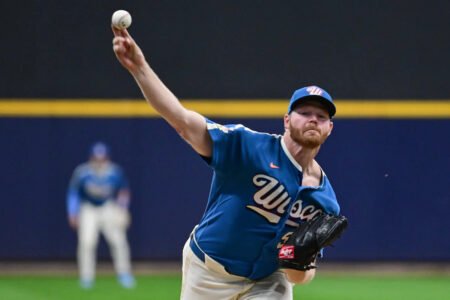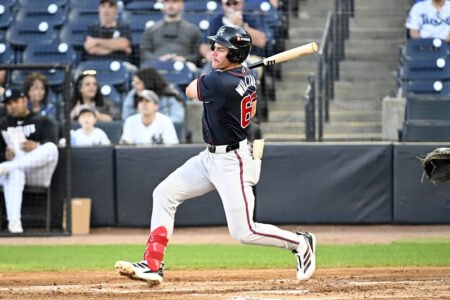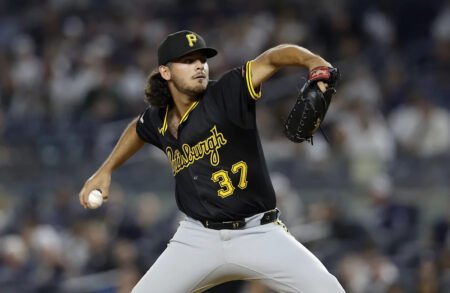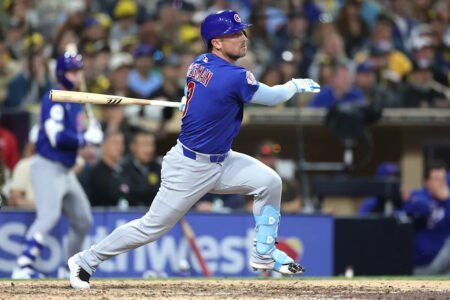




We examined several hitter skill and luck factors last week, including the mention of selling high on Munetaka Murakami, who probably hit another home run as you’re reading this. To identify the players to discuss, we’ll use the Yahoo player rater for the past two weeks to provide a small sample to choose from. Besides those hot hitters on the player rater, we’ll discuss other hitters generating plenty of buzz throughout the fantasy baseball community.
This piece includes two hitters performing well and two struggling players. Reach out if you have a player you would like me to examine on X/Twitter, @corbin_young21.
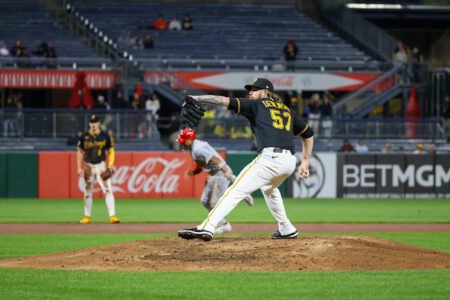
Oneil Cruz, Pirates (98% Rostered)
Cruz is blazing hot to begin the 2026 season. His .349 BABIP boosts his batting average, as we saw in 2024. Interestingly, Cruz’s 2026 61.2% contact rate is the career low since his rookie season; it sits five percentage points below his career average (66.7%). That aligns with Cruz’s 17.9% swinging-strike rate, nearly four points above his career average (14.4%).
Like Cruz’s BABIP, his contact rate will likely regress closer to his career norms, though it’s below the concerning threshold of 70%. Speaking of luck factors like BABIP, Cruz’s 34.9% home run rate (HR/F) is over 14 percentage points above his career average (19.9%). Hitters like Cruz with elite power skills can sustain higher home run rates, so it’s within the range of outcomes. That said, Cruz’s career HR/F tends to be in the 90th percentile based on his power skills, so the 2026 HR/F likely regresses.
It doesn’t appear that Cruz made any swing changes with his distance between his feet and stance angle within 2-3 inches and degrees from previous seasons. That’s something we like to examine if a hitter made a swing adjustment in the offseason, like Cam Smith or Jordan Walker.
It’s early, but Cruz has also been producing well against breaking and offspeed pitches in 2026 after mostly being successful against fastballs.
Oneil Cruz xwOBA by season. (Photo by Corbin Young/BaseballSavant)
He continues to whiff against all pitch types, but does damage against breaking (.349 wOBA, .345 xwOBA) and offspeed (.420 wOBA, .355 xwOBA) pitches. For context, Cruz had a .249 wOBA (.264 xwOBA), 7.6% barrel rate and 19.6% swinging-strike rate against breaking pitches before 2026. Meanwhile, Cruz was slightly better against offspeed pitches, given his .329 wOBA (.314 xwOBA), 9.3% barrel rate and 21% swinging-strike rate before 2026.

Oneil Cruz’s xwOBA by zone for breaking pitches. (Photo by Corbin Young/BaseballSavant)
When looking at where Cruz has been hitting the breaking and offspeed pitches in 2026, they have mostly been in the heart of the zone. Unfortunately, Cruz can still be susceptible to breaking and offspeed pitches thrown low and below the zone. Statcast provides new strike zone metrics with the Automated Balls and Strikes (ABS) system. When pitches have been thrown in the heart of the zone, Cruz swings 64.8% of the time while making contact 77.8% of the time in 2026. Both Cruz’s swing and contact rates in the heart of the zone remain within 2-3 percentage points of his career averages.
The visual below shows Cruz’s swing, contact and pitch zone rates in the heart, shadow and chase areas of the zone (the H, S and C refer to heart, shadow and chase).
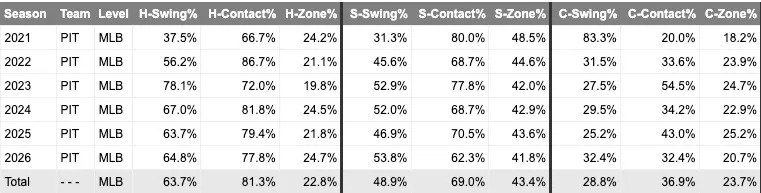
Oneil Cruz’s strike zone swing and contact rates. (Photo by Corbin Young/FanGraphs)
However, when pitches have been thrown in the shadow areas, around the edges of the zone, Cruz swings 53.8% of the time and makes contact 62.3% of the time. We know Cruz can be an aggressive swinger, leading to those whiffs and home runs. However, Cruz’s contact rate in the shadow areas would be over six percentage points below his career norm.
Historically, Cruz struggled against left-handed pitchers, with a brutal 66 wRC+, .186 BA and .267 wOBA through the 2025 season. Interestingly, Cruz’s performance against lefties has shifted in 2026. That’s evident by Cruz’s 201 wRC+, .351 BA and .471 wOBA against left-handed pitchers across a small 39 plate appearance sample. Meanwhile, Cruz has been struggling against right-handed pitchers in 2026, with a 102 wRC+, .225 BA and .324 wOBA.
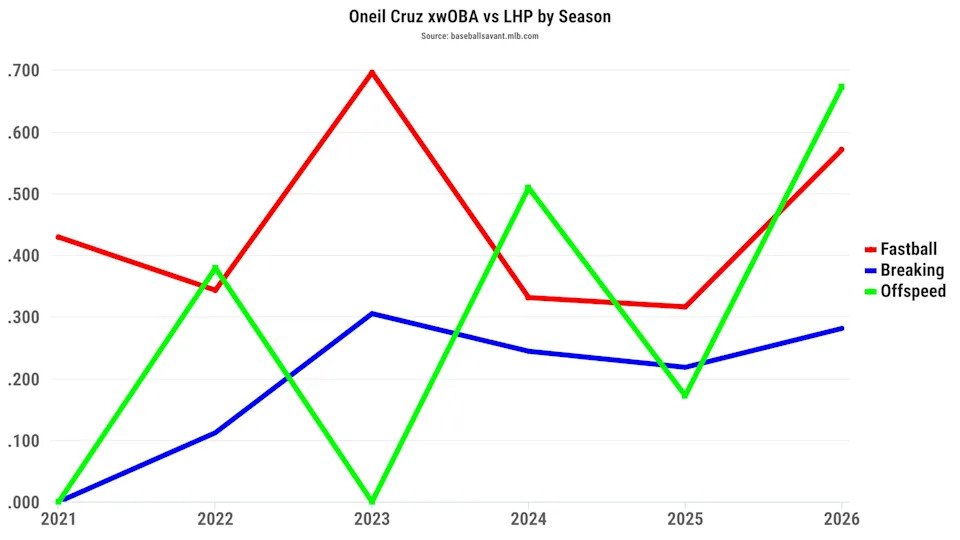
Oneil Cruz’s xwOBA by pitch type against LHP. (Photo by Corbin Young/BaseballSavant)
Cruz’s BABIP has been fueling the production while he continues to whiff against left- and right-handed pitchers. Over a larger sample, we should see Cruz’s splits regress, though it’s positive to see different outcomes early in 2026.
There is the volatility and upside for a player like Cruz, who struggles to make contact, yet smashes the ball and steals bases. Outliers exist in this game, and Cruz looks like one of them.
Ben Rice, Yankees (99% Rostered)
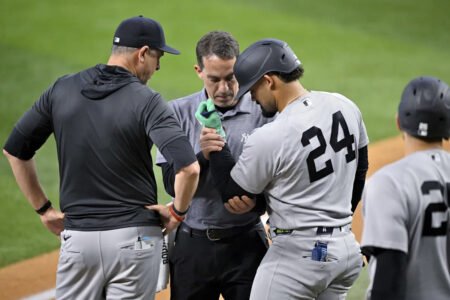
Rice is a cheat code who qualifies at catcher and performs well offensively, and he hasn’t even started a game at backstop this season yet. In the Yankees’ first five games against left-handed starting pitchers, Rice played in just one of them. Rice ultimately forced the Yankees’ hand by hitting well, leading to playing in five of six games against left-handed starting pitchers, including in four out of five consecutive games.
Rice smashed 26 home runs with a .255 batting average in 2025. There’s a good chance Rice matches or surpasses those numbers in 2026, though his .345 BABIP fuels his .309 batting average. After 57 barrels (No. 24), 104.1 mph EV50 (No. 16) and a 10.8% barrel rate per plate appearance in 2025, Rice followed that up with a 11.9% barrel rate and 103.7 mph EV50 (No. 25). Rice pulled the ball in the air 25.2% of the time in 2025, which dipped to 21.5% in 2026. That makes his already strong power skills play well in New York.
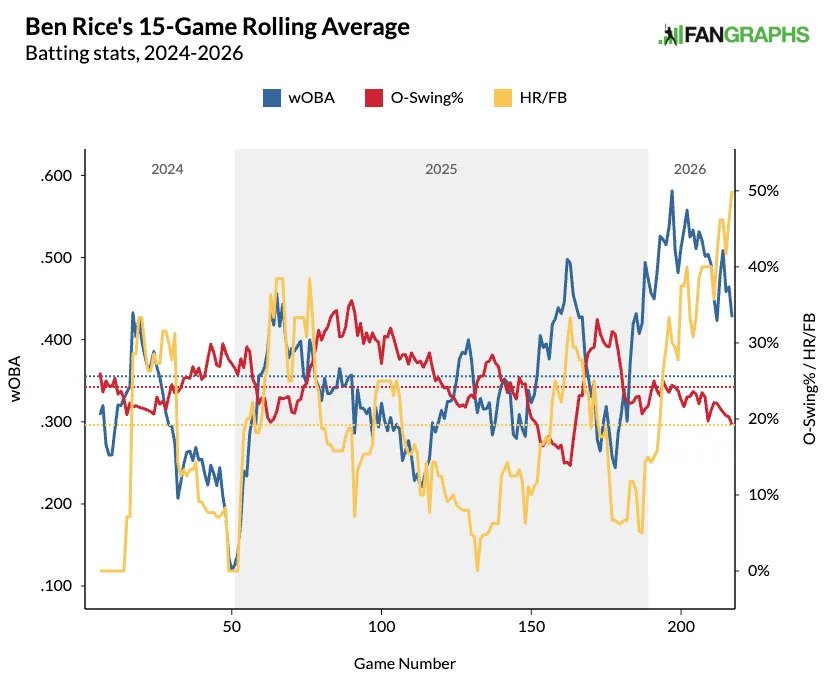
Ben Rice’s rolling wOBA, HR/F and chase rate. (Photo by Corbin Young/FanGraphs)
Since Rice hardly chases (20.6%) and walks at a double-digit rate (10.9%) in his career, he can be a value in points and OBP formats. It’s worth highlighting that Rice’s walk rate spiked to 17.8% in 2026, making him an elite OBP asset. Expect Rice’s 41.7% HR/F in 2026 to regress closer to his career average (19.2%). However, hitters like Rice, with high-end to near-elite power, can have higher home run rates and be efficient.
Rice’s skills support the early first-round production. Expect Rice’s production to continue, leading to a step forward in 2026. Don’t sell high.
Jackson Merrill, Padres (97% Rostered)
Though it’s fun to discuss positives and hitters performing well, let’s examine Jackson Merrill, who had a down 2025 season due to injuries. Merrill spent over 50 days on the injured list with a strained hamstring, concussion and sprained ankle last year. That led to Merrill’s high-end fantasy value as a power/speed option from his rookie season dipping to underwhelming numbers in 2025. Merrill came into 2026 with a slightly discounted draft price, but many still believed in the former top prospect’s profile.
Merrill has been unlucky from a BABIP standpoint, with a .256 BABIP in 2026 compared to his career norm (.310), directly impacting his batting average. That coincides with Merrill’s contact rate declining and swinging-strike rate rising, which typically isn’t a trend we want to see, especially for a younger hitter expected to progress. Merrill’s contact rate fell to 75.1% in 2026, nearly identical to 2025 (75.5%) and 81% (2024). Meanwhile, his swinging-strike rate went from 10.8% (2024) to 14.1% (2025) and 14.4% (2026).
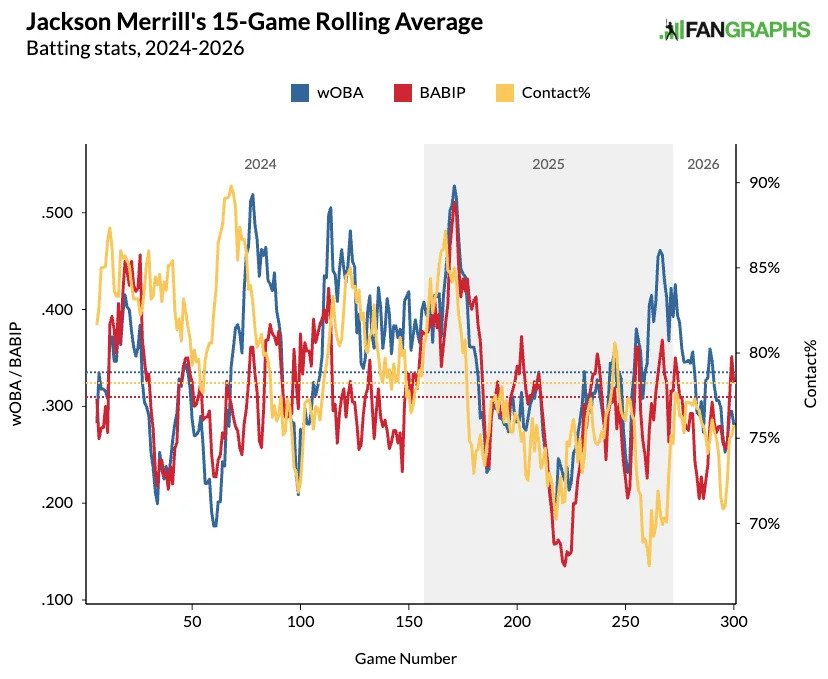
Jackson Merrill’s rolling wOBA, BABIP and contact percentage. (Photo by Corbin Young/FanGraphs)
Merrill’s hit tool had 55 to 60 grades, with potential for a 70-grade in the future. Typically, hitters with strong hit tools should be a strong source of batting average and not have those concerns about making contact. We might trust the prospect’s pedigree and expect better contact rates moving forward.
Merrill has been swinging the bat faster (73.5 mph), increasing from 72 mph in 2025. It’s a notable increase in bat speed, supporting his high-end barrel rate per plate appearance (8.8%) in his career. We want to monitor Merrill’s groundball rate, which spiked to 43.2%, compared to a 37.3% career average. Merrill’s swing tilt increased by two degrees in 2026, which isn’t significant, but may suggest the groundball rates will regress to the career norms.
Interestingly, Merrill hasn’t been squaring up the ball as often when making contact. Merrill’s squared up rate when making contact was around 30% throughout 2024 and 2025. However, Merrill’s squared-up contact rate dropped to 21.3% in 2026. Baseball Savant defines squared-up percentage as the percentage of swings that reaches 80% of the max attainable exit velocity. That indicates Merrill has been struggling to find the sweet spot of the bat consistently in 2026.
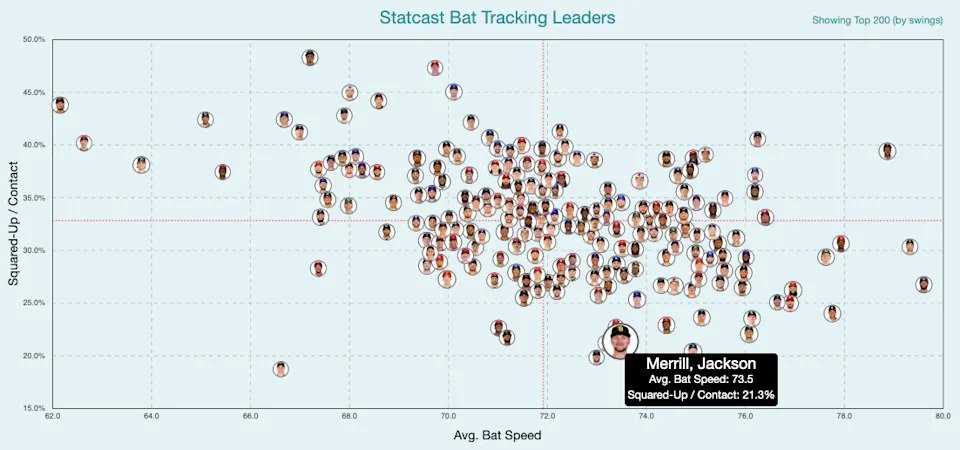
Jackson Merrill’s squared up per contact and bat speed in 2026. (Photo by Corbin Young/BaseballSavant)
There’s clearly some swing consistency issues for Merrill in making contact and squaring up the ball, though the power metrics have balanced that out. On a positive note from a speed standpoint, Merrill’s stolen base opportunity rate spiked to 21% in 2026, up from a 10% career average. That shows us there’s a path for 15-20 stolen bases, as we saw in his rookie season.
Assuming Merrill’s plate discipline and swing consistencies return, Merrill expects to produce 20+ home runs, 15-20 stolen bases and a .260 batting average. There could be an early buy-low opportunity in trading leagues if there’s panic around his early-season production.
Pete Crow-Armstrong, Cubs (98% Rostered)
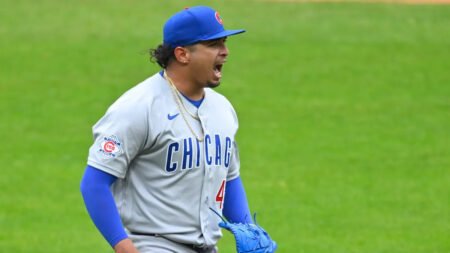
One of the most polarizing players to debate throughout the offseason was Pete Crow-Armstrong. It was a tale of two halves in 2025, with 21 HR, 25 SB and a .262 BA in the first half, then 10 HR, 10 SB and a .228 BA in the second. Crow-Armstrong showed similar contact rates (73-74%), yet his home run rate fell to 10% in the second half from 17% in the first half. Meanwhile, Crow-Armstrong ran more (51% stolen-base opportunity rate) with better conversion rates (86%) in the first half, which dipped to 29% and 71%, respectively, in the second half.
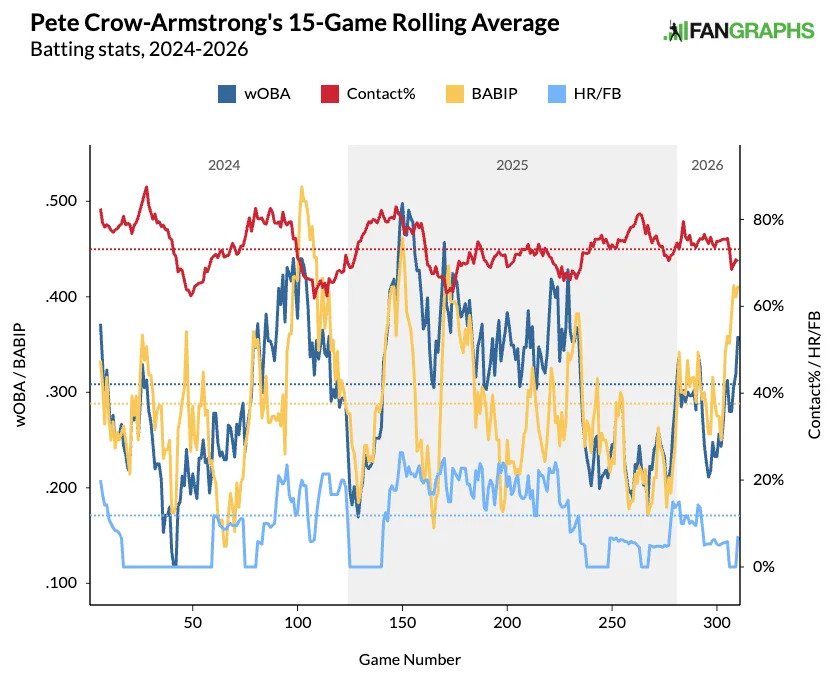
PCA’s rolling game averages. (Photo by Corbin Young/FanGraphs)
Crow-Armstrong’s aggressive plate discipline can lead to highs and lows, especially considering he chases 44.7% of the time and swings 56.8% of the time. For context, Crow-Armstrong chases over 13 percentage points more and 10 points above the league average. We’ve seen several fantasy-relevant hitters have chase rates above 40% and contact rates below 75%, as seen below in 2026.
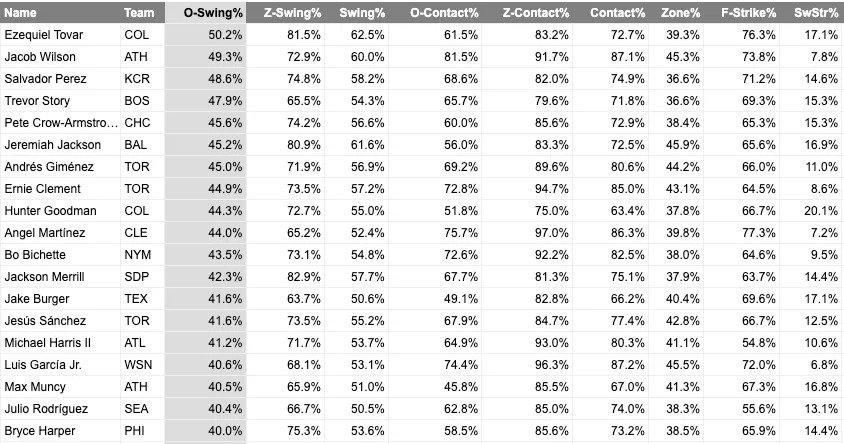
Hitter leaders by the highest chase rate in 2026. (Photo by Corbin Young/FanGraphs)
Those hitters include Ezequiel Tovar, Salvador Pérez, Trevor Story, Jeremiah Jackson, Hunter Goodman, Jake Burger, Julio Rodríguez and Max Muncy (Athletics) and Bryce Harper. Merrill almost met those thresholds with a 75.1% contact rate in 2026. Thankfully, Crow-Armstrong hits the ball hard when he makes contact. He swings hard, with a 73.8 mph bat speed and 41% fast-swing rate (percentage of swings at 75 mph or faster).
Groundballs have been an issue, up to 40.8% (2026) from 31.3% (2025), though Crow-Armstrong continues to use a pull-heavy (52-53%), flyball (46-50%) approach. The results haven’t been the same on pulled batted balls for Crow-Armstrong in 2026, given his .337 wOBA (.381 xwOBA) and 75.2 mph bat speed. Maybe the ball is dead or it’s weather-related, but Crow-Armstrong’s pulled batted balls have averaged 113 feet in 2026, down from 188 (2025) and 160 (2024). Part of Crow-Armstrong’s issues involves only one barrel (2.9%) on pulled balls in 2026, after 34 barrels (16.5%) in 2025.
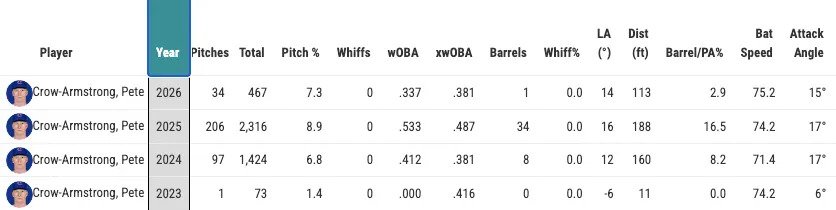
PCA’s outcomes and exit velocities on pulled batted balls (2023-26). (Photo by Corbin Young/BaseballSavant)
There could be diminishing returns for Crow-Armstrong if he is pulling the ball too often on the ground. That’s further evident by Crow-Armstrong’s pulled air rate dropping from 30.2% (2025) to 19.7% (2026). We’re hypothesizing that this could be the case, given his 8.5-inch intercept point in front of the plate in 2026, which is over two inches higher than in 2025. In short, Crow-Armstrong could be hitting into the shift, which can be problematic, given his .268 wOBA (2026) against the shift.
Strong defense keeps Crow-Armstrong’s bat in the lineup, though the Cubs have been moving him down. To begin the season, Crow-Armstrong was hitting cleanup, but he has regularly batted in the bottom third of the lineup since the start of April.
It’s hard to sell low on Crow-Armstrong, given his high draft cost. Hold him instead, because the inputs (bat speed exit velocities) should lead to more home runs with the pull-heavy, flyball approach, though an Oneil Cruz-type season from 2025 (power, speed and bad BA) is a likely outcome.
Read the full article here