



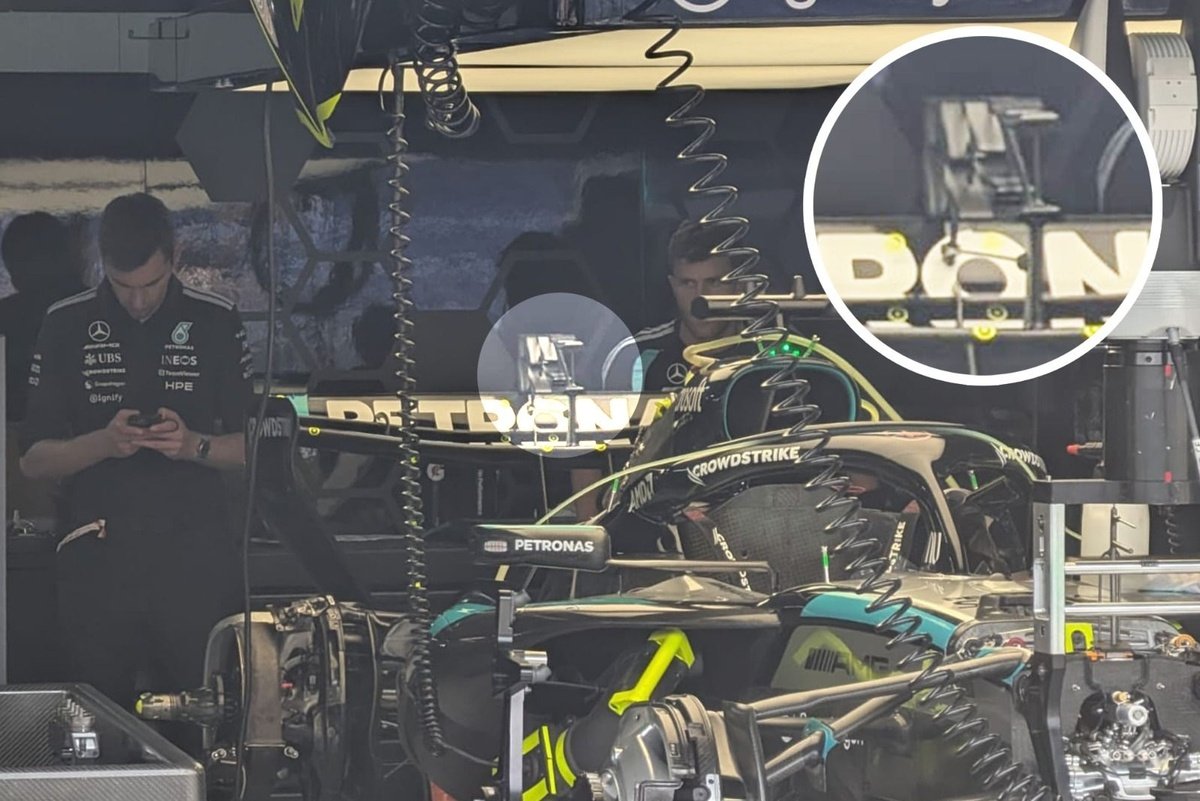
The removal of straight mode for Formula 1’s Monaco Grand Prix has led to an interesting approach from a handful of teams – which have used the opportunity to replace their rear wing actuators with a cluster of tiny winglets.
All bodywork must fit into the defined legality boxes defined by the FIA’s technical regulations. There is a small rectangular box on top of the rear wing for the wing actuator housing, previously used for DRS and now used for the active aero functionality.
Since straight mode is not in operation for this weekend, the actuator is superfluous. However, this has offered the opportunity to use this box for downforce purposes, a key component for performance in Monaco.
The aerodynamicists’ pursuit of downforce usually needs to be balanced by efficiency; while a development might offer high levels of peak load, it would not be viable to use it should the drag penalty be too high. The best-performing cars are those that find the strongest balance between downforce and drag overall.
Low cornering speeds in Monaco significantly reduce the need for efficiency; thus, teams can bolt on their largest wings and benefit from the increased acceleration under traction. It might be described as ‘dirty downforce’, but it’s sensible to pursue that route at the Monte Carlo circuit as none of the straights are long enough to create a realistic drag penalty.
Additionally, these winglets can also help the rear wing work harder through generating upwash, which expands the lower pressure field at the rear of the car. If this is linked to the diffuser, it generates more suction and thus pulls airflow underneath the car at a higher velocity – thus, increasing downforce.
Car of Max Verstappen, Red Bull Racing
Photo by: Marcel van Dorst / EYE4images / NurPhoto via Getty Images
This is all possible because the bounding box for the actuator housing extends well above the rear wing elements, allowing the teams to use the verticality to fit their winglets into.
Mercedes has taken a particularly radical approach here, and its arrangement of aero devices very much looks like a series of aerofoils on a vine. The mainplane mounted pylon houses a trio of cascading winglets, with another winglet mounted on top.
There are two further banks of two winglets behind this, with the final bank mounted to the upper rear wing flap. Each of the final winglets in each ‘cascade’ has a Gurney flap to further increase their potency.
Red Bull, meanwhile, appears to have modified its standard actuator housing to fit two winglets, enclosed by endplates.
Audi has two cascading elements sitting on the upper rear wing plane, attached to a mainplane-mounted pylon. This fits on like an extra tab, much like Ferrari’s standard rear wing design, and this is an approach Cadillac has also taken for this round. To fit this, the American team has removed the actuator section entirely.
Racing Bulls has also modified its standard actuator housing to resolve in a single tab to extend the working chord length of the central part of the rear wing, also with a Gurney flap at the trailing edge.
McLaren has also stacked a series of winglets into the actuator position, with a trio of longer-chord winglets stacked on top of each other on the mainplane, sitting ahead a pair of smaller winglets attached to the trailing edge of the upper flap.
We want to hear from you!
Let us know what you would like to see from us in the future.
Take our survey
– The Autosport.com Team
Read the full article here