



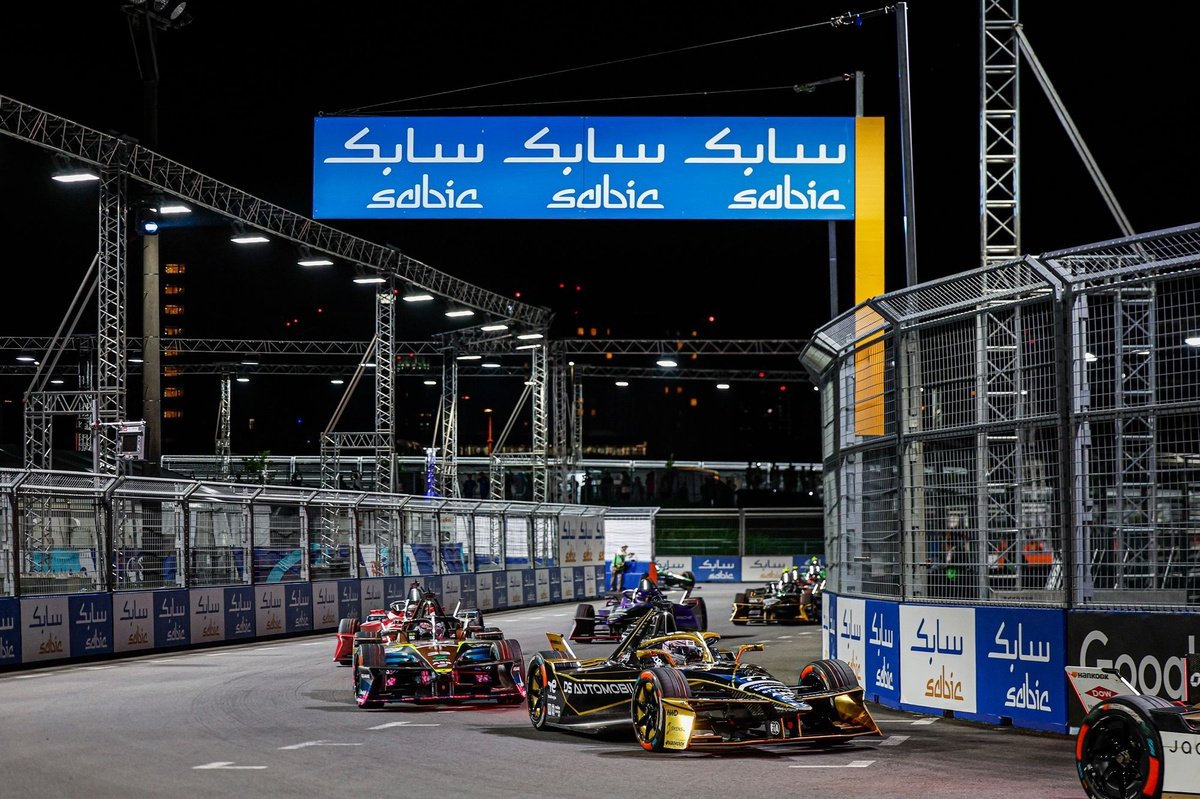
The Formula E world championship is breaking new ground this season with a double-header held at night in the Japanese capital.
The 2.58km street circuit, featuring 18 corners and fully floodlit, offers a unique spectacle but also poses a real challenge for the drivers. “At night, and if it rains on top of that, it could get very tricky,” said Taylor Barnard ahead of practice, having secured a podium finish here in 2025. “But the track is really cool; it’s almost surreal to race through the streets of such a megacity, especially for someone like me who’s a fan of video games.”
After a downpour that delayed the first practice session by 15 minutes, the drivers found a track that was still damp and full of pitfalls. Despite these tricky conditions, Maximilian Guenther set the second-fastest time of the session, just two tenths off the pace. This result was all the more remarkable given that the German had been feeling unwell with a fever right up until a few hours before getting behind the wheel.
On Saturday, conditions changed completely. In sweltering heat, the two DS E-Tense FE25s confirmed their competitiveness in free practice: Guenther was seventh, Barnard 10th. In qualifying, the English driver reached the quarter-finals for the eighth time this season. Facing Jake Dennis, the Briton put in a solid performance before securing an excellent fifth place on the grid. Guenther, fifth in his group, narrowly missed out on a place in the duels but started from a promising ninth position.
DS Penske takes centre stage
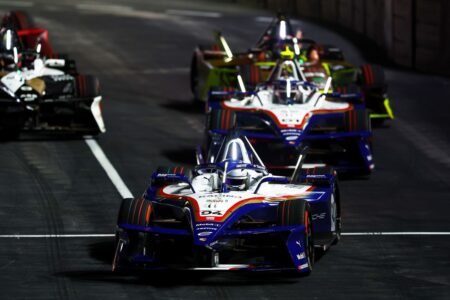
At the start of the 36-lap race, both drivers managed their start well and each gained a position. Very quickly, Barnard settled into the leading group, whilst Guenther adopted a more patient strategy, aiming to optimise his energy consumption. In an E-Prix featuring Pit Boost and a single six-minute Attack Mode, the execution of the strategy becomes crucial.
Track action
Photo by: DPPI
The DS Penske team executed this perfectly, and Guenther made his mandatory pitstop first, right at the halfway point of the race. Barnard extended his stint by three laps and, in doing so, set the provisional fastest lap of the race. Once the Pit Boost sequence was complete, both DS E-Tense FE25s were still in positions that allowed them to aim for big points. In the final third of the race, Barnard made full use of his Attack Mode and climbs back up to fourth place, once again demonstrating his car’s excellent pace. Guenther opts to activate it later in order to have maximum power throughout the final laps.
However, the particularly tight energy management in this first race eventually shuffles the deck. Faced with staggered strategies and an extremely tightly bunched field, both drivers lost several places in the final corners. Barnard secured a point for 10th place, while Guenther finished 15th. This result does not fully reflect the level of performance shown by the team, which was consistently in the top 10 and capable of battling at the front for most of the race.
Better things expected tomorrow
Beyond the result, DS Penske takes away several positives from this first race: a fast car on a demanding circuit, a strong performance in qualifying, a race pace capable of rivalling the best, and a well-executed strategy. These elements provide an encouraging foundation ahead of the second race in Tokyo, which takes place on Sunday evening (at 8.00pm local time).
With no Pit Boost and three laps fewer, this second race will present a different scenario, which may allow the Franco-American team to capitalise on the potential demonstrated during the weekend’s opening race.
We want to hear from you!
Let us know what you would like to see from us in the future.
Take our survey
– The Autosport.com Team
Read the full article here