



By Eurohoops team / info@eurohoops.net
The script, as ever, should have been written by the titans—record champions Real Madrid, reigning champions Fenerbahce, the perennial blue bloods—who have long dictated the league’s rhythms, year after year.
But so far? All established wisdom has gone up in smoke.
Heavyweights Falter
Let’s begin where upheaval is most visible: the demise, at least for now, of the old order. Los Blancos, typically clinical, supremely drilled, and never far from the summit, have stumbled to 10th. Under Sergio Scariolo’s stewardship, a side built on ironclad defense and surgical execution has lost both. The ball movement stutters. The edge is dulled. A power rarely seen adrift now floats in unfamiliar waters, undone by new faces and an identity crisis that has left even their most ardent followers restless.
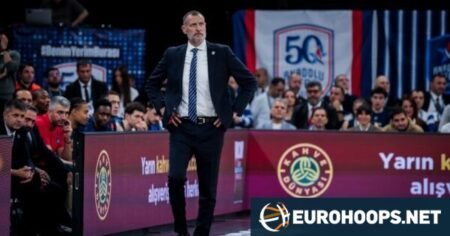
The reigning champions, Fenerbahce? If Madrid’s malaise is surprising, Fener’s fall is a technical knockout. Their 2024–25 championship parade rapidly gave way to roster overhauls and fitness woes, which have seen them slip to the outer edges of the playoff picture. Eighth, clinging on for dear life, and not even Sarunas Jasikevicius’ tactical acumen can instantly resolve the slide.
Of course, it is still early days, and both ailing giants could revive in next to no time at all. But for right now, they have both been overshadowed by three upstarts, only one of them ever being crowned European champions before, all upsetting the odds as they rise to the EuroLeague’s summit. So, who are they, and can they continue their Cinderella stories as the 2025/26 campaign progresses? Let’s take a look.
Hapoel Tel Aviv
Hapel Tel Aviv has long lived in the shadow of its rivals in the Israeli capital. Maccabi are six-time EuroLeague champions, the fourth most of all time. For Hapoel, meanwhile, it’s a different story, with the 2025/26 season representing their maiden campaign in Europe’s elite club competition. But to say that they have hit the ground running would be an understatement.
No team better encapsulates this season’s anarchy than The Reds, as the Israeli outfit has rocketed to the top of the standings with an impressive 9-4 record. Statement wins include an 85-77 triumph against last season’s beaten finalists, Monaco, an Elijah Bryant-inspired beatdown of Baskonia, and a thrilling one-point victory on the road against Paris. However, there has been heartbreak, too. All four of their losses have been painful, including three defeats to heavyweights Real Madrid, Olympiacos, and Fenerbahce, as well as a crushing defeat to struggling rivals Maccabi.
Furthermore, inexperience in playoff cauldrons cannot be masked by regular-season fireworks, and online oddsmakers seemingly agree. The latest Bovada basketball odds still make Hapoel a 9/1 shot, well behind heavy 5/2 favourites Panathinaikos. Hapoel, though, has a ruthless streak previously unseen, and if injuries don’t intervene, their devil-may-care audacity could make them the team no favorite wants to see when everything’s on the line.
Crvena Zvezda
There is a different energy building in Belgrade, one forged from adversity and weaponized by 18,000 Belgrade Arena throats. Crvena Zvezda has turned a turbulent preseason—the kind that usually dooms even promising projects—into a springboard for one of the league’s stiffest, most physical offenses. Their record (9–4, +71 net margin) is a product not just of defensive snarl, but of strategic menace.
Countless pundits wrote off Red Star after roster shakeups mid-campaign. Instead, they’ve grown stronger, falling back on a DNA built on stifling rebounding and a relentless, bruising style. Chima Moneke has emerged as a talisman for this resurgence—his performances a microcosm of Zvezda’s best qualities: toughness, adaptability, and an unwillingness to blink in the face of adversity.
The apex arrived with a clinical 91-80 home win against Olympiacos, one of the league’s elite—a match in which Zvezda imposed their will both tactically and emotionally, suffocating and then seizing control late. That’s the playoff blueprint, distilled: hard, physical, unromantic, and devastating when executed to plan.
So can Zvezda break through? They’re not just a dark horse; they are a team with a playoff pedigree and a style custom-made for the slowdown and grind of May basketball. If health holds and the bracket delivers, this is the kind of team that could, against the 14/1 odds, electrify Belgrade with a return to the EuroLeague summit.
Žalgiris Kaunas
Žalgiris Kaunas have long stood as Europe’s perennial underdogs—champions in a distant era, and always a threat to spoil a superpower’s dream. This year’s group sits at 8–5, with dreams of repeating their shock success of 1999 alive and well.
It begins, and sometimes ends, with Sylvain Francisco. The French guard has transformed into one of EuroLeague’s most complete playmakers, his averages (16.9 ppg, 7.3 apg, PIR 21.1) leaping off the page, but given real meaning by his unflinching step-up performances. The recently chronicled 82–67 drubbing of Baskonia—Francisco dropped 23 alongside a defensive masterclass—signals a player and a team with the poise to survive any hostile tide.
Yet, Žalgiris is more than just their star. Their offensive flow is consistent, the ball movement sharp, and their structure—the product of a deeply rooted club ethos—rarely wavers under playoff pressure. They shockingly missed the playoffs altogether last term, with a disappointing 15-19 record, but already the Lithuanians seem well on their way back to European basketball’s summit. 33/1 odds say that they go all the way.
Read the full article here