



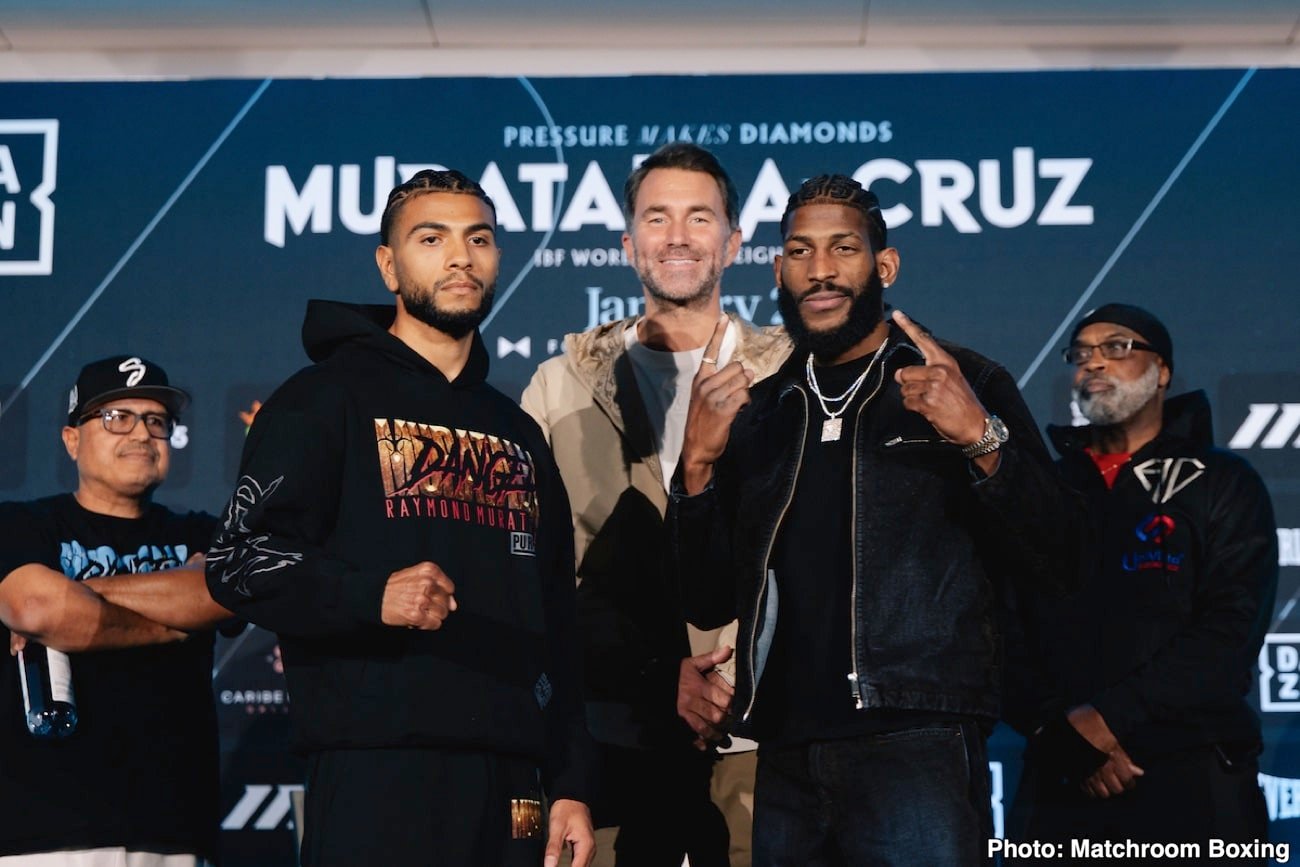
That alone is enough to make it appointment viewing.
Muratalla is a good champion. That shouldn’t be controversial. He’s solid everywhere, hits hard enough to earn respect, and doesn’t beat himself. If you’re constructing a fighter in a lab to win rounds consistently and avoid disaster, you could do a lot worse than Muratalla. He stays balanced. He doesn’t panic. He understands where he is in the ring.
But when you line him up against Andy Cruz, all of that steadiness starts to look like a ceiling rather than a foundation.
Cruz is unusual. Not flashy for the sake of it, not reckless, not trying to prove how clever he is — just different in the way his reactions fire and his body occupies space. He does ordinary things at a speed that disrupts opponents before they can settle. That’s the core issue here. Muratalla is comfortable when exchanges unfold at a readable pace. Cruz does not allow that pace to exist for very long.
Watch how Cruz triggers his offense. There’s no loading phase. No visible decision-making. Punches appear where opponents expect a pause. His jab isn’t just fast; it’s timed to his foot placement so that he’s already exiting as the counter is being considered. It’s hard to steal momentum from someone who never fully commits it.
Muratalla can counter. He’s good at it. But countering Cruz requires a level of precision that borders on theoretical. You’re not reacting to what you see. You’re guessing where he’ll be half a second from now. Guess wrong, and you’re eating a follow-up or missing the window entirely.
Defensively, Muratalla gives Cruz openings he hasn’t needed much help to find. He pulls back in straight lines. He leans heavy on the lead foot when circling. He experiments with defensive looks that work best when the opponent lacks either speed or imagination. Cruz has neither problem.
That doesn’t mean Cruz is untouchable. He isn’t. He’s been clipped. He’s been buzzed. But there’s a difference between vulnerability and exposure. Most of the success opponents have had against him has come from timing anomalies rather than sustained control. When Cruz is fully alert, his recovery is immediate. He resets faster than opponents can capitalize.
Offensively, he’s more developed than he’s often given credit for. He goes downstairs willingly. He brings the uppercut into play. His right hand carries enough weight to demand respect, and once that respect is established, everything else opens up. Muratalla’s best punches tend to come when opponents make mistakes. Cruz’s best punches come because he creates mistakes.
This is where the fight becomes less about toughness and more about bandwidth. Muratalla will have moments. He’ll win rounds. He’ll land clean shots. But the accumulation favors Cruz — not just on the scorecards, but in control of the rhythm. Over twelve rounds, that control compounds.
The danger, as always, is the equalizer. Anyone can get caught. Boxing allows for chaos. But when you strip away the romance of possibility and look at the mechanics, it’s hard to find a path that doesn’t narrow back to the same conclusion.
Cruz is simply operating on a different level of responsiveness.
That doesn’t diminish Muratalla. If anything, it confirms his value as a measuring stick. Losing to a fighter like Cruz doesn’t expose flaws so much as it defines limits. And that’s useful information in a division that’s long on names and short on clarity.
This fight deserves attention not because it’s loud, but because it’s honest. It isn’t selling a dream. It’s offering a verdict.
You can still enjoy the rounds. You can still appreciate the adjustments. You can still get pulled into the moment. Knowing where it’s headed doesn’t cheapen the experience. It just changes how you watch it.
Sometimes the destination is obvious. That doesn’t mean the journey isn’t worth taking.
Read the full article here