



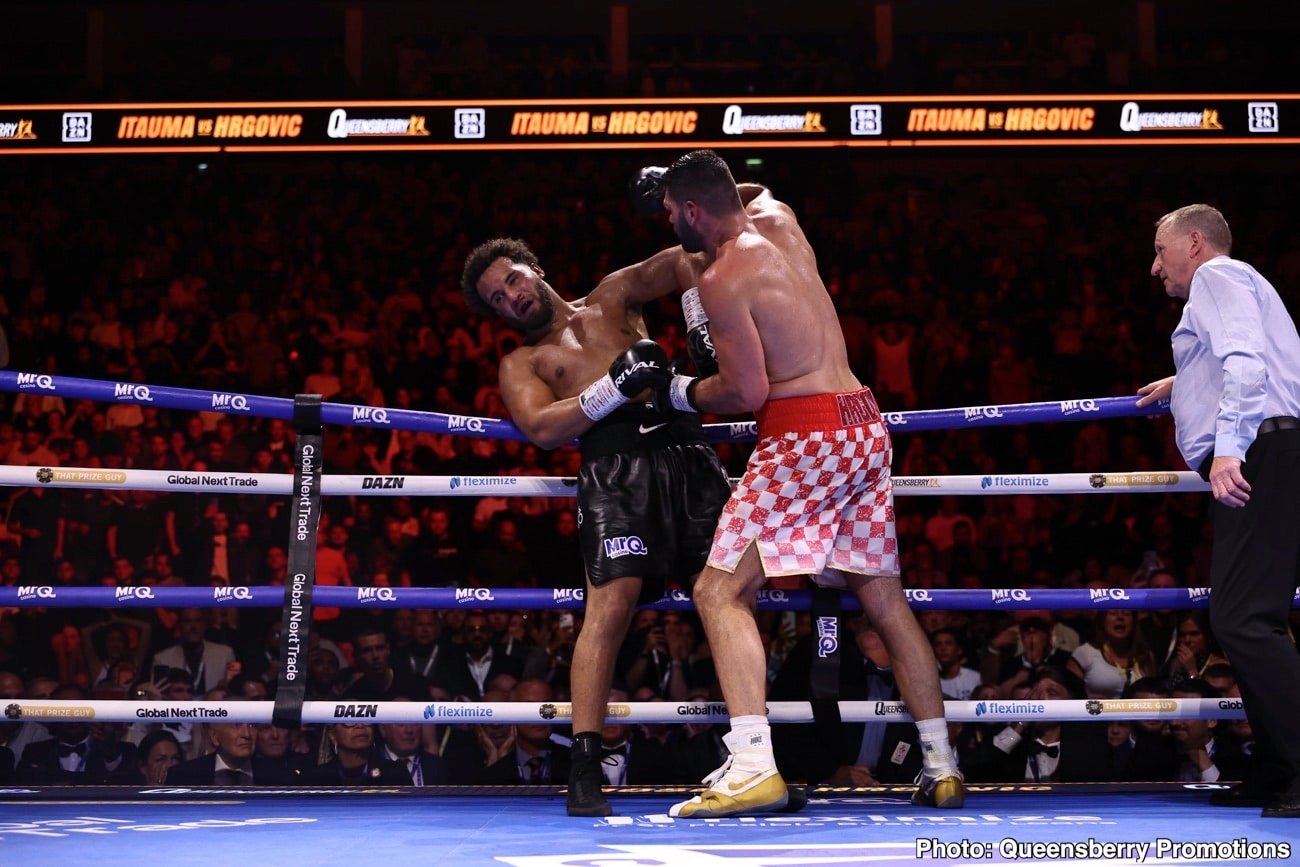
Moses Itauma’s explosive offense carried him into an IBF heavyweight title fight at 21, but Filip Hrgovic exposed the costly machinery underneath it. George Groves now describes Itauma as a “three-round fighter,” a label that rings true once the sheer physical toll of that early assault is broken down.
Itauma held the speed advantage, tagging Hrgovic with sharp, clean punches during the initial minutes. Rather than establishing control, he pursued the knockout as if Hrgovic were simply another fragile victim waiting to fold. The Croatian veteran absorbed the initial storm, forced the prospect into sustained manual labor, and closed the show in round nine.
“At the moment, he’s a three-round fighter. That’s the sad fact of it,” Groves told Sky Sports.
Groves saw the deterioration developing long before the stoppage. The tactical failure began with Itauma completely discarding distance management. Instead of flicking out light, probing jabs to displace Hrgovic’s guard, he loaded up on heavy hooks from the opening bell. Dozens of those shots crashed harmlessly against Hrgovic’s gloves, yet Itauma continued torqueing his entire core into every strike as though the target were exposed.
Bludgeoning a tight defense with maximum leverage wrecks the back and shoulders. Itauma made that deficit worse by firing extended combinations at top gear. He was emptying championship-level reserves on leather while Hrgovic waited calmly behind his shells.
Top-tier heavyweights pace their attacks. They dial back the force on four punches to mask the fifth, dislodging a guard to create genuine openings. Itauma approached every swing like an executioner. That blitz dismantles limited gatekeepers, but it burns through the reserve tank when a stubborn veteran stays upright.
His movement created a parallel physical leak. Itauma employed an active, darting bounce to step into range and pull away before Hrgovic could fire back. It caught the eye, but that bounce placed relentless strain on his calves.
The moment that bounce disappeared, his posture came apart. Itauma stood straight up, his head movement vanished, and his jaw drifted onto the center line. He quit pivoting off the ropes, retreating instead in straight lines. Hrgovic stopped having to track a mobile target because Itauma planted himself directly in the path of the right hand.
The most glaring flaw was Itauma’s lack of defensive resting skills. Elite fighters know how to steal breathers. Tyson Fury leans his massive frame into clinches to crush a man’s legs, while Oleksandr Usyk circles just outside reach to run thirty seconds off the clock. Itauma attempted to punch his way through suffocating fatigue. Rather than wrapping Hrgovic up, leaning on him or establishing a break in the action, he kept firing wild salvos.
A mental unraveling accompanied the bodily exhaustion. Having grown accustomed to early knockouts, Itauma looked rattled when Hrgovic absorbed his hardest punches without blinking. Lacking a fallback strategy, his shot selection deteriorated into desperate swings, speeding up his own demise.
Rebuilding Itauma requires a far more precise touch than feeding him a passive punching bag. Another two-minute knockout would decorate the highlight reel while leaving the critical flaws unaddressed. He requires an opponent whose defensive habits punish impatience without offering Hrgovic’s devastating counterpunching.
Hughie Fury provides the ideal stylistic puzzle. He fights ugly, stays elusive, ties up inside and refuses to grant young punchers the firefights they crave. Itauma would have to operate behind a steady jab, trap a retreating target along the ropes, and accept that an immediate finish is off the table.
Muscle fiber composition and cardiovascular ceilings are largely genetic. Fighters who carry dense, explosive, fast-twitch muscle mass do not wake up at 28 with the engine of an endurance athlete. George Foreman was an explosive wrecking ball who blew his tank against Muhammad Ali in Zaire at 25, and he never magically transformed into a high-output distance machine. He solved it later in life by stripping away almost all wasted motion, pacing himself to a crawl, and walking men down behind a heavy, thudding jab.
The hard truth for Itauma is that human physiology does not work backward. As heavyweights move out of their early twenties, their bodies naturally thicken, absolute fast-twitch snap dulls, and carrying 240-plus pounds over twelve rounds becomes more taxing on the heart and lungs, not less. If a fighter is hyperventilating and losing his legs after three hard frames at 21, running more miles on the road will not rewrite his DNA.
Right now, Itauma operates like a sports car redlining in first gear. Every punch is loaded with full hip and shoulder torque, every movement is an explosive leap into range, and he has zero concept of how to make an opponent carry his weight when he gets tired. That is catastrophic fuel economy.
If Itauma remains married to that style, he is permanently locked into being a dangerous three-round frontrunner who will get dragged out into deep water and finished by any durable contender with a pulse and a chin. He only stretches his effectiveness to six or seven rounds if he accepts a radical tactical lobotomy:
Read the full article here