


By Semih Tuna / stuna@eurohoops.net
There is a difference between surprising people once and convincing them that it was never really a surprise.
For Trabzonspor, that might be the challenge of the season ahead.
Their first year back in the Turkish Basketball Super League could hardly have gone much better. Nineteen wins, a direct ticket to the playoffs, and a team that quickly became much more than a newly promoted side trying to survive.
But success has consequences.
Nobody is going to look at Trabzonspor the same way anymore.
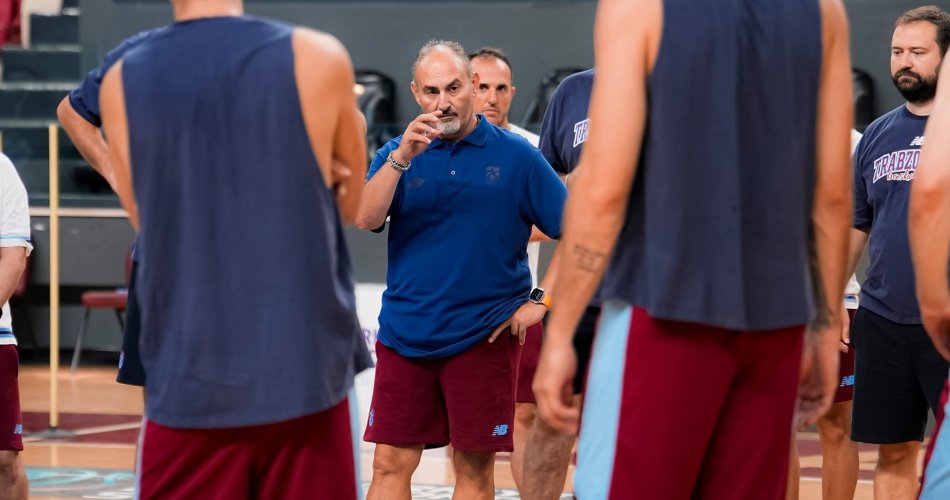
“Last season was above expectations and satisfying for all of us, and that creates a standard,” head coach Selcuk Ernak told Eurohoops. “We believe that for our city and our club to remain happy with the basketball being played in Trabzon, we have to take what we did last year one step further.”
That means entering a different kind of season.
Trabzonspor will now have the Basketball Champions League alongside its domestic commitments. Opponents know them. They will prepare for them differently. And a roster that spent large stretches of last season operating with limited depth will have to withstand a completely different schedule.
“We know that it will be a more difficult season,” Ernak said. “Teams will be better prepared for us; they will take us more seriously and think about more ways to stop us. So we tried to build a deeper, more talented and more athletic team to deal with those challenges.”
The transformation is easy to see.
Isaiah Canaan, Xavier Tillman and Shaq Harrison headline an ambitious summer, while Yiğit Arslan joined the project and Akwasi Yeboah remained from last season.
The names attract attention.
For Ernak, however, the interesting part is what those names allow Trabzonspor to become.
Last season’s team exceeded even his own expectations offensively. Trabzonspor produced in transition, scored effectively in the half court, and relied on a group of players capable of creating with the ball in their hands.
The other end of the floor was a different story.
“I think offensively we exceeded my expectations,” Ernak said. “But because of injuries and the size of our roster, we couldn’t reach the defensive quality and level of competitiveness that I wanted.
“People who have followed my teams before know that they have usually been among the better teams in the league in terms of competitiveness, physical basketball and defensive numbers. Last year’s team wasn’t that.”
So Trabzonspor went looking for more size, athleticism and defensive versatility.
At the same time, Ernak did not want fixing one problem to take away what had made his team successful.
That is where Canaan, Arslan and Yeboah become particularly interesting.
“With players like that, because of their shooting threat and the way they play, you create opportunities for everyone else,” Ernak explained. “They help your spacing and force more than one defender to become involved.”
The difference goes beyond shooting.
Last season, much of Trabzonspor’s offense began with the players who were given the ball and asked to create. This time, Ernak believes he has more players capable of affecting possessions without dominating them.
“Canaan, Yiğit and Yeboah are not only players who can finish possessions by scoring,” he said. “They have very good basketball IQ, vision and passing quality. They are willing passers and have the potential to make the players around them better.”
Then there is Xavier Tillman.
A recent NBA champion arriving in Trabzon at 27 years old naturally became the move that generated the most attention.
It is also a transfer Ernak knows probably would not have been possible under normal circumstances.
Tillman had spent the previous season playing less basketball than he wanted while also dealing with health issues. There were NBA opportunities available to him this summer, according to Ernak, but not necessarily in the roles he wanted.
That opened a window.
“If he hadn’t gone through a period like that, he wouldn’t be a player within our transfer market,” Ernak said. “I didn’t think he would come from the NBA to Europe.
“Tillman is 27 years old. He isn’t a 37-year-old NBA veteran. He believes he belongs in the NBA and that he has a future there.”
Trabzonspor’s pitch was therefore not to convince Tillman that his NBA chapter was over.
Quite the opposite.
“He was looking for the right project where he could show himself, and that was a big opportunity for us,” Ernak explained. “I think I explained correctly how we could help him get back to the level he wants.”
And despite Tillman’s desire to eventually return to the NBA, Ernak was particularly clear about one detail of the agreement: there is no exit clause.
“He made a very clear decision that he wanted to play with us,” Ernak said. “There is no exit for the entire season. He wants to spend the whole season here and then evaluate his options next summer.”
Tillman has already arrived in Trabzon with his family, another detail Ernak points to when describing the commitment behind the move.
And Ernak does not intend to use him simply as the complementary piece NBA audiences became accustomed to seeing.
He sees more.
Tillman’s passing and decision-making from the frontcourt immediately stood out to him. So did his ability to put the ball on the floor and create a route to the basket without waiting for somebody else to manufacture the advantage.
There is another element Ernak wants to explore as well.
“He has a very serious outside shot that, in my opinion, wasn’t used that much in the NBA,” he said. “Maybe he simply didn’t get enough opportunities to show it. We’ve been working a lot on that since he arrived. Hopefully people will describe him differently as a player after this.”
Defensively, the ambition is just as significant.
Ernak wants Tillman to play both frontcourt positions, but there is a condition attached to that freedom.
“If I want to use him at two positions, there is one requirement: He has to be able to defend those positions,” he said.
Defending power forwards should not present much of a problem for a player with Tillman’s strength and NBA-level athleticism. The real test, and potentially the feature that could unlock different lineups for Trabzonspor, will come when guards are placed in front of him.
Ernak has already made his expectations clear.
“I told him, ‘You’ve been put in those situations against NBA-level athletic guards. You have to have the mentality that you can stop the guards in Europe.’”
If he can, the possibilities multiply.
Yet Tillman’s arrival — just like Canaan’s — was partly made possible by a transfer that happened earlier.
Shaq Harrison.
Before Trabzonspor could convince some of its biggest names to come, it first had to convince someone who could make the next conversation easier.
“Having already signed Shaq Harrison was a very important factor in the transfers of Tillman and Canaan,” Ernak said. “He has a very wide social network and he’s a very respected player. Him signing with us definitely helped us convince other players to come to Trabzon.”
Getting Harrison himself was no simple task.
Trabzonspor were far from his only option. But Ernak believes the club had something more substantial to sell than a contract.
The project had already started before his own arrival, when Trabzonspor were still playing in the Turkish second division. It was the vision presented to him by Cömert Küce, the club’s sporting director, that helped persuade Ernak to become part of it in the first place.
Years into his coaching career, it gave him something familiar.
Excitement.
“I think it’s a project that you can really want to be part of in your career, regardless of your experience or income level,” Ernak said. “That’s why I came here too. Cömert Küce explained the project to me, and after all these years I can still keep those old feelings of excitement alive.”
The same idea was presented to Harrison.
Why did Trabzonspor want him? Where could they go together? Could the relationship last one year, two years, three years? And what could Harrison eventually get out of it?
Ernak believes honesty mattered.
Timing did too.
“If we had made our move for him 10 or 15 days later, I don’t think we would have had the same chance,” he admitted.
Signing Harrison then changed what was possible.
The transfer itself became a message to the market.
Something is happening here.
“When respected players decide to join a club, other players — especially players they have relationships with — ask them why,” Ernak said. “‘Why did you accept this city? Why do you want to play for this coach? Why did you join this club? What are you expecting there?’
“That’s different from me explaining it or an agent explaining it.”
It is one of the realities of roster building that Ernak comes back to repeatedly.
Players are not products sitting on shelves.
You cannot simply identify what you need, pay the price, and expect everything else to fall into place.
“These are decisions that affect these people and the future of their families,” he said.
That philosophy extends beyond talent.
Trabzonspor’s roster may be more experienced this season, something Ernak openly welcomes. Veteran players can solve small locker-room issues before they ever reach the coaching staff. They understand situations faster. They reduce the amount of time a coach has to spend establishing basic habits.
But experience alone is not what Ernak is looking for.
Character matters just as much.
“We work very hard on bringing the right characters together,” he said. “For us, recruitment isn’t something that starts in the middle of June and finishes at the end of July. It’s a process that never stops throughout the year. In fact, it’s information you collect, relationships you build and players and teams you follow over many years.”
There is one rule that perhaps explains his approach better than any scouting report could.
“I always tell the players: I won’t bring anyone into this team who I wouldn’t sit at the same dinner table with my family.
“It doesn’t matter how good an athlete, scorer, or basketball player he is.”
It is an approach Ernak would probably not have expressed in exactly the same way at the beginning of his head-coaching career.
He readily admits that the young version of himself believed too strongly in something else.
Hardness.
“When I first started, I was chasing an unnecessary level of strictness and discipline that today I can comfortably describe as a mistake,” he said. “For the first three years of my head-coaching career, I believed in coaching that way.”
Then came China.
Ernak worked as an assistant with the Chinese national team under Bob Donewald Jr. from 2010 through the end of the 2012 Olympics.
That experience changed him.
“That’s where I learned what the concept of being a ‘players’ coach’ actually means and how you can integrate that into the life of a coach and the way a team operates,” Ernak said.
“My coaching became something different after that. My relationships with players, my player choices, my daily reactions and the way I reacted to different periods during a season all evolved.”
More than a decade later, the evolution continues.
But now Ernak has a project whose own ambitions are evolving just as quickly.
Promotion was one step.
Nineteen wins and the playoffs were another.
The new roster suggests Trabzonspor has little interest in treating either as a destination.
So where does all of this ultimately lead?
Ernak smiled at the question.
He was glad it had been asked.
Because, for Trabzonspor, defining the destination is part of the project itself.
“We want Trabzonspor to be one of the major clubs in Turkish basketball,” he said. “If there are going to be three, four, or five big clubs with continuity, that can sustain themselves and have their own economy, we definitely want Trabzonspor to be one of them.
“When the time comes, we want to reach a point where we’re considered candidates to win championships in Turkey.”
And the ambition does not stop at the country’s borders.
Whether the future of European basketball leads Trabzonspor toward the EuroLeague, the FIBA ecosystem, or eventually NBA Europe is almost secondary to Ernak’s point.
The destination is wherever the top of European basketball happens to be.
“Whatever the summit of European basketball is,” Ernak said, “we want to take the steps that will eventually bring Trabzonspor there.
“That is our ultimate goal.”
Read the full article here