


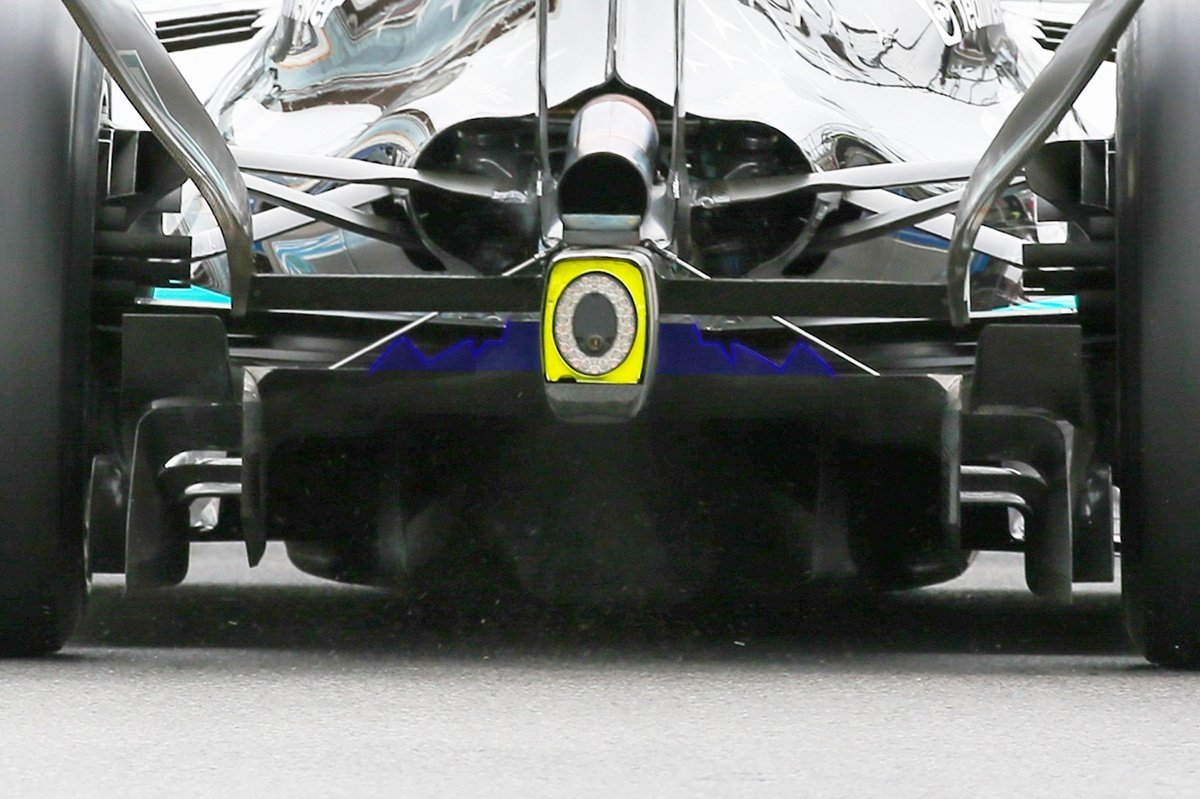
Mercedes introduced a substantial package of technical updates for the recent Canadian Grand Prix. Beyond the work carried out on the front and central sections of the Formula 1 car, new solutions appeared at the rear that had not been seen before in this technical cycle.
The Silver Arrows arrived in Montreal with the first truly significant upgrade package of its season, introducing changes across several areas of the car. For example, while maintaining a philosophy very similar to the previous design, the front wing was revised almost entirely, with modifications made in several areas. Considerable attention was also devoted to the bargeboards and the floor.
The area ahead of the rear tyres is now much more complex, which is significant because this is always a sensitive region where engineers try to mitigate the harmful aerodynamic effects generated by tyre rotation. Looking slightly farther back, another new feature introduced on the W17 becomes apparent in the diffuser area, where the Brackley engineers have adopted a solution that differs from the approach taken by the rest of the grid.
Since the first pre-season tests, teams have been trying to find ways to extend the diffuser, introducing extensions attached directly to the rear crash structure. In some cases, these extensions even incorporated the horizontal support that holds up the rear wing, in an effort to maximise the diffuser’s effect within the limits of the regulations.
Mercedes diffuser
Photo by: Sam Bloxham / LAT Images via Getty Images
In addition to the vertical element mounted along the rear crash structure, which has been present for some time, a close look at the Montreal-spec W17 reveals that serrated profiles have now appeared along the upper section of the diffuser. This is somewhat similar to the serrated elements used by some teams on the transparent screen in front of the driver’s cockpit.
Mercedes has therefore chosen to extend the diffuser using a different approach, covering more than half of its width. So far, this solution has not been seen on any other car.
That is not the only interesting feature: in the area of the waterfall profiles beside the diffuser, a small outward-facing flow deflector (highlighted in yellow) has also appeared, designed to fine-tune the management of airflow exiting the floor.
Many teams have attempted to modify the outermost part of the diffuser, precisely where it connects to the lateral waterfall section, with Ferrari experimenting with its own solutions in the lower area. Mercedes, however, has taken a different route by working on the upper section, adding this small deflector to the highest element of the waterfall structure to clean up the wake. This, too, is a solution that had not previously been seen on any other car.
We want to hear from you!
Let us know what you would like to see from us in the future.
Take our survey
– The Autosport.com Team
Read the full article here