



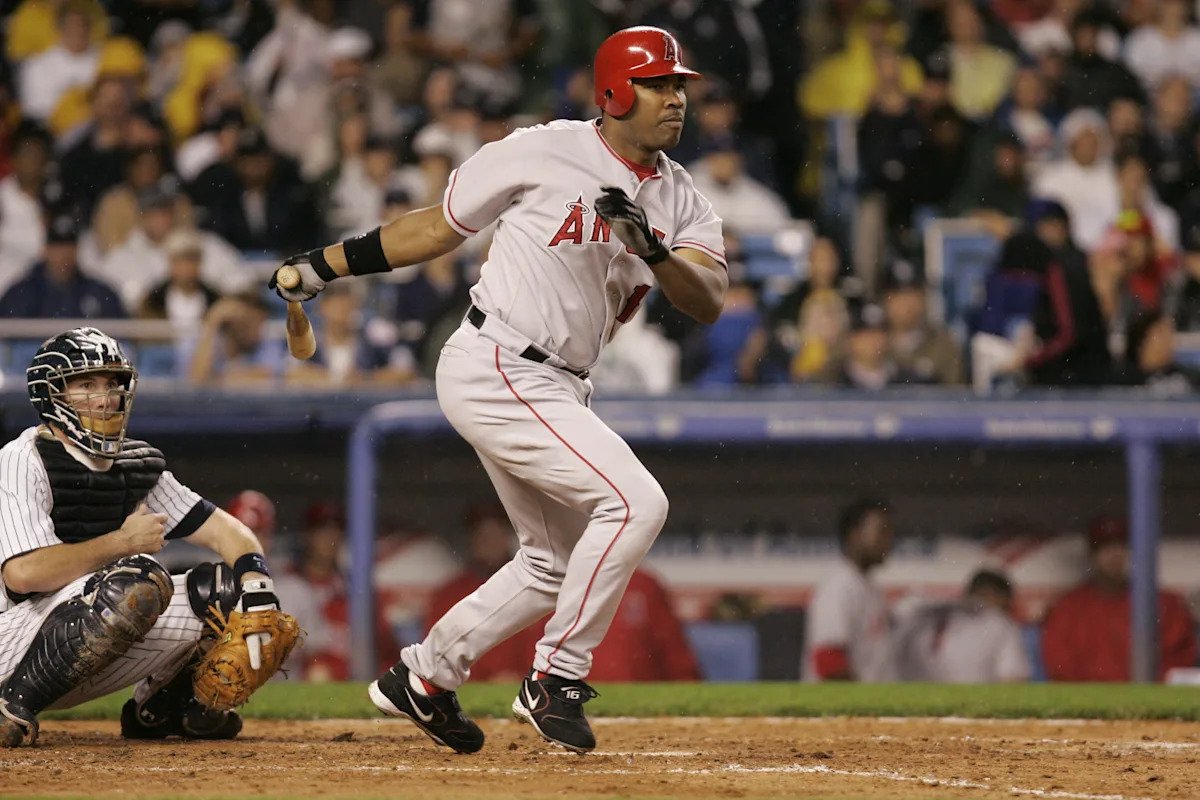
Yesterday afternoon, the baseball world received stunning news. Former Angels outfielder Garret Anderson, who earned three All-Star nods, won the 2003 Home Run Derby and All-Star Game MVP, had the game-winning hit in 2002 World Series Game 7, and sits atop the Angels franchise leaderboards in several categories, passed away at just 53 years old, having suffered a fatal heart attack. As the Anderson family, not to mention the baseball world at large, let us honor his career in the best way an opposing fanbase can: by remembering the times we cursed his name.
You see, Garret Anderson belongs to a small fraternity of certified Yankees Killers — players who, no matter the situation, always found a way to come up big against the Bombers. His numbers, of course, speak for themselves. Overall, he had a career .293/.324/.461 slash line across his 17-year career — good for a slightly above-average 102 OPS+ despite multiple seasons of sub-100 offensive production at the end of his career dragging it down. Against the Yankees? That line skyrockets to .319/.338/.486 — the fourth-best against teams he played at least 100 games against and honestly pretty close to the .312/.341/.497 he had against Boston, his most victimized foe.
The thing is, though, a lot of players have great numbers against a particular team. What made Anderson a Yankee Killer, though, was the context. It didn’t matter how the Yankees approached him. Send out Andy Pettitte or David Wells as the day’s starter, giving you the platoon advantage against the lefty Anderson? It didn’t matter — in 83 plate appearances against Pettitte, he had three homers and posted a .402/.410/.549 slash line, and in 66 against Wells, he had two homers and posted a .400/.409/.569 slash.
Bring in a top LOOGY like Mike Stanton late in the game in a big spot? He still got on at a .375 clip and walked him off as well. Was future Hall of Famer Mike Mussina starting that day? Moose did a tad better, getting his batting average under .300, but he still posted a .283/.321/.528 slash with three home runs in 53 plate appearances. These were some of the best arms the Yankees had during his career, and Anderson simply pummeled them.
It was characteristic of Anderson’s Angels, who stood alone in their dominance of Joe Torre’s dynastic Yankees. They were the only AL opponent with a winning record against them during Torre’s tenure, going 61-55 from 1996 through 2007. Anderson certainly did his part in twisting the knife.
Furthermore, when the Yankees faced the Angels during the postseason, Anderson went nuclear. During his first career playoff series after nine years in the majors, Anderson went 7-for-18 with a walk, one home run, and five runs scored (good for a 1.088 OPS) against New York in the 2002 ALDS. His leadoff homer off playoff veteran Orlando “El Duque” Hernández in the eighth inning of Game 2, tying the game at five apiece, was arguably the series’ turning point, as it helped prevent the Yankees from jumping out to a 2-0 series lead.
View Link
Fellow Halos nemesis Troy Glaus immediately followed with a solo shot of his own, and the eventual champion Angels never looked back in an upset series victory over the four-time defending AL champs.
Three years later, the Yankees and Angels squared off in another Division Series, this time with no one taking Anderson’s club for granted. He didn’t smolder quite as much as he did in 2002 and was held to five hits — and none in three of the five games. But Anderson still managed to muster a .934 OPS because he absolutely made his hits count. At 0-for-8 entering Game 3 at the old Yankee Stadium with no less a lefty-neutralizing demon than Hall of Famer Randy Johnson on the bump, Anderson greeted him in the first with a three-run bomb.
View Link
It was the first of four hits on the night (including a triple) for Anderson in an 11-7 win. A split series turned in the Angels’ favor, and Anderson clubbed his second long ball of the series off Mussina in the Game 5 clincher at the Big A. Thankfully, the Yankees never had to face Anderson in the postseason again, as by the time they got their vengeance on the Angels in the 2009 ALCS, he and the club had parted ways, finishing out his career with the Braves and Dodgers.
But there’s one last Anderson/Yankees story to tell. Do you know the answer to the trivia question, “Who has the most runs batted in against the Yankees in a single game?”
By now, you probably have a sneaking suspicion, and it’s correct: Garret Anderson. On August 21, 2007, he laced a two-run double off Mussina in the first, drove in Vladimir Guerrero in the second with another double to right off Moose, drilled a three-run shot off Edwar Ramírez in the third, and deposited a grand slam into the right field seats in the sixth off Sean Henn.
View Link
By the time the game had mercifully ended in an 18-9 Angels victory, Anderson had accrued 10 runs batted in — a pretty decent month all in one day! To this day, he is one of just 16 players in MLB history since 1900 with a 10-RBI day, just like 2005 Alex Rodriguez.
When Anderson finally retired ahead of the 2011 season, the Yankees were certainly glad to see one of their greatest pests leave the field for the final time — the ultimate sign of respect you can give an opposing player. He was voted into the Angels Hall of Fame in 2016, and it probably felt fitting that the ceremony took place before a game against those same Yankees.
Rest in peace, Garret; we wish your family the best.
Read the full article here