



Kevin Durant is in an especially jovial mood following a late February triumph over Utah, a night off in the NBA. After scoring 18 points, he arrives inside the Rockets’ locker room, which as usual is boisterous and rambunctious, heavy in Generation Z.
Durant’s station, wedged between 23-year-old Amen Thompson and 24-year-old Tari Eason, is a daily reminder of how long it’s been since he’s had colleagues this young on either side of him; the juxtaposition of which often offers perspective into the strange, hilarious concept of time. The conversations are slightly different than, say, with Royce O’Neale or Andre Iguodala, former locker mates in Phoenix and Golden State, respectively. But the tonality and humor transfers by osmosis.
Ironically, this evening’s conversation is centered around Floyd Mayweather and Manny Pacquiao, the pair of 47-year-old legendary boxers set to face off one more time this year. Given the similarities in athletic excellence, achievement and age, it doesn’t take long for the 37-year-old Durant to make a connection.
(Hassan Ahmad/Yahoo Sports Illustration)
“When I’m 50 and come back in here,” Durant yells in Thompson’s direction as he removes his socks, “you’re gonna be a true vet.”
Thompson, an old-school 23-year-old and a man of few words, can only offer up a hearty chuckle while shaking his head.
“You damn near 30 now!” Durant adds, before the section of the room bursts into laughter.
Longevity, with nearly two decades of professional basketball under his belt, is synonymous with Durant’s legacy. Durant has seen and done it all. But the spirit of the Slim Reaper still burns fervently within his svelte frame wanting to challenge the notion of Father Time.
The Rockets’ season has been centered on a legend yet to slow down, a team that clings to his every move, and an organization that punted on major pieces of its core — the biggest move of the NBA offseason — just for the privilege of greatness.
“I never thought in my years that I’d be playing with Kevin Durant,” says 22-year-old Jabari Smith Jr. “Just soaking it up.”
As the playoffs begin on Saturday, one of the youngest teams in the NBA has its hopes pinned on the oldest guy in the room.
A night in January serves as another reminder of Durant’s footprint. The elder statesman was surrounded by reporters at the same locker roughly 48 hours before Durant passed Dirk Nowitzki for sixth on the NBA’s all-time scoring list. But the breadth and scope of Durant’s offensive prowess — tens of thousands of points that a generation of players could only dream of grasping — wasn’t at the forefront of his mind.
It wasn’t the accumulation of buckets, at a historically efficient rate, that consumed him. It was the ones he didn’t score. The shots that felt good leaving his fingertips. The ones that didn’t. The nagging, random injuries he picked up along the way. That evening, Durant estimated he had left at least 4,000 points on the table.
It’s hard not to think about how long I’ve been in the league and how much longer I [have] to go.
His rough, on-the-spot calculation could easily be perceived as a lofty exaggeration. But it is precisely this eagerness to excel that has enhanced Durant’s legacy. The dedication to mastering the midrange despite what the modern game dictates. A gravitational pull unlike any other, save for Stephen Curry, the greatest shooter to ever walk this planet.
“I feel like I came into the league at the perfect time,” he says. “I just think with the 3-point, heliocentric offense and the five-out spacing boom, I feel like it was good for me to come in at a slower pace — from early [Oklahoma City days] until the 3-point era now. I just think it was such a drastic change in the style of play that being able to play in both of those eras of basketball was pretty sweet. It just taught me a lot about the game.”
Even on the cusp of 40, if the sheer production — 26 points, 5.5 rebounds and 4.8 assists per game on .520/.413/.874 splits — doesn’t jump off the page, consider this: In the history of the shot-clock era, Durant is the oldest player to reach those benchmarks. He actually possesses the four-best seasons along those guidelines, all coming in his 30s.
But the reality of the situation is not lost on Durant when it comes to his basketball mortality. The tunnel is shorter, the light at the end more luminous. Gone are the assumed deep playoff runs year after year. Everything is different: rest, recovery, expectations. More games played this year than in a decade, a testament to a strict regimen but a reminder that time isn’t promised. Two Larry O’Brien’s sit atop Durant’s mantle, the pinnacle of achievement in the sport, but the proximity to the end is like the fine print on the rearview mirror — closer than it appears.
“I tend to think about it, for sure,” he says, lightly scratching at his beard. “It’s hard not to think about how long I’ve been in the league and how much longer I [have] to go. But that’s when I have some alone time and I’m ready to think. … My days are consumed with how I can make my team better today, not so much what may happen in two or three years.
“My age and the amount of conversations going on around my game, it’s not hard to hear that stuff — but I try to stay in the moment as much as possible.”
It’s early April and Durant is plopped down at a different locker, this time at his old stomping grounds in the desert. He’s signing his battle-tested jersey for former teammate Ryan Dunn. Less than an hour earlier, Durant was the catalyst of a valiant Houston comeback from a 21-point deficit against his old Suns buddies, a game rife with tension, back-and-forth jawing and enough dustups to keep a janitor busy.
The significance of the game, a critical win in a sardine-packed Western Conference, was vital. But for Durant, who earlier laughed off the notion that Dillon Brooks got under his skin, it was a stop on his revenge tour. So much of the season’s social media chatter — at least in the early months — begged the question if Phoenix was better off without Durant. After his third straight win against them, he wonders why the conversation never suggests the opposite.
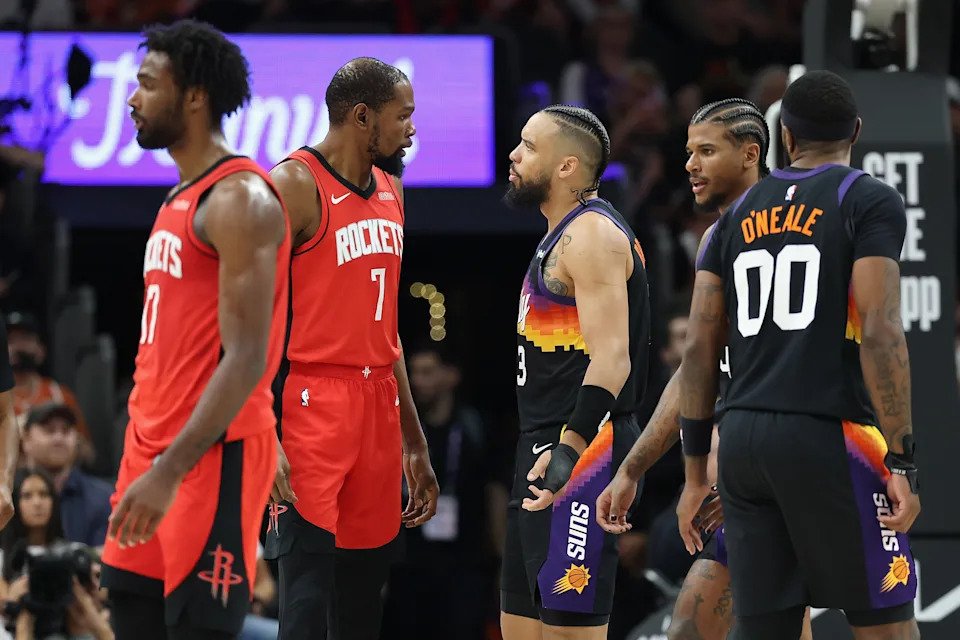
Kevin Durant made his return to Phoenix in early April and came away with the victory. (Photo by Christian Petersen/Getty Images)
(Christian Petersen via Getty Images)
Notwithstanding, Durant relishes moments like this, building blocks that can carry over into the playoffs. This is why the Rockets brought him in after all, despite internal expectations changing on the fly after season-ending injuries to Fred VanVleet and Steven Adams. From a coaching standpoint, two key ingredients were lost, a possession stabilizer in VanVleet and possession extender in Adams, thus heaping even more pressure on Durant’s shoulders to produce. Considering all the pre-planning that was done with Durant and a healthy roster in mind, a season that began with ample anticipation had been rooted in self-doubt.
Durant embraced the challenge.
“It’s a grind, man,” Durant says. “[This season] hasn’t taught me anything I don’t already know. It’s an opportunity everyday to come out here, build my game and see how it fits into the team. But I know the flow of the season and how it’s gonna happen. I’m just tryna take it a day at a time and be the best version of me everyday.”
In a strange way, Houston’s losses also became Durant’s gain. A new situation forced him to come to terms with the next phase of his leadership, sifting through eyes of idolization and extracting lessons by focusing on pressure points. The Rockets were far from a perfect team: a low-volume 3-point unit in a league predicated on spacing; a stagnant, slow-operating group that struggled in the half-court; a defensive collective seeking last year’s tenacity and grit.
But the highs were also exhilarating: second-year guard Reed Sheppard blossoming into a key rotational floor spacer; Thompson evolving as a primary initiator; Alperen Şengün growing as an All-Star offensive hub. And the Rockets, despite all indications that this was a lost season, still found their way to 52 wins and a favorable first-round matchup against the injury-ravaged Los Angeles Lakers.
“He’s a calming presence,” Rockets coach Ime Udoka says. “You know what you can get from him when you go to him. He understands what we have and who he’s been playing with all year — and the patience it’s going to take.”
With the pain and bitterness of last season’s playoff collapse against Golden State in the first round, Houston will draw upon KD’s experience. Durant’s 101 career playoff wins are more than the entire roster combined with room to spare.
But for Durant, who’s never been the type to yell from a pulpit or soapbox, these next few weeks are just as important for his young brothers growing up.
“More so than anything, this should be about their own individual experiences and what they take from them,” Durant says. “I can talk and give advice all I want, but every player needs to step into that situation and figure out what they need to do, regardless of what anybody else is doing. I’m excited for the team to have another opportunity to step into that.”
The definitive discourse on Durant, regardless of personal feelings, lies in the record books. A myriad of tales can be told about the slender man with a killer jump shot, but numbers have no agenda or ulterior motive. The stamp left by Durant on basketball is a far greater imprint than social media drama, rumors or antics. The man has been, and always will be, about the business of ball. And the Rockets, who have heavily invested in Durant’s stock price, are awaiting the playoff dividends.
“To me, the value of my legacy and story is going down by the day,” Durant says. “It doesn’t matter to me how my story is told. It doesn’t matter who says what. It’s more about the experience I went through and what I put down on paper every day. That’s the only thing you can’t diminish — the stats, the accolades, the stuff you acquire for doing the s*** you do on the court.
“But the story around all of that, I’ve become disinterested in it as I’ve gotten older.”
Read the full article here