


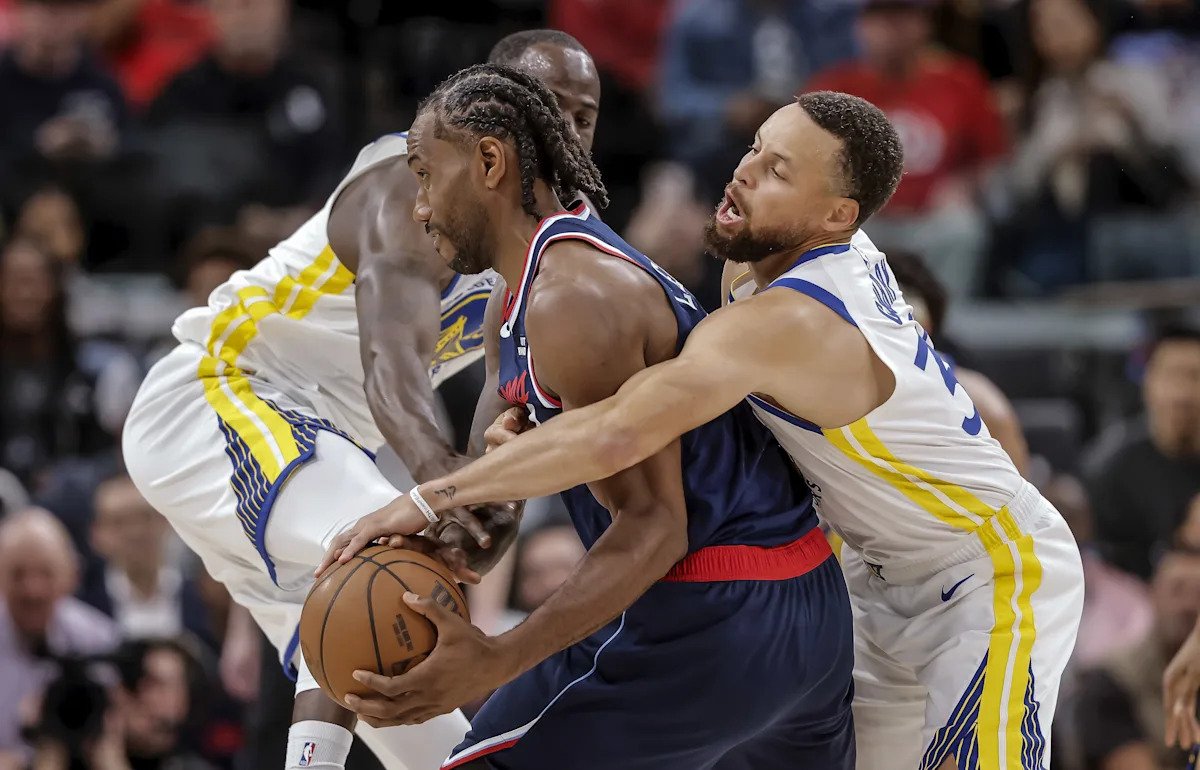
The difficulty of guarding an action involving Steph Curry and Draymond Green is the sheer unpredictability of how it will manifest. It’s difficult enough to solve the typical Curry-Green pick-and-roll — playing drop will end up in Curry pulling up around the screen for a rhythm three. Playing a more aggressive form of coverage such as a hedge or outright blitz unleashes Green in the short roll with a 4-on-3 numbers advantage, a realm that Green has historically dominated with near-equal efficiency as a Curry pull-up three.
Adding to that difficulty is when Green starts possessions out handling the ball with Curry parking himself in the middle of the paint. Whenever Steve Kerr calls for “Small,” it often entails an inverted pick-and-roll in which Curry steps up to set the screen for Green. The reticence of Curry’s defender to detach himself from the greatest shooter of all time often allows Green to dribble downhill through a wide-open lane.
Teams have come to expect “Small” action, owing to the fact that the Warriors are so fond of having Curry be the ball screener for Green and bigger ball-handling wings (previously, that role was played by the likes of Jimmy Butler, Andrew Wiggins, and Jonathan Kuminga). Naturally, a scouted action needs to evolve in order to maintain its effectiveness. As such, back on December 14 against the Portland Trail Blazers, Kerr called for “Small” action and the Blazers expected an inverted pick-and-roll possession.
However, the Warriors were expecting the Blazers to expect the ball-screen. In that regard, the Warriors threw a curve ball that caught the Blazers with their tail between their legs:
The rationale behind this action is rather simple: with Green’s defenders often sagging way off of him (with the additional purpose of not letting themselves getting screened by Curry above the free-throw line, which would give Green a runway toward the rim), Green’s defenders will find themselves playing drop coverage unintentionally whenever Curry comes off of Green and pulls up from deep. The irony of the situation is then realized: teams are forced to play a pick-and-roll coverage that has been proven to be extremely ineffective against basketball history’s greatest shooter.
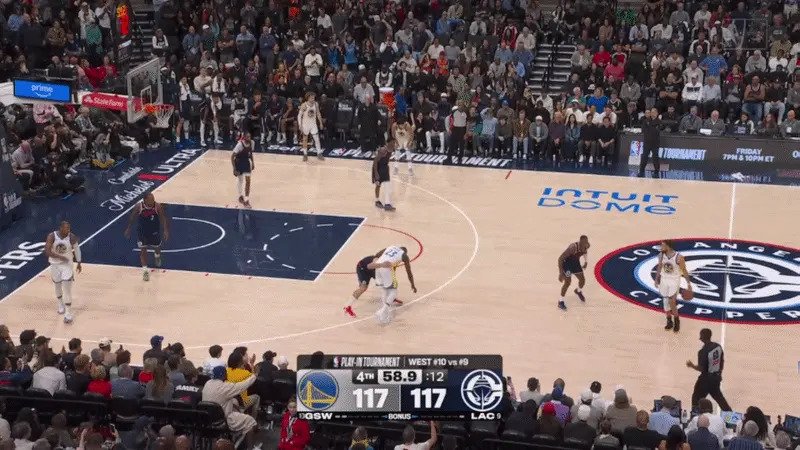
This callback all leads into a sequence against the Los Angeles Clippers in the Golden State Warriors’ momentous Play-In victory, one that prolonged their tumultuous season. With the seven-minute mark approaching in the third quarter and the Warriors aiming to keep things manageable in the midst of a precarious deficit, “Small” is called for what is apparently going to be a Curry screen for Green, who brings the ball up.
To Brook Lopez’s credit, he refuses to sag back and let Green and Curry dictate matters at the top of the arc. The risk behind this decision, however, is Curry catching Lopez with a screen and Green diving past for what could be an easy layup. But Curry elects to come off of Green instead of setting the screen. Perhaps in anticipation of a screen, Lopez drops back to avoid the pick — but falls victim to an unintentional bout of drop coverage.
To add insult to injury, Derrick Jones Jr. attempts to recover over the screen, and in the process fouls Curry on the four-point play:
The deceptive nature of the action underscores its overall inevitability, one that has had Curry and Green in the center of it all. The Clippers may have had the Warriors’ number over the past couple of years, but they fell victim once again to the one-two punch that has taken opposing fanbases’ hearts several times, over and over, enough to convince a die-hard fan to accept the fact that Curry and Green will forever haunt them in their dreams, even after their stories careers have seen their eventual end.
In an elimination game with everything on the line, Curry and Green were expected to handle things from their respective specialties: Curry as the Warriors’ offensive engine, Green as their defensive anchor. The former, with help from Green but whose machinery was driven by the all-time talents of Curry, furthered a legacy that already was and has been unimpeachable:
The latter saw Green get up for a vintage performance that belied his aging profile.
While Green’s defensive reputation was built mostly on a role that saw him as an off-ball roamer and mistake-eraser, Green was tasked to defend the Clippers’ resident terminator. Kawhi Leonard finished the game with 21 points on 17 shots — good for a true shooting percentage of 56 percent. In a do-or-die game, 17 shots clearly wasn’t good enough for a superstar the caliber of Leonard’s, whose resurgence this season will see him almost certainly be included in an All-NBA Team, let alone the first team.
But Leonard managing to put up only 17 shots had plenty to do with Green and his tenacity as Leonard’s tormentor. Of those 17 shots, six were taken in the second half; two of those six were taken in the crucial fourth quarter.
Make no mistake, Green had schematic help — i.e., Kerr and de facto defensive coordinator Jerry Stackhouse opting to surprise Leonard with doubles. The Warriors were clearly more concerned with Leonard the scorer as opposed to Leonard the passer; the latter was even more palatable if Leonard was forced to pass in the face of daunting pressure:
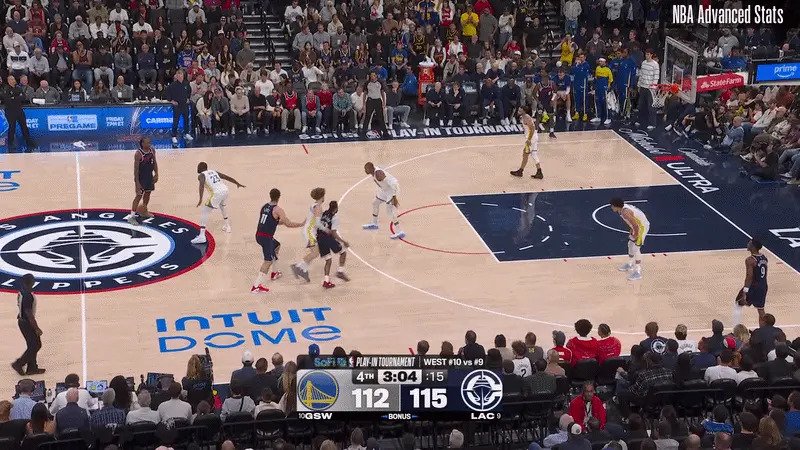
But on an individual basis, Green displayed his mettle and pedigree. He rose to the occasion on two separate occasions, both of them equally crucial behind the Warriors’ win.
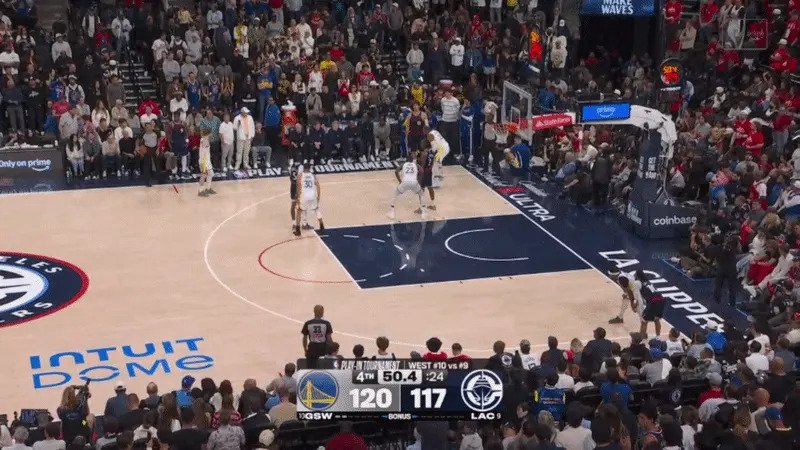
Showing an incredible refusal to be dictated by the Clippers’ after-timeout (ATO) play (in the sense that the Clippers wanted to draw Green away from Leonard courtesy of a screen), Green tenaciously fights over the screen, pins Leonard against the sideline, and intercepts a pass that was meant for Leonard, leading to an and-1 layup by Brandin Podziemski:
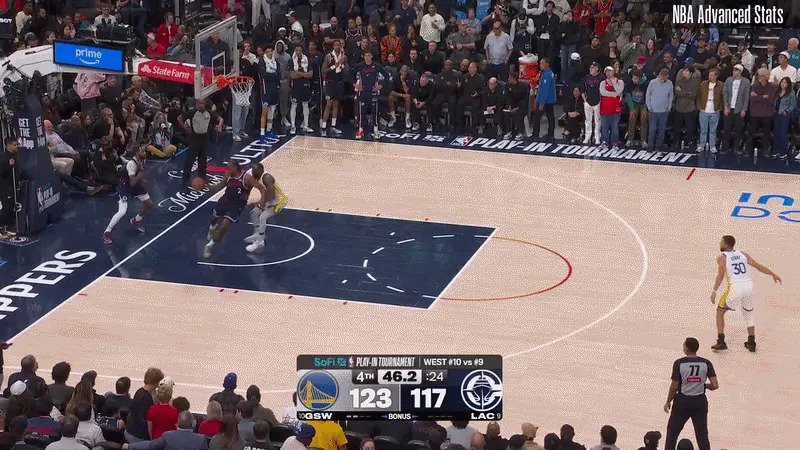
A few possessions later, Green flashes an incredible knowledge of Leonard’s rhythm and handle by timing a swipe at the end of Leonard’s right-to-left crossover, forcing another turnover that all but seals the deal for the Warriors:
Despite the fleeting nature of this run, in the sense that one loss can send it all into the realm of futility, it was nevertheless a treat to see these two legends of the sport turn back the clock and produce another vintage performance. Let it be known, however, that they had the requisite help: Al Horford had four massive threes in the fourth quarter and finished with 14 points; Kristaps Porzingis chipped in with his 20 points; Podziemski himself had 17 points while hauling in seven rebounds as a 6’4” unathletic guard; and Gui Santos produced 20 crucial points, all while the Warriors outscored the Clippers by 16 points in his 32 minutes of floor time, a team high.
No matter what the outcome of the next tilt against the Phoenix Suns may be, the Warriors —powering through a season that saw season-ending injuries to Butler and Moses Moody, a 27-game absence from their franchise superstar, and a highly unnecessary saga involving Kuminga — have already overachieved. If their so-called “uncs” have more gas in their tanks, further overachieving would be the money that keeps on giving — until it chooses to stop giving.
Read the full article here