



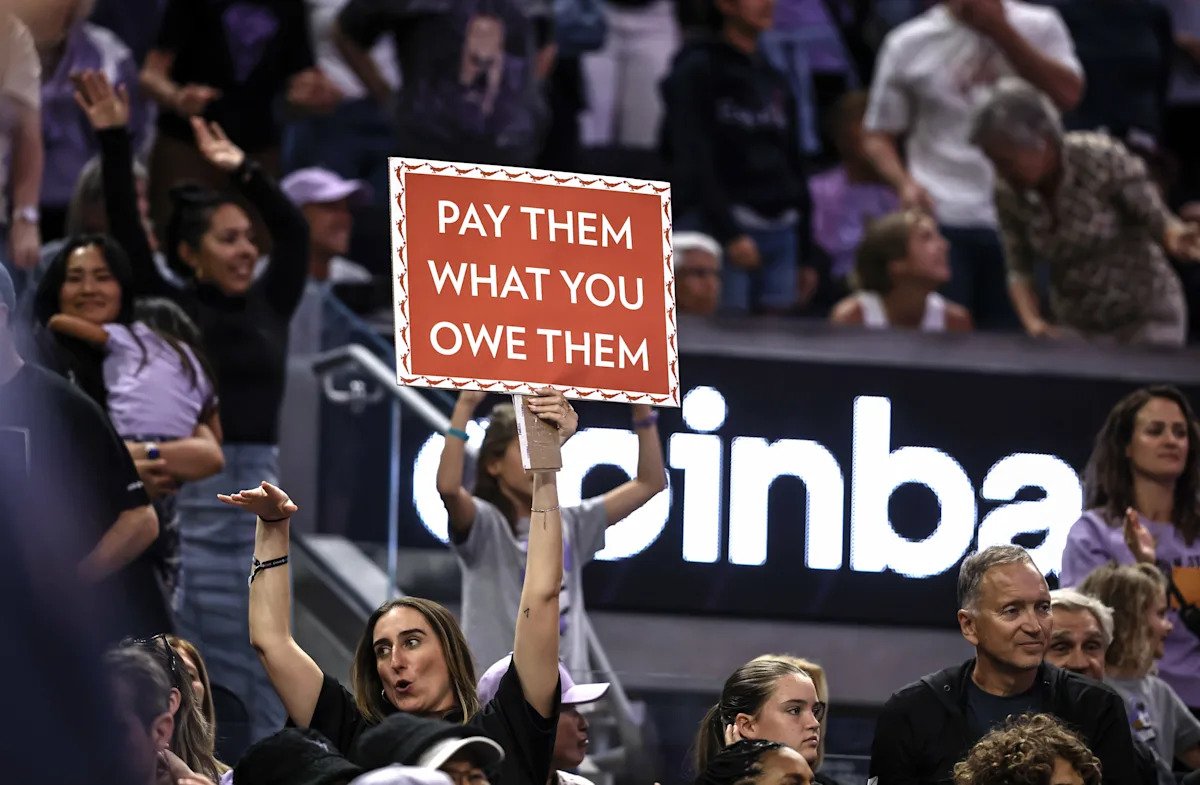
Last week, the WNBA established a historic seven-year collective bargaining agreement (CBA) that will run through 2032, paving the way for astronomical league growth. In what will be marked as one of the biggest breakthroughs in women’s professional sports, the WNBA has proven that league growth, competitive parity and expansion are not mutually exclusive.
MLB, on the other hand, is at a pivotal intersection of balancing competitive parity and league growth. The league is staring down an almost guaranteed lose-lose scenario with the current CBA expiring at the end of this year, and salary floors and potential ceilings are nowhere near agreed upon. If the league and team owners want to preserve as much of the 2027 season as possible, they may want to borrow one distinct element from the WNBA’s CBA: scaled player compensation.
In their recently-ratified CBA, the WNBA raised its salary floors and caps to acknowledge the league’s massive boom in the last five years.
Maximum player salaries may grow to up to $2.4 million, based on financial projections. WNBA players are also guaranteed at least 20% of the league’s gross revenue, replacing the previous revenue-sharing model that required league revenue to exceed a specific threshold before players saw any returns.
The increased player compensation corrects previous underpayments and sets a scalable economic system for future growth and league establishment, tying player salaries directly to league performance.
MLB’s economic structure differs greatly, as revenue doesn’t automatically scale with league engagement.
For starters, player salaries aren’t tied directly to revenue. Salaries increase through free market competition, with team revenue growth and superstars serving as the main drivers for market rates in free agency and arbitration. MLB players have traditionally made as much as teams wanted to pay them. Mechanisms for limiting salary during a player’s initial six years of team control also cut into potential player profits. Long story short, front offices have a heavy hand in balancing salaries with revenue.
In turn, revenue sharing isn’t guaranteed for MLB players. Profits from revenue sharing from local markets are distributed to teams, not players. Players are at the mercy of owners to reap what they sow. Adjustments to the revenue-sharing model would likely require players to concede to a salary cap.
The dramatic contrasts between a league intentionally designed to scale with anticipated growth and a league having to backtrack and update its structures to preserve its fan base result in severe economic disparity. Using ESPN’s table of WNBA salaries by CBA year and Spotrac’s minimum and highest AAV MLB salaries by CBA year, I recorded salary changes in each league from 2015 to 2026. The results were astonishing.
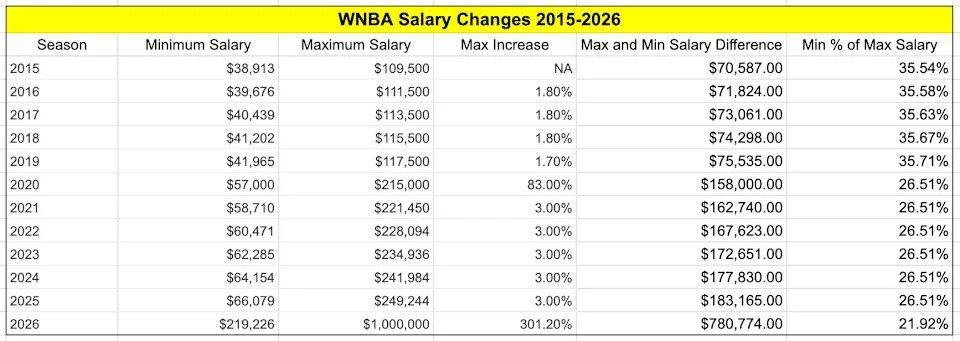
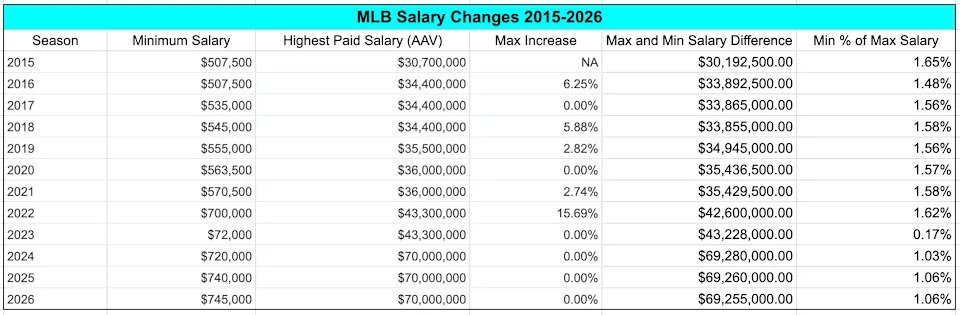
The lowest-paid WNBA players will make at least 20% of the salary earned by the highest-paid players, while the lowest-paid MLB players make less than 2% of the salary earned by the highest-paid ballplayers. The millions, that’s right, millions of dollars of pay gap is the crux of the problem. Since international market growth, historic media deals, shifts toward direct-to-consumer streaming, and increases in fan attendance have made MLB an $11.1 billion industry, grave salary disparities among MLB players are unjustifiable.
If MLB decides to directly tie salaries to league revenue in the next CBA, it could transform the game for the future. Tightening the pay gap between rookies and stars would incentivize winning and stellar performance. Rewarding players for their contributions on the field through direct revenue sharing or salary scaling would introduce invisible pay structures that preserve the traditional free market economic system without letting the rich get richer at the expense of the prospects and young talent that serve as the foundation for baseball’s development.
Read the full article here