




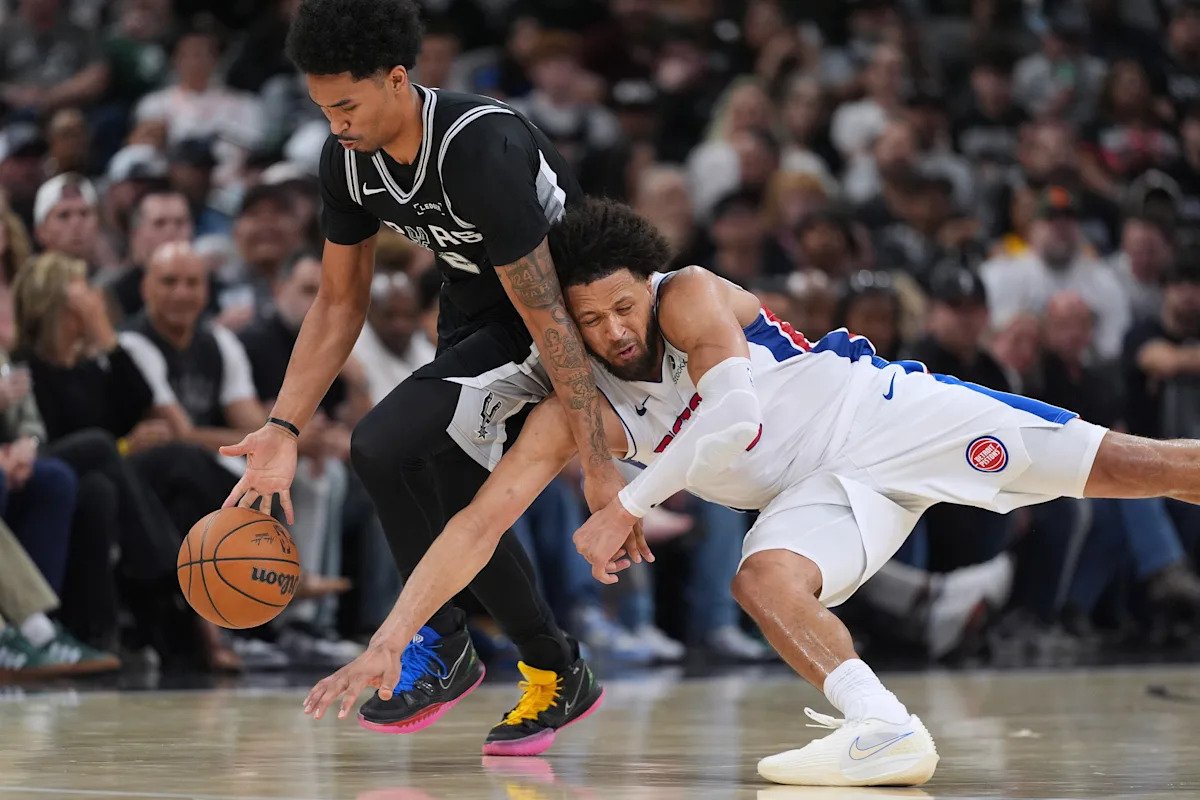
SAN ANTONIO — On multiple occasions in Thursday’s 121-106 loss to the San Antonio Spurs, Cade Cunningham seemingly had nowhere to run and no room to breathe.
At every turn and every dribble, the Pistons star’s airspace was crowded, met with hands in his face and a body in front of him. First, it was Stephon Castle. Then it was Carter Bryant. Then it was both of them. And then, the rest copied and pasted. For 48 minutes, a black and silver shadow followed Cunningham around every inch of Frost Bank Center.
The few times when Cunningham was somehow able to escape, momentarily avoiding pressure, his shot was either erased at the rim by Victor Wembanyama, stifled on the perimeter by Castle, or he threw the ball away. He finished with 26 points but took 26 shots to get there — along with four turnovers — with the bulk of his points coming in random outbursts like an impatient toddler.
At a micro level, San Antonio’s defensive clinic was a reminder of Cunningham’s recent shooting woes. In just three games in the month of March, with all three coming against playoff opponents, Cunningham has already missed 42 field-goal attempts. On a macro, perhaps more sinister, level, Detroit’s biggest fears were becoming more realized by the minute: the over-reliance on Cunningham as a Plan A without a viable Plan B.
“They’re a good defensive team,” Pistons head coach J.B. Bickerstaff said following the game. “They got a lot of guys who can get up in you, put pressure on you and trust the fact that they’ve got that big behind them to protect. Of course, there are things we can do better. I always take responsibility for that — it’s my responsibility to help create space and opportunities for them. We’ll watch the film, continue to work at it and get better from it.”
If there’s any issue to take with a 45-16 team that suffered just its third losing streak of the season, it’s the problem of the rest of the pack. On paper, Detroit’s current net rating paints a similar profile to the ’05 Spurs and the ’09 and ’20 Lakers, all of which finished the season hoisting the Larry O’Brien. That’s fine and dandy, until you look over your shoulder and see the rival teams champing at the bit. Cleveland, through its two recent meetings, the first one sans Donovan Mitchell and James Harden and the second one without Mitchell again, have echoed the strong sentiments of a lack of fear. Boston is hours away from the impending return of Jayson Tatum just 10 months after Achilles surgery, instantly propelling the Celtics back to the top of the Eastern Conference — even if Tatum is 60 percent of his former self. And then there’s New York, the telenovela you just can’t look away from that has Boston’s postseason number.
All of the aforementioned ball clubs have secondary and even tertiary options when the primary methodology is paused. Detroit doesn’t. The closer and closer the playoffs become, the more damning the film becomes. By this point in the season, a testament to Cunningham’s presence as arguably one of the top 10 players in the NBA, there’s an understanding that teams will send immense pressure his way — either in the form of a trap, blitz or outright double team. Once that happens, a few options remain: give up the ball and trust your teammates can take advantage of 4-on-3 situations, force your way through contact or relocate and hope the ball finds you again before the shot clock expires.
The Spurs had no problem swarming Cade Cunningham. (NBA broadcast screengrab)
Should Detroit have done more at the deadline besides adding Kevin Huerter? That’s a valid question considering its roster makeup. At a glance, there’s a glaring lack of true secondary scoring or consistent perimeter options that can act as a release valve for Cunningham. The Pistons never adequately replaced Malik Beasley and the negative trickle-down effects are hard to ignore. The surrounding talent is deficient in one area or the other — whether it’s streaky shooters on a team that doesn’t let it fly, athletic defenders who aren’t respected from deep or physical bigs.
Again, this isn’t necessarily an indictment on Detroit’s season. What the Pistons have built, largely from the ground up, has been admirable: an organic, Bad Boys-ish bully ball. A relic, if you will. But this is the NBA where nothing is guaranteed. These chances at greatness, as enthralling as they can be in the thick of it, can be fleeting. This has been a tremendous year by all accounts, punching above their weight class. “We came from the bottom,” center Isaiah Stewart said emphatically at the podium. But who’s to say any of this is a given next season? Or the one after that?
That’s why it’s important that Detroit maximizes its returns this season, and that starts by tweaking the game plan. The Pistons are currently operating on Cunningham’s software, a player already in the top 10 in minutes per game and a 91st percentile handler, per Cleaning the Glass. With Cunningham on the floor, Detroit’s offense churns out an impressive 119.6 points per 100 possessions, which would place it fourth in the NBA right now. It takes care of the ball and creates efficient looks in Cunnigham’s minutes, all positive returns for a high-usage star.
The problem is what happens when Cunnigham is off the floor. Detroit’s offensive efficiency drops nearly eight points per 100 possessions, which would place them right above Dallas and right below Chicago — yikes. Cunningham has a penchant for midrange shots and enjoys forays in the paint, which explains why the Pistons’ 38.4 rim rate is in the 95th percentile. Bigs like Stewart and Jalen Duren also feed off Cunningham’s elite vision, whether via quick dumpoff passes, cuts or lobs.
In the process of falling in love with rim attacks and paint touches, the Pistons eschewed perimeter play. Detroit is 28th in made 3-pointers since the All-Star break, 27th in attempts and 29th in conversion rate. Those are dangerous warning signs for a team that needs maximum spacing to account for Cunningham being potentially taken out of games. It’s also an oddity considering the Pistons lead the league in paint touches — but they’re passing out of those on just 21.6 percent of the time, a hairline outside the bottom five. Detroit also is a bottom-three turnover team on said paint touches.
There are fixes, which involve others like Ausar Thompson and Tobias Harris making plays. From a spacing standpoint, Harris is likely more impactful for the potential to force defenses to rethink things, but Thompson is developing in his own playmaking right.
Dialing back some of Detroit’s rim attacks and converting paint touches into 3s — provided Huerter blends in with the group and Duncan Robinson continues his efficiency — could yield positive results rather quickly.
“Being ready and able to make a play,” Harris told Yahoo Sports. “You see different defenses in the playoffs, different adjustments. But keeping your personal reflexes ready, being able to make open shots or put the ball on the floor and create another mismatch.”
“It’s important to make decisions fast,” Thompson added. “Be aggressive and make them pay for doing that but if someone steps up, read the floor, spray the corner or drop off to the dunker.”
(Another option is ceding more opportunities to Caris LeVert, who has actually fared well as a 90th percentile creator but is playing a shade under 20 minutes a night.)
For so much of the season, Detroit has gone as far as Cunningham will take it. To escape the suddenly thick East, the Pistons will need contributors to bear some of the burden as well.
Read the full article here


