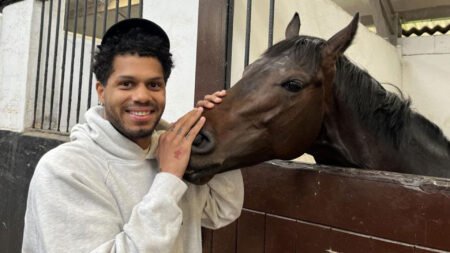




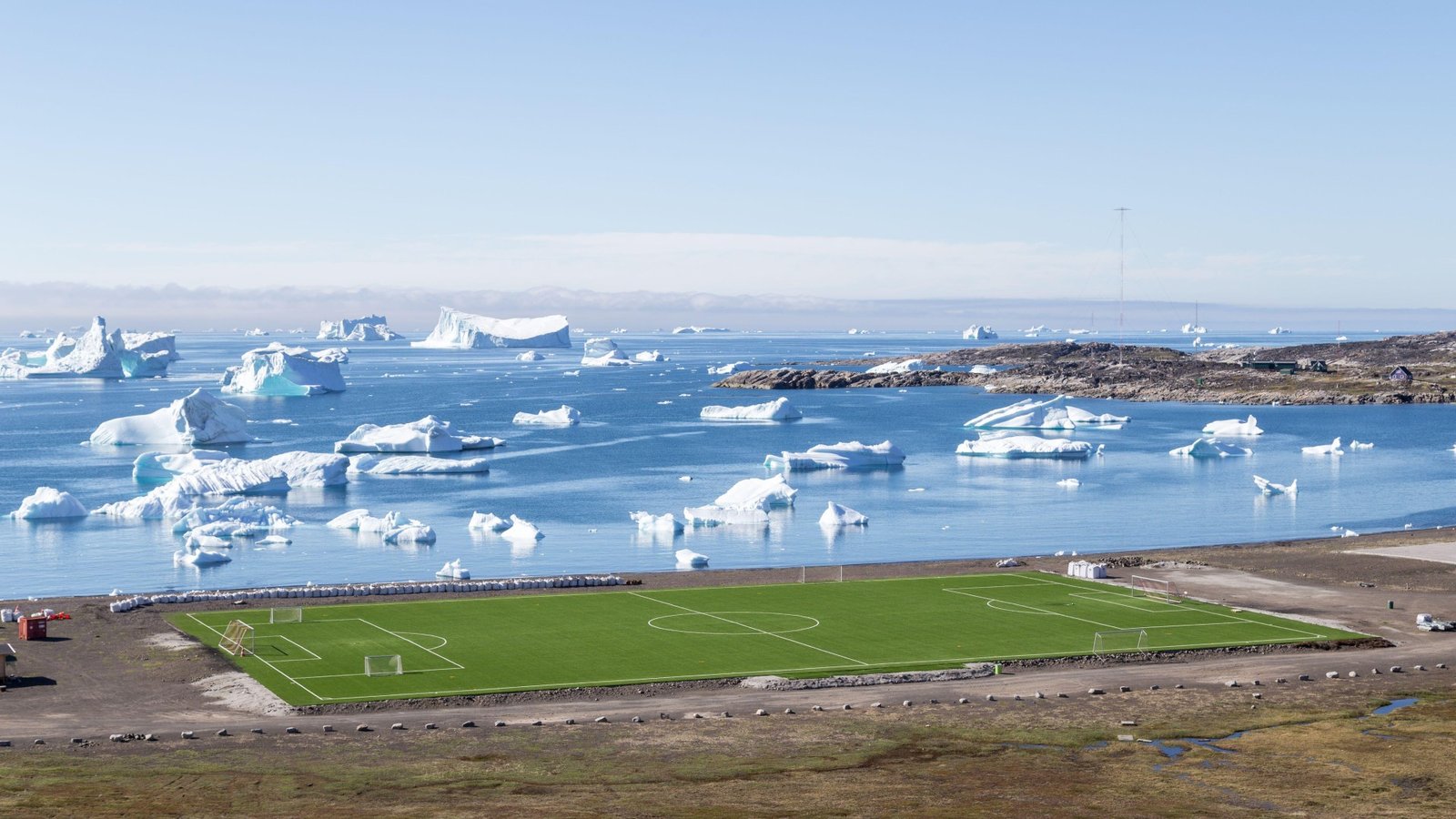
STARING across the icy bay towards Greenland’s snowbound international football stadium, captain Patrick Frederiksen insisted: “It would be a dream to play at Wembley.”
Yet, the Arsenal fan’s ambition of leading out his proud nation at the globe’s great footballing amphitheatres has been thwarted after the team was exiled from international football.
While footballing backwaters like San Marino, Gibraltar and Andorra have full international status, the world’s biggest island can only play friendly matches or amatuer sides.
And, in paradox not lost on many Greenlanders, currently their only route to playing World Cup qualifiers appears to be joining the American international body Concacaf.
Most islanders are vehemently opposed to Donald Trump’s plans to buy or seize Greenland, yet their football association was forced to go cap in hand to the US-dominated federation.
However, in a hammer blow to this football-mad land, Concacaf unanimously turned down the island’s request for membership.
ICE COLD
Trump warns ‘we can do what we want’ in Greenland as Danish PM flies to island
WAR ON ICE
‘Pockets’ of US territory & $1m handouts: First hints at Trump’s Greenland deal
Defender Patrick, 31, told The Sun: “We were rejected and we don’t know the reason. We could guess a lot of different kinds of things.
“I think it was likely financial. We know Greenland is so far away, so isolated. So it’s difficult to reach Greenland and it’s expensive.”
Yet, other Greenlanders have blamed politics for Concacaf’s decision.
Trump has repeatedly made sable-rattling threats to seize the strategic, mineral-rich island.
And the US is the economic and geopolitical powerhouse of Concacaf – the Confederation of North, Central America and Caribbean Association Football – which also includes footballing minnows Montserrat and Anguilla.
Barman Loki Davidsen, 35, said: “Trump wants to have Greenland. I don’t think he knows much about our country but he knows we have lots of minerals and oil.
“One day it would be a dream for Greenland to play in the World Cup. We should be in Concacaf.”
The governing body’s ruling in June was crushing in a proud footballing nation which boasts 5,500 registered football players, nearly 10 per cent of the island’s 57,000-strong population.
In a land where temperatures can drop towards -55C and the Arctic sun fails to rise in its far north for two months in winter, it’s a measure of the heartfelt passion for the game here.
Vying with more traditional pastimes like dog sled racing and ice fishing, football has become an obsession in Greenland with many here supporting Premier League teams.
Why does Trump want Greenland
President Donald Trump’s interest in acquiring Greenland is driven by a mix of national security, economic strategy, and historical ambition.
While the idea of “buying” the territory was met with significant backlash from Denmark and Greenland—leading to a diplomatic standoff—the motivations behind the pursuit remain consistent.
The primary reason cited by the Trump administration is the strategic importance of the Arctic in a “Great Power Competition” with Russia and China.
- The “Golden Dome”: Trump has emphasized that Greenland is a critical site for his proposed “Golden Dome” missile defense system, designed to protect the US from ballistic and hypersonic threats.
- Countering Adversaries: The US has expressed concern over increasing Russian and Chinese activity in the region. Trump has argued that Denmark lacks the resources to secure the island against these powers.
- Existing Infrastructure: The U.S. already operates the Pituffik Space Base (formerly Thule Air Base) in Greenland. Owning or having total control over the territory would allow for a much larger, permanent military footprint without needing Danish approval for expansion.
- Critical Minerals: Greenland holds some of the world’s largest deposits of rare earth elements (like neodymium and praseodymium), which are essential for high-tech electronics, electric vehicle batteries, and military hardware. Currently, China dominates this supply chain; control over Greenland would give the US a secure, domestic source.
- Energy Reserves: The island is believed to have significant untapped oil and gas reserves.
- New Arctic Shipping Routes: As Arctic ice recedes, the Northwest Passage is becoming a viable commercial shipping route. This route could significantly shorten the travel time between Europe and Asia compared to the Suez Canal. Controlling Greenland would give the U.S. a dominant position over these emerging “global highways.”
Speaking at his neat apartment overlooking capital Nuuk – population 20,000 – Patrick revealed: “It’s the biggest, most popular sport in Greenland.
“We have people cheering for Manchester United, Liverpool, Chelsea, Arsenal. The Premier League is big here in Greenland.”
The climatic hardships mean the nation’s football championship takes place over around a week in the summer.
National skipper Patrick, whose club team B67 Nuuk were crowned champion last year for the 16th time, revealed: “It’s one of the shortest and toughest tournaments in the world.
“Over around seven days we have five to six matches, depending on how many teams are participating.
“There’s one rest day. It’s so intense.”
Last year’s tournament was held at Nuuk Stadium where international fixtures are also staged.
Visiting this unique ground in the world’s most northerly capital city, I found one of football’s quirkiest outposts.
Bordered on one sided by a craggy outcrop of ice-covered rocks, its artificial pitch is covered with a two-foot crust of snow.
There are no covered stands but a couple of bleachers where fans can watch from pitchside.
Sitting on an ice-encrusted plastic seat in the manager’s dug out, it’s difficult to imagine England manager Thomas Tuchel or Brazil’s Carlo Ancelotti perched here.
If Concacaf had rubberstamped Greenland’s application bid it would have provided impetus for a new stadium.
Investment is also needed for a series of air domes – which act as multipurpose sports venues – that would allow year-round football fixtures to be played.
Patrick explains that because of the harsh climate, he and other players compete in indoor futsal – a five-a-side, 40-minute match scaled down version of football – for much of the year.
The dad-of-three said of Nuuk Stadium’s unique matchday atmosphere: “It’s really amazing, especially when we have a big crowd.
“It’s really loud. You can hear them yell. It’s so special to play here. They are sitting in their cars or on the mountain and cheering for the team.”
So why has football-mad Greenland been banished from international football?
Geographically, it’s part of North America, even boasting a land border with Canada on the tiny Hans Island. Yet, politically – as part of the Kingdom of Denmark – it’s European.
However, Greenland cannot join UEFA – Europe‘s football federation – because its members must be recognised as fully independent by the United Nations.
In what is galling for many Greenlanders, the Faroe Islands – also part of the Kingdom of Denmark – is a member of UEFA and plays in World Cup qualifiers.
That’s because that island nation joined the federation before membership rules were changed in 2007.
All I know is that we want to be a part of membership somewhere and the best thing for Greenland is to be a part of Concacaf, then the players have something to dream for and train for
Morten Rutkjaer,
Global governing body FIFA requires national football associations to join a regional confederation before being considered for membership.
So Greenland tried to throw their lot in with American federation Concacaf which doesn’t stipulate that nations have to be independent.
The long-standing membership negotiations were delayed last year when Trump boasted of wanting sovereignty over the Danish autonomous territory.
Greenland coach Morten Rutkjaer told ESPN in February: “When Concacaf responded to our application and invited us for talks, it was like Christmas Day for us.
“It’s a totally crazy thing that now everyone wants to talk with us and everyone said, ‘Oh, it’s about Trump.’
“No, no. We have worked on this for many years since I started in 2019.
“All I know is that we want to be a part of membership somewhere and the best thing for Greenland is to be a part of Concacaf, then the players have something to dream for and train for.”
Just four months later, the Greenland Football Association’s membership application was rejected. Concacaf gave no reasons.
The Greenland association posted on Facebook that it wasn’t “a victory for football where you want to include everyone,” but they promised: “We keep fighting.”
Coach Rutkjaer – based in Denmark – said of his Greenlandic team: “They’re very good football players right now.
“And they will only become better when we have the competition to play in. It’s a totally crazy football country. Everyone plays football everywhere.
“The children are playing on ice, on football fields inside, outside and they talk about football every hour they can.”
Frozen out
For many fans in this proud land – where 90 per cent of the population are Inuits – Greenland’s exclusion from the big stage rankles.
It has stunted the growth of football here and meant the national team has sometimes struggled on the international stage.
At the 2023 Island Games, the Shetland Islands thumped them 5-1. However, they beat the Orkney Islands on penalties after their game finished 2-2.
Their last fixture – against the Slovenian amateur team in October – ended in a hard-fought 5-4 defeat.
The Greenlandic players juggle day jobs alongside their football careers. Skipper Patrick is a carer in an orphanage while others work in banking, fishing, hairdressing and the civil service.
Through his orphanage work, Patrick can see the boost provided by football in a land that has the highest suicide rate in the world.
“Football brings people together on our island,” he told The Sun. “We gather together and there is joy and excitement.
“We hope that Concacaf will rethink it and look at the application again. It would mean so much to Greenland.”
An Arctic land cruelly frozen out of the beautiful game.
Read the full article here