

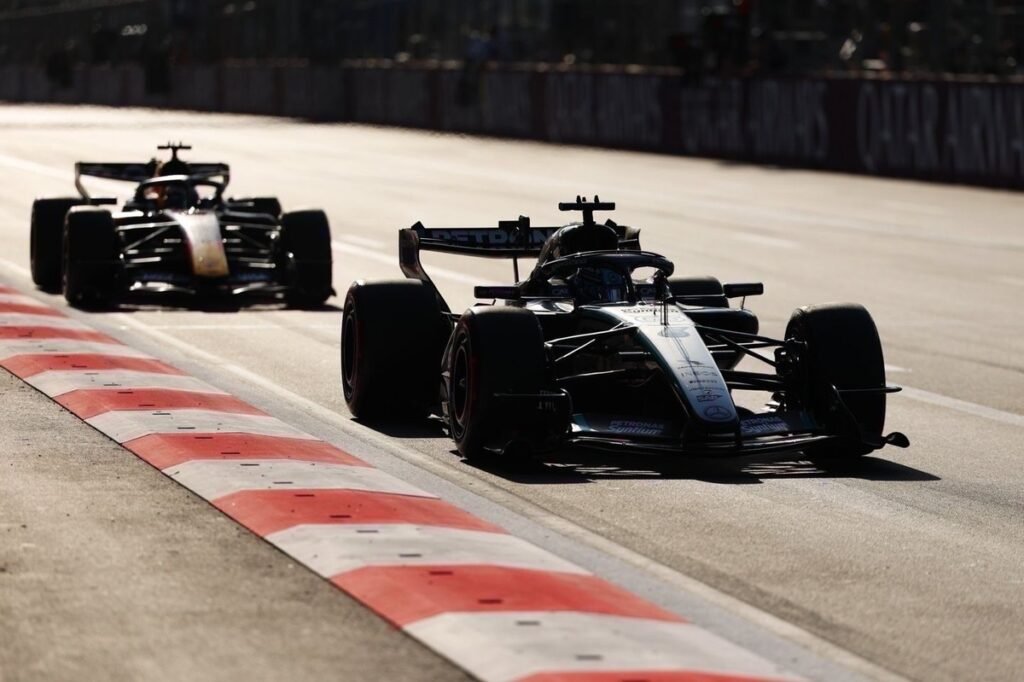
For those watching the Azerbaijan Grand Prix, many would agree that George Russell delivered a dominant drive to take a lights-to-flag Formula 1 victory from Red Bull’s Max Verstappen.
Yet dominance isn’t a word often used when the margin of victory is as small as the gap separating the duo when the chequered flag flew at the end of 51 laps of the Baku City Circuit, four-time champion Verstappen just 0.196s down on the Mercedes driver having launched a late attack following two safety car interventions.
With that gap ensuring this year’s Azerbaijan GP ranks as the 11th-closest race finish in Formula 1 history, let’s take a look at the events that make up the top 10.
Michael Schumacher, Ferrari F2002, follows team orders and takes over team-mate Rubens Barrichello, Ferrari F2002
Photo by: LAT Photographic
A controversial finish to begin the list.
Ferrari team-mates Rubens Barrichello and Michael Schumacher were holding a 1-2 for the Scuderia at what was then the A1 Ring in Austria, the Brazilian on course for his first win of a season already dominated by his then-four-time champion German counterpart.
But coming out of the final corner, Barrichello slowed and allowed Schumacher past across the line to the dismay of those watching on. The incident led to a fine for the team and both drivers, while team orders were banned for the following season.
The gap across the line was 0.182s.
9. Australia 2023 – Max Verstappen and Lewis Hamilton – 0.179s
The Safety Car Max Verstappen, Red Bull Racing RB19, Lewis Hamilton, Mercedes F1 W14, Fernando Alonso, Aston Martin AMR23
Photo by: Lionel Ng / Motorsport Images
A dramatic third round of the 2023 season saw Max Verstappen emerge victorious, albeit with the race effectively ended by a safety car period.
A race thrice red-flagged – twice within the final three laps for separate restart carambolages – ended in neutralisation and the now-traditional end of safety car notice being issued on the final lap, allowing Verstappen to coast over the line untroubled.
Aided by the field being bunched by the safety car, the gap between the top two was just 0.179s.
8. Canada 2000 – Michael Schumacher and Rubens Barrichello – 0.174s
Podium: race winner Michael Schumacher, second place Rubens Barrichello, Ferrari, third place Giancarlo Fisichella, Benetton
Photo by: Sutton Images
Back to the early 2000s Ferrari partnership for eighth on the list and this time the 2000 Canadian Grand Prix in Montreal.
Team orders were again present but not in the controversial fashion that would affect the 2002 campaign. A rain-affected race saw Schumacher lead from the front but in an ailing Ferrari, Barrichello began to close in during the latter stages of the event.
He was instructed to slow and maintain position, with Schumacher in the midst of a title battle with McLaren’s Mika Hakkinen, and Barrichello duly obliged, ranging up to the back of his team-mate and finishing 0.174s behind.
7. France 1961 – Giancarlo Baghetti and Dan Gurney – 0.100s
Giancarlo Baghetti, Ferrari 156, Dan Gurney, Porsche 718
Photo by: Motorsport Images
A trip to Reims next and a race with an interesting result beyond just the gap between first and second at the end.
Giancarlo Baghetti had qualified 12th in his very first championship race but used his FISA-entered Ferrari to climb through the field, enjoying a gargantuan battle for fourth involving eventual second Dan Gurney and a host of other drivers.
But when Phil Hill and Stirling Moss succumbed among a myriad of issues for the top drivers – including Hill and his Ferrari team-mates Wolfgang Von Trips and Richie Ginther – Baghetti was left to fend of Gurney’s Porsche in a battle to the finish.
Baghetti won by just 0.100s, becoming just the third driver to win on his championship debut.
6. France 1954 – Juan Manuel Fangio and Karl Kling – 0.100s
Hans Herrmann, Juan Manuel Fangio and Karl Kling, Mercedes
Photo by: Mercedes-Benz
France again, this time seven years earlier, yet the finishing gap was identical at 0.100s.
A resounding return for Mercedes saw a dominant result in Reims, with Juan Manuel Fangio taking victory from pole, just holding off team-mate Karl Kling.
It almost certainly would have been a 1-2-3 had Hans Herrmann not retired – the German having set the race’s fastest lap. Robert Manzon was third in a privateer Ferrari, albeit a lap down on the top two.
5. Italy 1969 – Jackie Stewart and Jochen Rindt – 0.080s
Jackie Stewart, Matra MS80 takes the flag to win just ahead of Jochen Rindt, Lotus 49B, and Jean-Pierre Beltoise, Matra MS80
Photo by: Sutton Images
The old-school slipstream festival at Monza provided two of the top-five closest finishes in F1 history and in 1969, the win was claimed by Sir Jackie Stewart for Matra.
Stewart finished the 68-lap race in an hour and 39 minutes, just 0.080s ahead of Lotus driver Jochen Rindt.
But what makes this finish even more extraordinary is the fact that the gap between the top four would have been close enough to warrant a mention in this article alone – Matra’s Jean-Pierre Beltoise and Bruce McLaren in his own car finishing within 0.190s of the victor.
4. Austria 1982 – Elio de Angelis and Keke Rosberg – 0.050s
Podium: race winner Elio de Angelis, Lotus Ford congratulated by Keke Rosberg, Williams, 2nd position
Photo by: Motorsport Images
What had looked like a certain victory for Alain Prost resulted in a fierce battle between two drivers who had never won in F1 previously at the 1982 Austrian GP.
The Frenchman retired from the lead with five laps remaining, leaving Elio de Angelis to hold off Keke Rosberg, who would ultimately be crowned world champion at the end of the season.
Rosberg tried as he could to get past de Angelis and despite closing in on the final lap, the Williams missed out by only 0.050s to the Lotus.
3. Spain 1986 – Ayrton Senna and Nigel Mansell – 0.014s
Ayrton Senna, Lotus 98T Renault, Nigel Mansell, Williams FW11 Honda
Photo by: Ercole Colombo / Studio Colombo / Getty Images
Jerez was the battleground for three of the finest drivers of a generation to play out what ended up as a thrilling end to the 1986 Spanish Grand Prix.
Ayrton Senna led Nigel Mansell and Alain Prost as they duked it out in the final half of the race but looked to be in control as the Briton pitted for fresh tyres and his arch rival faded.
But a stellar charge on the newer rubber brought Mansell back into the reckoning and by the final corner it seemed he had a chance to drag past the Lotus to the line. Though he tried, Senna held on by fractions – 0.014s the official time as he beat the Williams to the finish.
2. USA 2002 – Rubens Barrichello and Michael Schumacher – 0.011s
Rubens Barrichello pips Michael Schumacher, Ferrari on the finish line
Photo by: Steve Etherington / Motorsport Images
Another orchestrated swap for Ferrari team-mates Barrichello and Schumacher? Not quite, though this was equally as messy.
Schumacher was the driver to lose out this time, albeit he had long secured a fifth world title. Seemingly attempting to stage a dead-heat photo finish, the calculations were just out and Barrichello took victory, perhaps making up for the lost silverware in Austria.
The gap was a mere 0.011s.
1. Italy 1971 – Peter Gethin and Ronnie Peterson – 0.010s
Mike Hailwood, Surtees TS9, Peter Gethin, McLaren M14A Ford, Francois Cevert, Tyrrell 002 Ford
Photo by: David Phipps
The closest finish in F1 history was another multi-car barnstorming slipstream event at Monza, this time in 1971.
The top five were covered by just six-tenths as they crossed the finishing line but it was Peter Gethin who emerged victorious.
After what had built into a thrilling pack-race following retirements for Jackie Steward, Clay Regazzoni and Jacky Ickx, Gethin would take victory by margin of 0.010s from Ronnie Peterson.
Francois Cevert, Mike Hailwood and Howden Ganley made the famous image as the quintet took the chequered flag.
We want to hear from you!
Let us know what you would like to see from us in the future.
Take our survey
– The Autosport.com Team
Read the full article here