Follow Boxing News 24 on Google News

Rain delayed the rematch twice. When the fighters finally met, Marciano carried a 46-0 record and the undisputed championship into the ring. Charles was trying to become the first former heavyweight champion to regain the crown.

Charles came in at 192½ pounds, seven pounds heavier than he had been for the first fight. His camp may have decided that another 15 rounds with Marciano was too punishing to repeat. The additional weight suggested Charles planned to hurt the champion early, but it pushed him toward a power punching fight that suited Marciano far better.

Charles landed cleanly in the opening round, but Marciano dropped him with a right hand in the second. The challenger became increasingly cautious after rising. Marciano crowded him through the middle rounds, attacking the arms, ribs and head while Charles searched for room to box.

The extra weight failed to produce greater authority in Charles’s punches. It mainly gave Marciano a slower target.

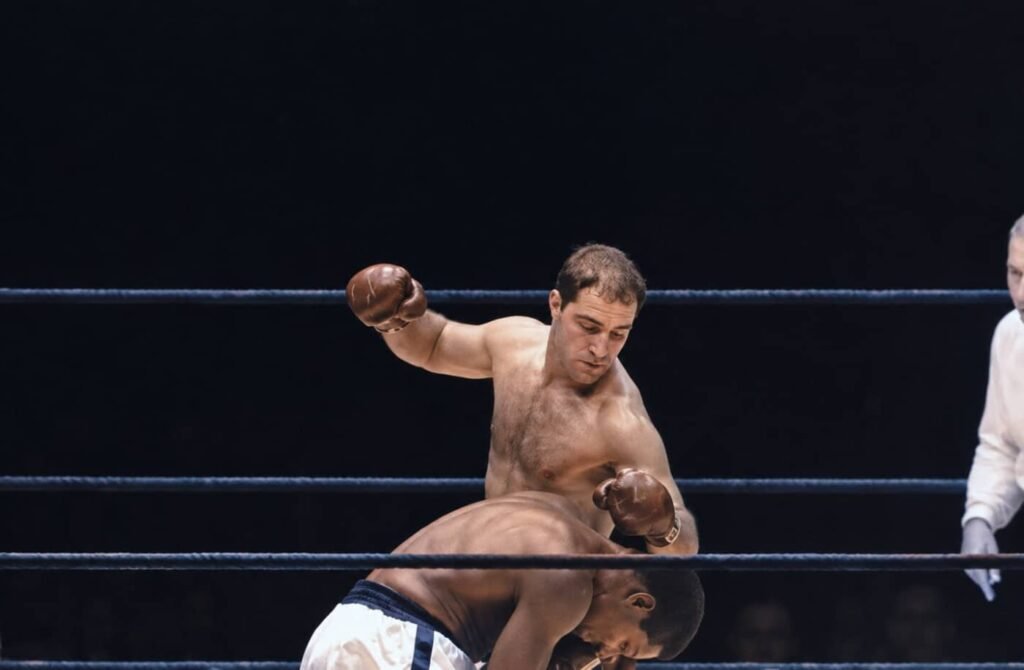
Marciano’s pressure also came with a steady supply of illegal punches. Whenever Charles bent forward to escape, Marciano chopped right hands onto the back of his head. Slow-motion footage shows this was not an isolated blow caused by Charles turning at the wrong instant. It happened repeatedly in nearly every round, often directly in front of referee Al Berl.

Charles’s low defensive posture created the opening, but the back of his head remained an illegal target. Marciano also used his glove laces and heel, struck low, and continued punching after the bell without losing a point. Berl allowed him to fight with enormous freedom inside.

The fight changed in the sixth when Marciano came out of a clinch with his left nostril split deeply enough to leave part of it hanging loose. Blood poured down his face. Charles’s corner immediately told him to attack the injury, knowing a medical stoppage offered his clearest route to the championship.

Marciano also had a cut near his left eye, but he kept advancing. By the end of the seventh, he had Charles reeling at the bell.

His corner wanted body punches in the eighth. Marciano rejected the advice.

“I was spilling too much blood, and they might have stopped it. I like my title too much to lose it on account of a little blood. I don’t knock ’em out in the body. I knock ’em out on the chin.”

That decision showed more than courage. Marciano understood that he no longer had time to break Charles down through the body. He abandoned his usual attritional attack and concentrated everything upstairs, calculating that one clean right would protect his championship faster than several more minutes of body work.

A long right dropped Charles for a four count. After Charles rose, a left hook and another right sent him down again. He barely beat the count, but Berl stopped the fight at 2:36.

Charles had fought Marciano for 23 brutal rounds across two bouts. He had outboxed him, cut him, and torn open his nose, yet none of it stopped the champion from advancing. The psychological burden must have been enormous. Injuring Marciano only triggered a more desperate assault.

Still, the rabbit punches complicate the familiar story of Marciano overcoming blood through courage alone. His urgency was genuine, but Charles had absorbed repeated illegal shots to the back of the head. Berl’s tolerance turned every defensive bend from Charles into another opportunity for Marciano to club him.

The Ring named it the 1954 Fight of the Year. Marciano moved to 47-0 and later called Charles the toughest man he ever fought. His toughness and finishing instinct were extraordinary, but this was also a dirty performance protected by the permissive officiating of the era. Both truths belong in the story.

Photo: AI-improved

Youtube video

Read the full article here

Share.